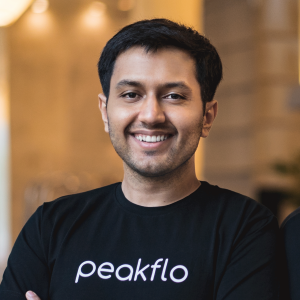
Saurabh Chauhan Podcast Transcript
Saurabh Chauhan joins host Brian Thomas on The Digital Executive Podcast.
Brian-Thomas: Welcome to Coruzant Technologies, Home of The Digital Executive podcast.
Do you work in emerging tech? Working on something innovative? Maybe an entrepreneur? Apply to be a guest at www.coruzant.com/brand.
Welcome to The Digital Executive. Today’s guest is Saurabh Chauhan. Saurabh Chauhan is the founder and CEO of Peakflo, a fast-scaling AI startup that automates complex back office financial operations for enterprises across APAC and the United States.
Under his leadership, Peakflo has secured over one hundred enterprise clients, including Fortune five hundred companies such as Hitachi Construction Machinery, and recently launched voice AI agents that quickly rose to the top three products of the day on Product Hunt. The voice AI agents are part of Peakflo’s flagship 20x AI agents orchestrator platform, an open source agent orchestrator that runs inbound lead generation through AI, GEO, generative engine optimization, outbound via AI SDR, and back office work like month-end close with all the humans in the loop Peakflo positions 20x as the operating system for the era of micro unicorns.
Well, good afternoon, Saurabh. Welcome to the show.
Saurabh Chauhan: Thanks for having me, Brian.
Brian-Thomas: Absolutely, my friend. I appreciate it. And you’re hailing out of the San Francisco Bay Area in California. I’m in Kansas City. Appreciate you making the time zones, the calendar jumps, et cetera, to get here.
Again, thank you. And Saurabh, I’m gonna jump into your first question. You’ve had a diverse c-career spanning McKinsey, Rocket Internet Ventures, and now founding Peakflo. What key experience has shaped your journey to becoming a leader in AI-driven financial operations?
Saurabh Chauhan: Sure. So, I’ll, I’ll start with my journey at McKinsey first.
McKinsey was from twenty thirteen to fifteen where I was advising Fortune five hundred clients on strategy and operations. So, that’s really the place where, I saw enterprise dysfunction at scale but from the chair of a consultant. So, I think during that time it was immense exposure to problem statements, but not necessarily something where we could deliver impact beyond client recommendations.
So I think at some point I wanted to operate, not advise, and that’s what essentially took me towards Rocket Internet, which was my second stint. So I ran a few ventures for them the most notable one being Daraz. So Daraz is a South Asian e-commerce marketplace that was acquired by Alibaba for two hundred million dollars in twenty eighteen so I ran the company in the Sri Lankan market for two years from twenty fifteen to seventeen.
Built from, you know, essentially a headcount of five to a sixty-member team, grew the revenue three X year over year for multiple years. And h-honestly, I mean, the… what, what I greatly learned over there was, managing sixty people was that, we were essentially paying for judgment and getting it about twenty percent of the time.
The other eighty percent went to execution. Lots of manual stuff happens when you’re scaling e-commerce marketplaces, like chasing on invoices and reconciling spreadsheets and following up on customer tickets. So the valuable part of every employee was being squeezed into, essentially twenty percent of their day.
I took that learning from Rocket, and that’s when I met my co-founder, Dmitry. He, he’s a PhD in artificial intelligence. And honestly, we agreed that the next generation of software should not help humans do the work faster. It should do the work and sort of let humans manage it. So what BFlow…
that, that’s what took us to BFlow. We founded it in January 2021 went to Y Combinator in winter 2022, then moved pro you know, moved to Google AI Accelerator, raised four million in seed and are now serving a hundred plus enterprises across APAC and US, including large publicly listed companies like Hitachi.
And yeah s-excited to be here and would love to talk more about what we’re doing now.
Brian-Thomas: Great. Thank you so much. Saurabh, I appreciate that. I love the backstory. Always do. It’s usually my first question. You cut your teeth at McKinsey. A lot of people do. They, they get a lot of good experience there, and you said you were advising Fortune five hundred, and y-as you said, you found a lot of dysfunction in these businesses which gives you a lot of ideas for your future aspirations and ideas.
The, the Rocket Internet Ventures was pretty cool, how you grew that into a powerhouse, which eventually was sold. But really, starting a startup and moving to Northern California and being accepted into Y Combinator and doing these different s- things around startups is, is awesome.
That’s always one of those stories that people really wanna really sink their teeth in and learn more about the founder, which we’re doing today. And Saurabh, in a highly complex financial environments, ROI is critical. How do you ensure AI solutions deliver measurable impact rather than just incremental efficiency gains?
Saurabh Chauhan: Yeah, absolutely. So I think first off, Brian, I’d probably push back on the way the industry talks about ROI. Most AI software right now is sold at five to fifteen percent efficiency gains. And we don’t, we don’t see that as a transformation. That’s, that’s more or less an incremental op-optimization.
So, at, at, Peakflo we measure ROI in terms of, FTEs the productivity gains in terms of FTE replaced or the cycle days eliminated based on the operation workflows that our clients run. So typically the way it translates into customer proof would be ninety-five percent accuracy in invoice data extraction which is essentially, better than humans or vendor bill payment time gets cut by fifty percent or customer payment cycles reduced by fifteen to twenty-five days.
So, we have delivered customer, outcomes which would have been the, using the same finance team that they currently have in most cases, but the team essentially become agent managers. So that’s not really a productivity gain as much as it’s sort of creating an entire different category of software.
And even inside Peakflo just to sort of give you a reflection, not just in what we do outward, but also inside the company, our twenty twenty-six engineering plan had initially called for, fifteen engineers or we’re operating that on just this team of seven engineers. The other eight engineers are AI agents, and the entire agent infrastructure is probably, you know, one-tenth of the fraction one-tenth of the cost of essentially adding those eight engineers.
So, my test for whether an AI deployment is real is pretty simple. Can we point to a couple of headcounts that we did not hire and then the cycle days that did not get extended? And if the answer is no and our team feels more productive we essentially go on with that.
And it-it’s working really well because we have, stopped helping humans do the work faster. We essentially give the work to agents and we essentially put humans in, in management. So that’s where the order of magnitude gains come from as far as both internal and external deployments look like when, when we’re you know, serving our clients.
Brian-Thomas: Great. I appreciate that. Pretty cool, and I didn’t know, but I, I like hearing from, from guests talk about, this ROI. You said the industry states it’s anywhere from five to fifteen percent, but you disagree, and I, I think that’s cool. You measure in FTEs and the number of human hour reductions.
So, in, in that measurement you talked about do we expand, FTEs or not? Do we reduce that– those cycle days? And if it’s because of those agents- we’re able to do that, then we can obviously see an ROI from your perspective. But I really like that, how you can move the humans into more critical level tasks and then keep the agents working on those things that maybe are repeatable and mundane.
So again, I appreciate that. And Saurabh, Peakflo has introduced the 20x AI agent orchestrator, which promises to deliver 20x productivity gains by turning specialized AI agents into full-time equivalent FTEs for knowledge work. Can you walk us through what 20x is and how it goes beyond traditional automation tools, especially with applications like AI SDR for sales, AI marketer agents for content creation, AI agents for back-office workflows, etc.?
Saurabh Chauhan: Sure. So, 20x is a self-improving agent orchestrator. It’s open sourced on github.com/peakflo/20x. It’s MIT licensed, and the enterprise version is available on our website, peakflow.co. Essentially the mental model is that 20x is the brain. The models, AI models like Claude, GPT, Gemini, these are the underlying models, are essentially the hands.
And 20x decides what needs to happen, decomposes it into tasks, picks the right model for each, and then surfaces what needs re-human review. And the three things that essentially separate it from, you know, your run-of-the-mill traditional automation would be, number one would be the heartbeats. So essentially, traditional automate-automation waits to be triggered, whereas, 20x agents are checking proactively, just like a potential employee would be checking the work.
So for example, if, let’s say, three invoices are forty-five days overdue, and, and I’m just giving you an example of finance use case and or collection drafts are ready for approval, those would be the sort of things that the agent would be proactively checking in the ERP and emails whatever are the collected data sources, and would be surfacing tasks that require human in the loop or human intervention.
But essentially, an agent would be performing these checks and that’s essentially one, one of its superpowers. The second is skills. So skills would be that every time an agent finishes a task it updates its own playbook based on what it worked and confidence scores are tracked. So over time, the runbook writes itself.
Most AI agents are confident interns who you know who don’t really learn. But our AI agent essentially gets sharper every week. Pretty much like, it would be the case if you were to hire a full-time employer, a full-time employee. So the more they work on specific tasks, the smarter they get.
20X agents operate just like that. And lastly, we’re, we’re model agnostic. So what that means is we are multi-model by default. I, I, I don’t know if you recall, but recently in the news I think Anthropic gave Windsurf, like, five day’s notice before cutting Claude access. A lot of companies currently are locked in or single model reliant.
When OpenAI silently retired GPT-4o, a lot of companies were impacted. So essentially, it removes the single model dependency risk. If you’re a single model, you can get hit. So, enterprises typically prefer running mission-critical functions like finance automation, but also their go-to-market on not, not being hostage to one lab’s roadmap.
So, so that’s really the three outcomes that we love for. And, and in terms of, the use cases that you mentioned, whether it’s AI SDR, AI marketer, or AI finance these are in fact our top three use cases. So, the AI SDR is our go-to-market champion for outbound sales. The sales lead just doesn’t write outbound anymore in, in, in our client organizations.
They manage an SDR agent that runs daily. The agent will pull signals, from the available information for clients from CRM databases or lead gen databases. It would automatically draft personalized sequences. It would surface prospects that are relevant, and then the, the judgment is then taken care of by the actual human in the loop.
That’s the same case for AI marketers that or the AI agents for content creation. So our content lead would manage a marketing agent that runs weekly. It would the agent would brief would design the brief, would design the draft, would do A/B testing based on subject lines, and would do the shipping.
But the human in the loop would essentially be our, our content head would– who, who would be, reviewing all the work and the analytics that are derived from the AI marketer. And same for our actual product that we deploy for lots of clients which is our AI finance agent for back-office automation.
This is what our customers have been running for several years now. Hundred plus enterprises large publicly listed brands like Hitachi. Their finance teams manage agents that do three-way matching, anomaly detection, vendor recon. And essentially the outcomes are, they’re able to close their month-end from, reduce those times from ten days all the way down to three days.
And I think the proof really is, is inside our own walls. My, my CTO, Dmitry, literally shipped a full enterprise vendor recon product in four days, ten thousand lines of code. Everything from document ingestion to data extraction, matching engine, full database schema, web app. And he, quite frankly, didn’t write any of the code.
He managed the team of five, six agents that he spun up who, who, who did write the code. So that’s essentially what 20X looks like when you, when, when, when we live it not just as, you know, a client-facing product, but also something that it has created a massive impact in terms of our productivity internally.
Brian-Thomas: That’s amazing, and thank you. And I’ll just highlight a few things. Obviously your 20X AI agent orchestrator is a self-improving AI agent that can address most tasks and be able to escalate or elevate complex decisions up to the human level. I thought that was pretty cool. And the skills part, you– every time an agent finishes a new task, it documents and learns it and adds it to its knowledge base, which obviously sharpens its skills day by day.
I like that your model is agnostic or model agnostic, which is, again, another benefit there. And the fact that agents can handle sales, marketing, finance, back-end operations, all this stuff, is really transforming how businesses can be more efficient and productive and, and really scale. So thank you.
And, Saurabh, the last question I have for you, with the 20– 20X agents acting as self-improving teammates that handle everything from prospecting and content workflows to invoice processing and re-reconciliation, how are these specialized agents fundamentally changing how enterprises scale their operations?
And what advice would you give leaders looking to deploy them to achieve that true 20X leap rather than just incremental gains?
Saurabh Chauhan: Sure. I, I’ll touch on how agents are actually, changing how, how enterprises scale first. So, the old SaaS playbook was that when your revenue grows, headcount needs to grow linearly or essentially proportionally, and that usually leads to some form of margin compression.
So essentially every doubling of revenue meant, some proportional increase in the number of headcount. And that playbook tends to break once you go beyond the twenty twenty-one, twenty twenty-two era of gen AI and now subsequently AI agents being deployed. So now the new playbook essentially is great, your revenue grows, but so does your agent fleet.
The human managers or your human headcount more or less stays flat, and that allows an margin expansion. So- like I mentioned inside People we replaced you know, potential eight engineering hires that we were– we had planned with essentially ten thousand dollars of monthly agent spend in terms of tokens, infrastructure, and other compute costs.
And that fundamentally changes the unit economics of enterprise software. And this is just isn’t a, you know, a People thing. Garry Tan, who’s the, the, the current CEO of Y Combinator, mentioned that twenty-five percent of YC’s last batch had ninety-five percent of their code written by AI. Cursor, that’s a– that’s doing about a billion dollars in annual recurring revenue or you know, s-some of all these companies that are coming out of the AI accelerators.
And these are all micro unicorns, meaning you have teams that are incredibly lean and are doing millions if not sorry are doing billions if not hundreds of millions in revenue with an incredibly lean team, which was completely unthinkable let’s say three years ago. And that’s really the new default.
Obviously, startups tend to show emerging trends first, but we do believe that these trends will catch up to large enterprises over the next couple of years because, that’s how most changes sort of trickle down. In terms of my advice for, for leaders who are looking at, you know, looking at a path to deploy AI and agentic workflows within their organizations, I think the worst question right now for them would be to ask, “How do I add AI to my workflow?”
I think that’s an incremental question, and which will only give them very incremental answers. The right question would be that if they rebuilt their entire function or their entire business unit today, where every employee would manage five agents instead of doing the work themselves, what does the new org chart look like?
I think that’s really the, the correct question to ask. And for most companies, the honest answer is probably half the size, twice the velocity, ten times the leverage. So, the three concrete steps I would advise would be to audit every single headcount in terms of, just what, what is called like bottom-up org building.
And that’s essentially classifying headcount that’s doing pure execution. That’s essentially where the agents will go and do the work. Typically pick a process. Don’t try to automate everything at once. Get the agent management muscle built internally within the org. And lastly, make sure your platform is multimodal.
I mean, please don’t bet the company on one lab, on one cool model. The last six months, especially with the incidents with the Windsurf essentially proved the fact that being reliant on a single model, it can be quite catastrophic in terms of outcomes. So yeah, that’s, that’s pretty much that’s pretty much the three points on what I’d love for leaders to do.
Brian-Thomas: Thank you. I appreciate your insights, really do. Just to highlight a few things here with your 20 X agents, you’re able to scale the agents with the business while keeping that human headcount the same, which I thought was pretty interesting. And in some cases, you talked about some business seeing, 1,000 times growth in productivity and in financial gains.
And the– truly these businesses will be able to compete with the larger c- companies, of course. So that question, you know, that we asked, what advice would you give leaders looking to deploy? And you said, if you wanna– if they rebuilt their entire business unit, meaning each employee were managing five agents going forward, what does the org chart look like?
And I thought that was interesting. And we are starting to see now it’s, it’s the human, human in the loop, but man and machine working together to be more efficient and really scale businesses. So, I appreciate your insights today. And Saurabh, it was such a pleasure having you on today, and I look forward to speaking with you real soon.
Saurabh Chauhan: Awesome. Thanks, Brian. Likewise.
Brian-Thomas: Bye for now.
Saurabh Chauhan Podcast Transcript. Listen to the audio on the guest’s Podcast Page.