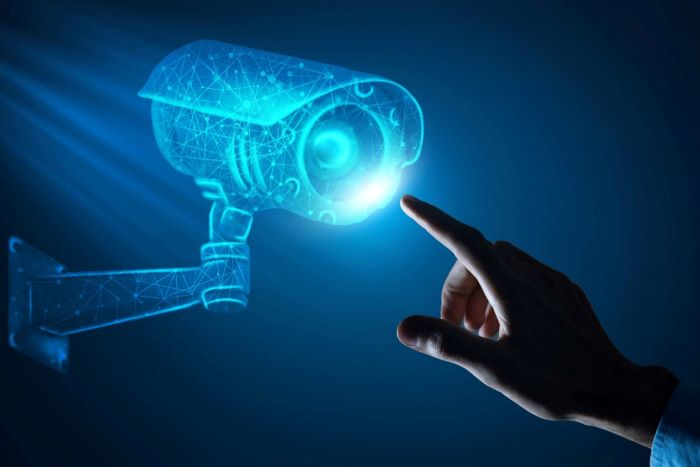
As digitalization continues to take hold of the world, population centers become more dense. The amount of data generated daily will grow to staggering amounts. One significant source of data in today’s society is images, including video surveillance recordings from security cameras. These devices help to deter unwanted or inappropriate actions. They also monitor patterns and behavior of individuals. Additionally, they provide valuable evidence for legal proceedings. The future of security will be determined by enhanced AI monitoring.
However, when a camera system malfunctions or fails to properly monitor its intended focus, the ramifications can put people and property at risk. To deter these threats, organizations utilizing these systems now require internal policies. These include video clarity assurance and records retention. Consequently, the ever-increasing amount of data becomes challenging to manage. This is where AI software can prove to be extremely advantageous.
Key Takeaways
- Digitalization increases data generation, especially from security camera systems.
- AI enhances security by monitoring camera functionality and detecting issues, improving efficiency.
- Limitations include specific pattern recognition and the need for human decision-making in complex situations.
- Future developments will likely enhance AI’s ability to assess situations accurately, boosting security effectiveness.
- Collaboration between AI developers and security professionals is crucial for maximizing the potential of AI in the future of security.
AI for security cameras: Current capabilities
AI software and pattern recognition have played a significant role in business applications such as fraud detection, high-frequency trading, and user recommendations on social media. This technology’s métier is its ability to detect patterns among vast amounts of data. Therefore, it leads to more efficient, timely, and effective solutions. Similarly, AI can be used for pattern recognition to monitor the functionality of camera systems and the future of security.
An AI program monitoring security cameras is paving the way for enhancing efficiency and the future of security for people and organizations. For instance, a military installation or a large corporate office typically has a system comprised of hundreds or thousands of cameras. These must be maintained at a given time. Monitoring the maintenance of such a system is an almost impossible task for humans to perform manually.
However, AI monitoring the status and operation of security cameras streamlines the inspection process for camera issues. It does this by automatically catching camera view failure due to blur, block, tilt, glare, or low-light. It also identifies other camera view problems. The AI technology promptly alerts users about any problems with the security camera evidence they expect to have.
For indoor cameras, AI software can signal when issues occur, including problems relating to infrared functionality used to capture night-time video footage. Even specks of dust, scratches on the lens, or spider webs can cause the infrared light to diffuse. This can produce a blurry image. While video recording technology for surveillance cameras is improving vastly, it is the role of AI to ensure that the quality of the images and videos captured has the clarity and usefulness expected by users.
The limitations of security camera software
While security camera software with AI can reduce worker hours and increase efficiency, there are currently some limitations. AI makes predictions based on pattern recognition, but it only recognizes very specific patterns encoded into it. For example, it can identify cars in video surveillance imagery, but it can’t necessarily recognize other objects or phenomena.
To create the most effective programs and for AI to reach its full potential, tech developers and business leaders need to collaborate. Finding the right blueprint or model for information input will achieve the highest standards of performance. There is no one-size-fits-all solution. Although, this will be the future of security.
Another limitation to consider is that while AI can automate many tasks, many tasks that require decision-making (e.g., whether to call for first aid instead of calling the authorities) will still require human intervention. Over time, AI may be able to automate more workflows rather than just identifying specific objects or scenarios. However, it is a more complicated process and impossible to know exactly when that will occur.
The road ahead: Enhancing security surveillance with AI
While not every security solution contains or benefits from AI, those that do provide a tremendous ROI for the security team. Consider concept recognition and the understanding of whether movement in a public area is benign or potentially harmful. Each task in a security situation can be broken into a concept and a situation. Thus, the framework of people in a certain situation could be classified and tagged for the security team as it happens.
While AI is currently really good at concept recognition, it’s not very good at making decisions based on recognition. For example, AI wouldn’t know if it saw someone behind a dumpster whether to call the police or the ambulance. In this situation, the individual could be passing out because they are sick, or someone trying to break into a facility.
But soon, business leaders can expect that we will reach a point where users can decide how much context is needed to make an accurate determination of the situation. Is it reasonable to expect someone behind a dumpster (concept) at 10 a.m. to be ill or committing a crime (situation)? By developing a system that is sensitive to all conditions, AI will truly be able to better increase the speed at which potential and actual crime is identified or deterred.
The Future of Security
The Future of Security: Using AI to Enhance Monitoring and RecognitionAs business leaders and AI specialists come to realize the best uses for AI software, the more effectively these solutions will be trained and deployed. There must be a symbiotic relationship between AI developers and security professionals. This way, the capabilities of AI can provide further value to the future of security and the industry. The rewards will be well worth the wait. Businesses will waste less time on tasks that AI can solve quickly AI developers will deliver the most efficient devices to the market.