



Women in tech made up just 26% of US artificial intelligence hires in 2025, against 50% of hires into every other kind of role (Source: LinkedIn). That single comparison explains more about the state of the industry than any diversity report published this year. The hiring machine has not slowed down. It has simply pointed itself somewhere women are not.
This matters because AI is where the money went. LinkedIn puts the typical AI job posting at roughly $177,000 in listed compensation, compared with about $80,000 for a non-AI role, and AI postings have roughly doubled since 2023. A field that pays double and hires at twice the rate is now the main engine of career mobility in technology. Women are entering it at half the rate they enter everything else.
Table of contents
- Key Takeaways
- A Bigger Industry That Did Not Get Fairer
- The AI Split: Building It Versus Being Replaced By It
- The Broken Rung Nobody Fixed
- Funding: A Record Year That Hid a Collapse
- The Pipeline Excuse Has Expired
- Why the Design Table Matters
- What Actually Changes the Number
- Conclusion
- Read Next
- Frequently Asked Questions
Key Takeaways
- Women held 26% of US AI hires in 2025 and 13% of AI C-suite roles globally.
- Female-dominated occupations face nearly double the generative AI exposure of male-dominated ones.
- All-female founding teams took 1.1% of US venture dollars in 2025, down from 2.1%.
- Promotion rates to first-line manager have barely moved in eleven years.
- Access to sponsorship, not ambition, explains most of the advancement gap.
A Bigger Industry That Did Not Get Fairer
Start with the baseline. Women hold somewhere around a quarter to 28% of computing occupations in the United States, a figure that has drifted within a few points for most of the past decade. In the corporate pipeline more broadly, women occupy 29% of C-suite seats, unchanged from the prior year and stuck there for the eleventh consecutive year of tracking (Source: McKinsey and LeanIn.Org).
The education numbers explain part of it, though less than people assume. Roughly one in five US computer science bachelor’s degrees goes to a woman, according to federal education data, well below the mid-1980s peak near 37%. The share has recovered slowly since bottoming out around 2010, but it has never returned to where it stood before the personal computer became a boy’s toy in advertising.
What changed in the last two years is not the baseline. It is what sits on top of it.
The AI Split: Building It Versus Being Replaced By It
Two things are happening at once, and they point in opposite directions.
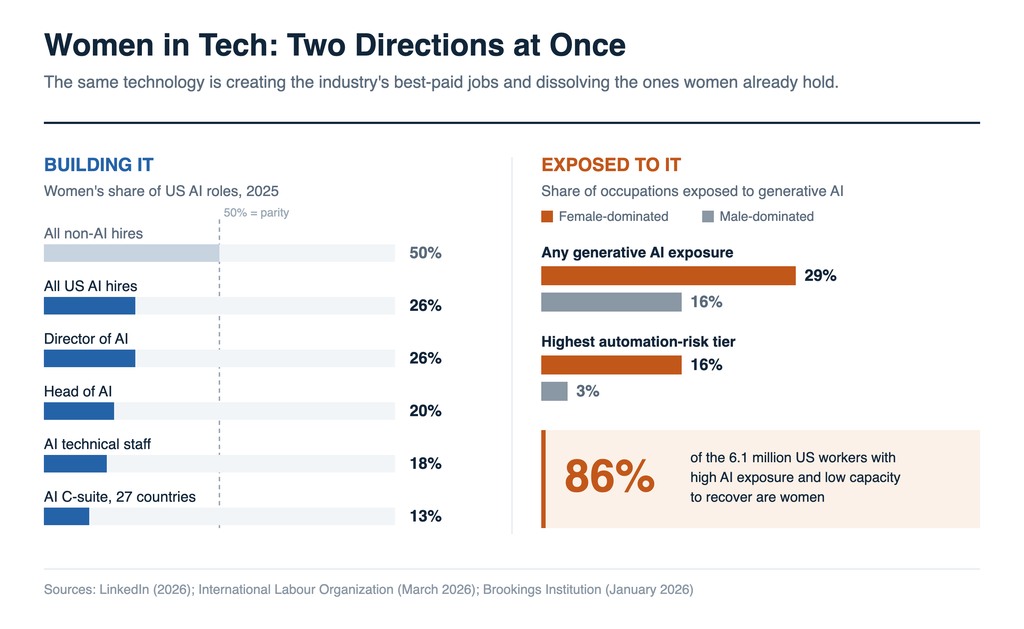
On the building side, women are scarce. Across 27 countries, women hold 13% of C-suite AI leadership roles at AI companies. Below that: 20% of Head of AI positions, 26% of Director of AI roles, and 18% of member-of-technical-staff jobs (Source: LinkedIn). The pattern tightens exactly where budget authority and technical direction concentrate. LinkedIn’s researchers describe it as a compounding penalty, with women’s share of AI roles running about 10 percentage points below their share of non-AI roles, then dropping another five points at AI-focused firms specifically, then widening by roughly 15 points at the executive level.
On the exposure side, women are everywhere. The International Labour Organization found in March 2026 that about 29% of female-dominated occupations are exposed to generative AI, compared with 16% of male-dominated ones. At the highest automation-risk tier the gap is starker still: 16% of female-dominated occupations against 3% of male-dominated ones. In 88% of the countries studied, women’s employment carried higher exposure than men’s.
Brookings sharpened the point with US data. Of 37.1 million American workers in the most AI-exposed occupations, about 6.1 million also lack the savings, skill transferability, or local job market to recover from displacement. Women are 86% of that group. They are concentrated in clerical and administrative work: schedulers, payroll clerks, receptionists, records staff. As Brookings researcher Mark Muro framed it, the vulnerability reflects what women do in the economy rather than anything about their capability.
So the same technology is pulling in two directions. It is creating the highest-paid roles in the industry and hiring men into them. It is dissolving a category of work and displacing women out of it.
The Broken Rung Nobody Fixed
The bottleneck is not the executive suite. It is the first promotion.
For every 100 men promoted to manager in the most recent tracking year, 93 women were promoted. For women of color the figure drops to 74. That gap compounds: fewer women at manager level means a smaller pool for senior manager, then for director, then for VP. Eleven years of data and the arithmetic has never resolved itself.
The tempting read is that women want it less. The data says otherwise, and the distinction is worth sitting with. Yes, 69% of entry-level women say they want a promotion versus 80% of entry-level men. But 45% of entry-level men report having a sponsor, against 31% of women. When career support is equal, the ambition gap disappears. What looks like a preference is a response to conditions.
AI has added a fresh layer to this. At entry level, 21% of women report a manager encouraging them to use AI tools, compared with 33% of men. Early-career women are also more likely to worry that using AI at work will be read as cutting corners. The tool that most obviously accelerates a junior career is being recommended to men and quietly withheld from women, and around six in ten companies have not assessed how AI affects fairness in their own hiring and promotion decisions.
If you manage people, that last statistic is the one to act on this quarter. Auditing AI-assisted screening and review is cheap. Rebuilding a pipeline after five years of skew is not.
Funding: A Record Year That Hid a Collapse
Venture capital produced the year’s most misleading headline. US female-founded companies raised a record $73.6 billion in 2025, capturing 27.7% of total US venture deal value, up from 19.9% the year before (Source: PitchBook).
Read the composition and the story inverts. More than $30 billion of that came from two raises, Scale AI and Anthropic, both of which have a female co-founder. Strip those out and the underlying growth was roughly 13%. Companies founded entirely by women received 1.1% of US venture dollars in 2025, down from 2.1% in 2024. All-female teams raised $3.2 billion across 794 deals. All-male teams raised $191.1 billion across 10,048.
The unicorn count makes it plainer. In 2025, 124 US startups reached billion-dollar valuations. About 20 had at least one female founder. None were founded by an all-female team.
There is also a leading indicator worth watching. The share of first-time venture recipients who are women peaked at 27.7% in 2021 and fell to 21.2% by 2025. Fewer women are getting their first check, which sets the ceiling on how many can reach a second, a third, or an exit five years out.
The Pipeline Excuse Has Expired
For two decades the standard defense was supply. Not enough women study computer science, so not enough women can be hired. The argument has thinned considerably.
Women earn about 57% of US bachelor’s degrees overall. Female enrollment in computer science programs has climbed substantially since the mid-2010s. Globally, the share of women listing AI engineering skills on LinkedIn rose from 23.5% in 2018 to 29.4% in 2025, with the gap narrowing in 74 of 75 countries surveyed. Stanford researchers now put women at roughly 30% of AI professionals, up from 12% of machine learning engineers in 2018.
Supply improved. Allocation did not. When a group’s skill share rises and its hiring share into the best-paid roles falls, the constraint sits with the buyer, not the seller. Scholarship and training programs still matter for widening the top of the funnel, and there are more of them than most students realize, from the Society of Women Engineers’ award pool to corporate programs that bundle tuition with an internship.
Coruzant’s computer science scholarship guide covers the main ones. But funnel-widening alone will not fix a leak at the promotion stage.
Why the Design Table Matters
There is a practical argument for representation that has nothing to do with fairness, and it lands harder in 2026 than it did in 2020.
AI systems inherit the assumptions of the people who scope them. The ILO listed gender bias embedded in AI systems as one of three structural drivers of unequal impact, alongside occupational segregation and underrepresentation in STEM. When a screening model, a performance-review tool, or a customer-service agent is specified, tested, and signed off by a room that is 87% male at the executive level, the failure modes that room does not think to test for ship to production.
Companies deploying these systems face the same question internally. AI adoption depends far more on training and trust than on tool selection, and uneven access to that training is precisely what the entry-level numbers describe. A rollout that reaches a third of men and a fifth of women is not a rollout. It is a widening gap with a budget attached.
What Actually Changes the Number
Four things show up repeatedly in the data as levers rather than gestures.
Sponsorship, not mentorship. Mentors advise. Sponsors spend political capital. The 14-point sponsorship gap at entry level tracks directly with the promotion gap that follows.
Audit the AI you already use. Screening tools, performance summarizers, and internal mobility engines all make consequential calls. Six in ten companies have not checked theirs for fairness effects.
Distribute AI access deliberately. If managers are encouraging AI use at 33% for men and 21% for women, that is a training and permissions problem with a clear fix.
Tie it to compensation. Representation metrics have been quietly dropping out of executive pay packages. Nothing in the eleven-year record suggests voluntary commitment moves the number on its own.
Coverage across the industry, including the AI and emerging tech reporting published here and executive interviews with leaders like Linda Grasso, keeps returning to the same finding: the companies that treat this as an operating metric improve, and the ones that treat it as a values statement do not.
Conclusion
You are looking at a field where the supply argument has run out of evidence and the allocation problem is measurable to the percentage point. Women are earning the credentials, listing the skills, and applying at scale. They are being hired into the highest-paying corner of technology at half the rate they are hired into everything else, promoted to first-line manager at 93 for every 100 men, and funded, when they found alone, at roughly one dollar in a hundred.
None of that is fixed by another panel but by whoever controls a promotion slate, a hiring loop, an AI tool rollout, or a term sheet, making a different call than last quarter. If you hold one of those levers, the numbers above tell you exactly which one is stuck.
Read Next
More coverage on the technology and workforce shifts behind these numbers:
- Why AI Workforces Will Replace More AI Tools
- Lauren Hasson, Founder of DevelopHer
- Thea Myhrvold, Founder and CEO of GetBee
Frequently Asked Questions
Women in tech accounted for 26% of US AI hires in 2025, compared with 50% of hires into non-AI roles, according to LinkedIn data. Representation narrows further at senior levels, with women holding 13% of C-suite AI leadership roles at AI companies across 27 countries. Data annotation is the only AI occupation approaching gender balance.
AI is doing both, unevenly. It has created the fastest-growing and best-paid roles in technology while hiring women into them at half the usual rate. At the same time, female-dominated occupations are nearly twice as exposed to generative AI automation as male-dominated ones, according to the International Labour Organization.
Female-founded US companies raised a record $73.6 billion in 2025, or 27.7% of total deal value, but two AI megadeals accounted for more than $30 billion of that. Companies founded entirely by women received 1.1% of US venture dollars, down from 2.1% in 2024.
Workplace culture and blocked advancement are the two reasons cited most often, and the promotion data supports both. Only 93 women are promoted to first-line manager for every 100 men, and 74 for women of color, which limits how far a career can progress regardless of performance.
The broken rung is the gap in promotion rates at the first step from individual contributor to manager. Because that step feeds every level above it, a persistent shortfall there caps women’s representation in senior roles permanently, even if promotion rates are equal at every subsequent stage.









Comments are closed.