

Vinay Gidwany Podcast Transcript
Vinay Gidwany joins host Brian Thomas on The Digital Executive Podcast.
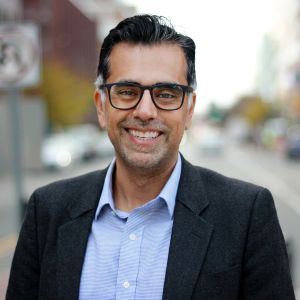
Brian Thomas: Welcome to The Digital Executive. Today’s guest is Vinay Gidwaney. As Chief Product Officer, Vinay Gidwaney is passionate about creating opportunities for employees and families to make better decisions around their finances through OneDigital’s integrated offerings. He leads a strong team of technology experts and developers who work to deliver the latest in innovative products and solutions to OneDigital’s customer base.
Well, good afternoon, Vinay. Welcome to the show.
Vinay Gidwaney: Thank you.
Brian Thomas: You’re very welcome for joining the show today. I appreciate that, Vinay. I know you had to traverse some calendars and time zones to get here, so thank you. Hailing out of Boston, I’m in Kansas City. Let’s get the show on the road, as they s- like to say.
So jumping in, Vinay, your path runs from building software companies to co-founding Maxwell Health, which Sun Life acquired, and now to leading product at OneDigital. So what thread connects those chapters?
Vinay Gidwaney: That’s a great question, Brian. I think the most important thing that I have dedicated my life to is really understanding the interface between humans and technology.
Like you mentioned, I- I’ve been a software entrepreneur for a long time, but I’ve also worked in neuroscience at MIT. I helped to start a, a company that did the mass vaccination sites during COVID here in Massachusetts. So I’ve always been on the edge of where technology and people came together, and making sure that technology is benefiting people, which of course in the age of AI now is a really important thing for us to work on.
Brian Thomas: Absolutely, and I appreciate that. I have a background in healthcare tech. I’ve been in healthcare a long time, and I appreciate you that being in this space and focusing and making the world a better place. People, tech, and healthcare, I think is a great place to be. So I appreciate the backstory.
Thank you. So Vinay, let’s talk about Workforce Intelligence argues that HR, not technology teams, should own AI transformation. So why do you believe that, and how did tech l- how did tech leaders react to that?
Vinay Gidwaney: That’s a great question, too, and I’ll start off by saying I’m a technologist, right?
So I’m, I’m one of those tech leaders that when ChatGPT came out, all of us were sort of enamored by this, and we could sort of see the potential of where it was going. There was one important insight that we had when we looked at ChatGPT, and I think it comes from the lens of the fact that we are a human-driven organization.
We believe in human capital. In fact, our whole business is predicated on people being employed. So it was very easy for us to see that if you think about tech… if you think about AI as a piece of technology, I think you’re underestimating what it can do, and instead, we wanted to think about A- AI as talent.
So for the existence of humans, we’ve had one kind of talent, the human being, and the human being was always supported with technology, and it was augmented with technology, and human beings got better because of technology. Artificial intelligence is a little bit different. We sort of think of it as another source of talent, especially in the workplace, and as AI becomes smarter and more capable, and agents and all these sorts of things become more available to people, we’re gonna start to look at our workforces as combinations of human and artificial talent.
And to answer your question, who are the people that lead talent in organizations today? Those are the folks who are managers. They’re leaders in organizations. It’s the HR department in many ways that is job, beyond the administrative parts of HR, to support the human talent in an organization. So we felt that they not only needed a seat at the table, but they actually needed to be the leaders of how AI adoption happened in a company.
Brian Thomas: Thank you. I appreciate that. And this kind of goes back even before AI, you really want the stakeholders involved and, and, and that’s the… what I’m taking away here, is having humans not only in the loop, but really being the masters of their domain-
Vinay Gidwaney: Mm-hmm …
Brian Thomas: and absolutely need to have a say in how that AI transformation progresses and is implemented.
So thank you. Vinay, you just- Well,
Vinay Gidwaney: if I could ask, Br- I, I will add to that, Brian, is that it’s not just a stakeholder role. It really is to recognize, and I think we all know this intuitively, that the opportunity for AI to drive transformation is not a technology problem, it’s a human challenge, right?
It’s changing people’s behavior. It’s understanding what kind of work to give to AI, what kind of work to keep with humans. It’s all of those things that are actually from the human lens, from the person lens. And, and again, we, we think of HR as the ones who, who deeply understand that. So there I, I would push the, the idea of it not just being a stakeholder at the table, but actually being the ones that are leading the transformation itself
Brian Thomas: Thank you.
Vinay, you describe AI agents as coworkers rather than software.
Vina Gidwaney: Mm-hmm.
Brian Thomas: So what does managing an AI coworker actually look like day to day inside of OneDigital?
Vinay Gidwaney: Yeah. Taking that lens of AI as talent, we actually took it pretty seriously, and what we do at OneDigital is we hire AI to do the work, and we actually take the AI through a hiring process.
So it all starts with a job description. So we write out what we want the AI to be capable of doing. It looks like a job description that you would put on any job board. It describes the qualifications, a little bit about the work and what’s entailed and, and so on. And we have feed that into sort of the vanilla version of a coworker.
And the great thing about AI, as you know, is that if you want it to have a particular point of view or a particular background, you can just tell it to do that. So, so the job description really serves as the initial prompting, the system prompting, so to speak, that tells the AI how we want it to behave and what we want it to know or focus on.
We actually hire the AI as an intern, so they begin as what you would normally expect an intern to be, sort of a little bit rough around the edges and, you know, sort of knows some things but doesn’t know a lot of things. And one of the most important things we do is we put a human supervisor in charge of that intern.
So just like any good boss, you’re gonna give an opportunity for that person to learn new things, to learn the ropes, so to speak, and get exposed to different challenges. And what we’re doing through the internship is trying to understand if this AI coworker is really capable of doing the work that we want it to.
Once it’s able to prove some of that, we then promote it to an apprenticeship. Apprenticeship is where it’s spending more time with other humans, where it’s starting to understand what it means to get the work done, what quality of work means, and we start to build out the actual resume for the coworker.
We give it guardrails. We give it best practices. We even give it a personality. We give it all the things that we want it to do and behave within the company. If it meets all of those qualifications, it then gets promoted into a full-time available. That whole process takes about six weeks. Now, the important thing is, is that once the AI coworker is full-time, it still has a human supervisor.
We all have a boss. And so that human supervisor is responsible for managing the quality of the work from the coworker. Now, that can’t really be done manually because thousands of people are chatting with a coworker every single day. So we have a team of sort of AI HR agents that help the supervisor manage the performance.
And we oftentimes… i’ll give you an example. So the, the, the longest-tenured coworker we have, his name is Ben. He’s the benefits consultant coworker, not a, not a big surprise there . And Ben is managed by a real person, her name is Shelly. And Shelly will constantly look for opportunities for Ben to know new things, to stay up to date on the regulations.
Oftentimes, Ben is challenged by our own people and learns something, so we then have to codify that learning. So this is a constant thing, and I think one of the, the big insights is that AI isn’t just a set-and-forget thing. It needs constant management in order for it to actually be effective, and we’ve built that structure here.
Brian-Thomas: That’s amazing. And I, I just love how it’s y- treating the AI, it’s obviously an intelligent platform, but treating it like an intern graduates to an apprentice and so on, and it totally correlates, like, how we hire humans today. Yeah. And that’s pretty amazing. Of course, we always have to keep humans in the loop, and as you talked about, as they move through their, their process over about a six-week period, they still always have a human supervisor, so that’s amazing.
Vinay Gidwaney: Thank you. Well, and, and you … And I think you touched on the key point there, is that we’ve all hired somebody if we’re in a management capacity. So when you talk to managers about, “Look, we want you to think about your workforce as both humans and AI,” you’re removing the sort of inaccessibility of the technology.
You don’t really need to know how the technology works. In fact, the technology is a lot more human-like than it is technology-like. Yeah. And so you can apply the same characteristics, the same process or frameworks that you have around how you find good talent to just how you get good AI into your organization, and what we’ve built is a whole process around that.
Brian Thomas: Thank you. Appreciate that. Vinay, as we look ahead to the future, five years, maybe beyond, how do you expect people and AI working side by side to change how employers deliver benefits and how families make financial decisions?
Vinay Gidwaney: Well, that’s a great question, and I think that the biggest challenge that we’ve always had around financial wellness and health, and in fact, I think that there are a few domains that are best served through one-to-one relationships.
It, education, healthcare, financial well-being. These are things that are much more about the relationship than they are about the content. I think in the health spectrum, we all more or less know what we need to do to be healthy. We don’t necessarily choose those things. What helps us choose those things is the relationships that we have with other people that build the incentives and the motivation to do things correctly or, or better for us.
And so when it comes to financial wellness and benefits, as we all know, these are really, really consequential decisions. How you decide what health insurance you have, how much money you put away in your 401, all of those really matter. Now, the problem is, is we have a supply and demand issue. We have a ton of demand for people to get assistance with this.
We don’t have enough people to help them, and that’s what AI is really good for, right? It can scale the impact of people. Now, does that mean that AI is gonna replace the need for a human relationship? No. I think that that is absolutely important, and one thing that we focus on here at One Digital is how we can elevate our people into doing things that are higher value.
Now, the problem with the supply and demand issue is that we have a lot of the supply doing administrative work, right? So when you need to get help with your health insurance, a big chunk of that assistance is moving paper around and calling people and so on. If you can have AI take care of all those things, then you can leave the people to do the relationship-building part.
That’s where if you have a question about your benefits because, God forbid, somebody in your family was diagnosed with cancer, you want an empathetic human being who understands what that means, who can put themselves in your shoes, and guide you through that. The AI… Let the AI take care of filing claims.
Let the AI take care of negotiating with your provider. AI should do all those things, but the relationship matters a lot. So I think the future really is this combination of human and artificial intelligence. The interesting thing that companies are faced with is not a question of whether AI can do everything.
It certainly can. It’s a question of what you want for your organization to be specifically human and what you want to be AI. At One Digital, we’re really choosing the relationship aspect to be human because that’s where the most value is.
Brian Thomas: Thank you. I appreciate you impacting me. Obviously things are gonna change in the next five years dramatically.
But at the end of the day, you do want that human connection, that human touch, especially as you mentioned God forbid somebody gets a, a bad diagnosis you want a human there to obviously work with the, the em- employee there in that case. But AI, absolutely. In fact, there’s agentic AI, as you know, I talk about this all the time working multiple companies agent to agent, and all that stuff that can be obviously automated can be done by agents today.
So I think that’s amazing, and I’m just can’t really wait to see what the future holds. So thank you.
Vinay Gidwaney: I, I, I think that just to add to that, I think we’re all starting to see what that means in our personal lives with these personal agents like Muse or Dot or Instinct and so on. I had Muse last night take care of some phone calls with some airlines that I didn’t wanna wor- worry about, which allowed me to spend more time with my children.
Exactly what AI should be doing is not replacing the time with the children. It’s doing the administrative work of sitting on hold with United Airlines and instead spending time with higher value opportunities.
Brian Thomas: Absolutely. Appreciate that, Vinay. And Vinay, it was such a pleasure having you on today, and I look forward to speaking with you real soon.
Vinay Gidwaney: Thanks, Brian.
Brian Thomas: Bye for now.
Vinay Gidwany Podcast Transcript. Listen to the audio on the guest’s Podcast Page.