


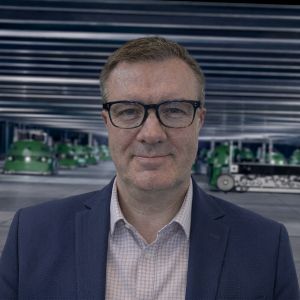
Darren Palmer Podcast Transcript
Darren Palmer joins host Brian Thomas on The Digital Executive Podcast.
Brian Thomas: Welcome to The Digital Executive. Today’s guest is Darren Palmer. Darren Palmer is Vice President of Bot Hardware at Symbotic, where he leads the development of robotic hardware, advancing warehouse automation, and supply chain operations. He brings more than 30 years of automotive innovation and technology leadership experience from Ford Motor Company, where he was a founding member of Team Edison and helped spearhead the development of Mustang Mach-E, F-150 Lightning, and E-Transit.
Throughout his career, Darren has led global teams and large-scale product development initiatives, bringing emerging technologies to market. At Symbotic, he applies this experience to advancing robots and automation technologies that are transforming global supply chains. Well, good afternoon, Darren.
Welcome to the show.
Darren Palmer: Thank you for having me.
Brian Thomas: You bet. I appreciate you making the time. Boston to Kansas City tonight, and again, so much appreciate that. I know it’s hard to juggle calendars and time zones, so thank you. Darren, if you don’t mind, I’m gonna jump to your first question. Your path started with an electrical engineering degree from the University of Birmingham, ran through more than 30 years at Ford, and now leads to robotics at Symbotic.
So what pulled you from cars to warehouse bots?
Darren Palmer: Well, after 30 years plus at Ford, culminating in launching the company’s first EV portfolio, I decided I would like to try a new challenge. So I searched for what is the hottest technology field in the world, and the answer that came back was AI robotics.
But I asked– I wanted something that’s adding huge value right now, and so I carried on searching, and the top of that list came back as Symbotic And so I wanted to know more about that, and perhaps how could I add value to what they were doing. So I contacted the leadership, and I found out that Symbotic had spent twelve years developing a system that uses robots to store, retrieve, and deliver packages at an incredible scale, often half a million a day in each facility, with over a thousand robots in each facility.
And they look like little EV cars. And their plans were starting to reach automotive scale. So they needed somebody to help scale production, design for quality in manufacturing, and reduce cost. And as I talked more with the leadership, I saw that there were quite a few opportunities that automotive has already solved that has not really been brought into the world of robotics yet.
And, and they invited me over to come and see a system running, and when I stood in front of the system and saw it running, incredible, a thousand robots running around autonomously, I was hooked, and the rest is history.
Brian Thomas: That’s awesome. Really appreciate that. You’ve obviously done some great things over your career, but the fact that you wanted a challenge, you reached out to Symbotic and looked…
really did some research, obviously, but when you looked at everything and the operation they were running, certainly was a challenge, but you got excited and jumped in. So thank you for sharing your backstory. Really appreciate that. Gary, you’ve said some of the most exciting hardware scaling challenges today aren’t all on the road.
So how do Symbotic’s bots compare with an electric vehicle in engineering complexity?
Darren Palmer: Well, the sensor stack is really similar. So our bots have over eight cameras, two lidar units, and also 3D perception as well. And they actually look like little EVs as well, and they go off to do tasks autonomously.
So they’re also, their reliability is extremely important. They actually do more miles than a car does in its lifetime. So they’re really quite similar to the type of challenges you have in autonomous cars. And since I’d worked on electric cars as well, and to some part on the autonomy part of that within the team, I thought that would be a great challenge.
And, and I thought I’d really like to bring some of those fixes and improvements that cars have already solved. An example, in refrigeration and in frozen environments, cars have really solved that really well, and in robotics it’s less developed. And so, you know, that I see quite, quite similar challenges that you, than you see in automotive.
Brian Thomas: That’s awesome. I appreciate that. There’s so many parallels there too, and you talked about that. But of course with autonomous vehicles, just like, bots, right, in, in warehouses, you’ve got LIDAR, you’ve got cameras three D perception. You’ve got a lot of things that you need to obviously work together to refine that product and, and make it operate at the most efficient at scale.
So I appreciate that. Darren, the bots you developed are AI powered, so how does your hardware team work with software and AI teams so that physical design and intelligence improve together rather than in silos?
Darren Palmer: Well, that’s one of the challenges you see across many industries, including automotive, and how do you integrate the teams to work as one?
So something I was really impressed with here and we’ve built upon is how the two teams work together. For an– And I’ll give you an example. Every morning, the hardware and software VPs meet with their teams in one place and look at what the deployment was last night example, they deploy software to the bot fleet, the entire bot fleet of over twenty-five to thirty thousand every single day.
And I was really impressed with that. Automotive aspire to do something like that. And so one of the things that we brought in is how they work to one scoreboard. Example, if you ask an F1 team who owns the lap time, the mechanics or the, or the strategist, the question is served to them. It’s one machine, one race, one scoreboard.
That we have one scoreboard for how the bots have performed. We measure wrangle rate, which is how often the bots have to be touched. We measure how many packages they have transferred, how efficiently have they have done that, for example. And so we all use the same set of metrics, and we all work towards those.
Sometimes it’s a software fix, sometimes it’s a hardware fix. They’re all working towards the same thing. Another thing we’ve developed recently is a thing called Sym Cloud, which is an agentic AI system that’s unique to Symbotic, and we can actually view the entire network. We have over twenty-three sites running at the moment, with over a thousand, sometimes more, bots running in real time in all sites, really around the clock.
We can look at the whole system, look at where there’s an issue, zoom into that site, and then zoom into a digital twin of the site where we can see all of the bots moving. Then we can zoom into one bot and if there’s an issue with it, we can investigate that issue. Once we get down to the bot level and we look at an issue, we can then switch to video, and we, it can…
Like Minority Report, we can re-reverse back the video to see what issue the bot had, so we can learn from that. And so every morning, we look at any issues that occurred overnight, and if they’re unusual, we think there’s some learning from that, we can actually zoom into that as a team and see how the bot performed.
And then we really go at that as a team. Who could solve that? What do we think the issue is? Could we solve it with hardware or software or a small tweak? I, I’ve seen that team increase performance of the bot fleet in one night by five percent. And when you’re delivering five hundred thousand packages from each site per day, that is a significant improvement and really adds value for the customer.
And the amount– what they do for that customer, that efficiency, that can reduce the cost of moving packages to a third of what they used to be. And in, in one of our top customers, they, they turn that into cheaper food or cheaper p- cheaper goods for customers, and they really need that at the moment. And so for me personally, we– I, I was working on the mission of high volume electric vehicles, which helps the planet, and now we’re working on cheaper food for America and expanding past that.
So that’s what makes me work as well, and that, that’s how I see the two teams working together.
Brian Thomas: That’s amazing. I appreciate that. And the fact that you talked about that standing daily meeting where the teams get together and review things from the previous work shift or a previous day, I think that’s important.
But again, you said their goals are aligned, a lot of their metrics are aligned. But at the end of the day, you have agents that can look into this stuff real time and see how that operation is running, how efficient it is. And then you can also kinda, like Minor-Minority Report, the movie, you can kinda rewind and look back and see where you can improve those failures.
So thank you. Darren, last question of the day. As we look ahead five, maybe even ten years, how do you see robotics hardware changing global supply chains, and what breakthrough are you most excited to help bring to the market?
Darren Palmer: Well, i-in, in the case, in the field that we’re in I see the efficiency that this has given.
It means that we can bring cheaper goods for people and also the resiliency of that. So these work… They’re very, very, very high accuracy. And so they mean that there are not mistakes which again reduces costs. Or for the end customer, it means the goods you order are exactly what you get. And so one breakthrough I see coming soon is bringing that efficiency out to the world.
So I see the type of systems I’ve talked about are huge. I don’t… Maybe they’re the size of 20 football pitches or more. And we… I see bringing these systems out to stores and creating a kind of vending machine for the store, so that when you leave your home and would like to order goods or food for home, you order it, and within 15 minutes you arrive to the store, and it comes out of the store like a vending machine, cold, frozen, ambient.
And or it can go into an Uber or into an autonomous taxi. So again, making your shopping extremely efficient, and again, with that very, very high accuracy. Sometimes now when you order fast goods in a similar system the accuracy is not as great, and we’ve all had that experience when you order, and you don’t get exactly what you, you were looking for.
These systems are something like 99.8% accurate. And so that piece of it I see making life more convenient meaning you only need to order what you use and making sure you get exactly what you, what, what you wanted. So I see that coming very, very soon now.
Brian Thomas: That’s awesome, and thank you for sharing that.
You know, you did unpack quite a bit around efficiency, resiliency. At the end of the day, improving that efficiency allows, manufacturers to deliver goods at a cheaper price for folks that live here in America and beyond. But of course, that accuracy is so important, and you talked about that as far as, ordering something online and having even a, an autonomous bot taxi or Uber deliver that stuff in a, in a short amount of time, again, with high accuracy.
So I appreciate that. And Darren, it was such a pleasure having you on today, and I look forward to speaking with you real soon.
Darren Palmer: Thank you so much for having me.
Brian Thomas: Bye for now.
Darren Palmer Podcast Transcript. Listen to the audio on the guest’s Podcast Page.