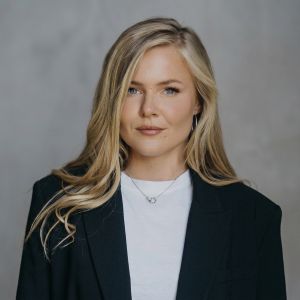
Tetiana Aleksandrova Podcast Transcript
Tetiana Aleksandrova joins host Brian Thomas on The Digital Executive Podcast.
Brian Thomas: Welcome to The Digital Executive. Today’s guest is Tatiana Alekandrova. Tatiana Alekandrova is a deep tech entrepreneur with 15 years of executive management experience and nearly a decade dedicating to commercializing brain-computer interface or BCI technologies. As co-founder and CEO of Subsense, she leads company strategy, fundraising, and global public representation.
Under her leadership, Subsense secured a landmark 27 million seed round led by Golden Falcon Capital and earned top industry honors, including the 2025 MedTech Breakthrough Award for Best New Technology Solution in Neurology and the Pinnacle Breakthrough Medical Device Award. Tatiana holds a degree in economics and an MBA from the Moscow School of Management Skolkovo.
Her visionary work in neurotech has earned her widespread recognition, including spots on the Top 100 Women in Tech, Top 100 Women in Venture, and the San Francisco Business Times 40 Under 40 list Well, good afternoon, Tetyana. Welcome to the show.
Tetiana Aleksandrova: Hi, nice to see you.
Brian Thomas: Absolutely, my friend. I appreciate it.
Making the time, jumping a couple time zones over here. I’m in Kansas City. You’re in Palo Alto, California. My, my favorite spot to do podcasts. I’ve done hundreds with CEOs like you from that area, and I just really love it. So let’s just jump into your first question, Tetyana. You have over 15 years of executive management experience and nearly a decade specifically dedicated to commercializing brain computer interfaces.
What first pulled you into neurotech, and what was the realization that led you and your co-founder, Artem Sokolov, to start Substance and pursue a fundamentally different path than everyone else in that field?
Tetiana Aleksandrova: That’s a great question because I believe that commercialization of brain computer interface haven’t started yet because most of the companies, they’re still in R&D stage.
And the reason how I got into neurotech is actually because I wanted to build something big, and I wanted to build some product that will lead to the new technological revolution. And many, many years ago, I believe that brain computer interface was the one. And I think it was a very good bet that I started to do that.
And the reason why we decided to start a new company, because Substance is my second brain computer interface company, is because, because of the experience that I had with my first company that was completely non-invasive. And with my experience, this company still exists, but w-with my experience, I realized that having completely non-invasive technology would not lead us to the consumer brain computer interface, something that we envision in movies and books, something that, that will unite eventually technology and the brain because the precision of the signal is not that high.
But at the same time, knowing a lot about invasive implantable brain computer interface, I don’t really believe that they would scale and people, like healthy individuals like you and I, would use it eventually for daily, daily life activities. That’s why we were trying to find the solution that will lead us from the product to the technology, not vice versa, that would have a very precise signal and would not require a surgery. That’s how we started Substance.
Brian Thomas: That’s awesome. I love that. And SubSense being your second company, what I took away here, took this note, is important, that you stuck with that non-invasive approach to it. Obviously, a lot of people don’t like to go to the doctors in the first place, but that’s just one reason.
For example, I sometimes don’t like to go there unless I know it’s gonna be non-invasive. You got into neurotech so that you could make a big impact here, a big difference in the world, and I’m glad you are here sharing that story today. Tetyana, well, Neuralink, BlackRock, and Precision Neuroscience all require surgical implementation.
SubSense went a completely different direction with nanoparticles delivered intranasally through the olfactor nerve, trained to last somewhere between 20 and 60 days before degrading. That’s a bold scientific bet. What made you willing to take that on, that much harder technical risk, rather than following the established implant playbook?
Tetiana Aleksandrova: As I said previously, I don’t believe that surgical implantation would really lead us to something that is scalable, and people would love to have a surgery in order to control their computer, and I’m not the only one in the industry who don’t believe that. So we were trying to find the way how we can make a very accurate signal, how we can get the very accurate signal from the brain, but something that would not require a surgery.
And that’s differentiate us from many, many other companies in the area that we didn’t get from, from the technology through the product. We were trying to find the way how it can be scalable for not only people with medical conditions, but for healthy users. And for more than a year my R&D team and I, we were talking to a lot of people from academia, very multidisciplinary people, like people from chemistry, physics, hardware development, engineering.
And we were trying not just to introduce them our idea, but we ask them, “Try to kill this idea. Try to prove us that we’re actually wrong, and this idea would never work with nanoparticles.” And eventually, we couldn’t find this killer statement, and we realized that potentially we’re not breaking any physics law, and we should try it.
And a lot of people that we have spoken to within this year validating our idea, they joined our advisory board, and we’re building it together right now with them.
Brian Thomas: Thank you so much. Really appreciate that. Again, highlighting just a few things you said here. You worked to develop really this very accurate signal from the brain without this invasive approach that you talked about, and I really liked your, really your tenacity, right?
You proved to your naysayers that using your approach, the nano, nanoparticle approach is the way to go, and you, now you have people, you have people that are believing and backing you in this technique. So I appreciate that. Tetyana, your system is bidirectional. It can read both from and tune right to the brain, and your ultimate vision includes a direct neural interface with AI that could change how humans interact with knowledge itself.
That raises profound ethical and safety questions. How are you thinking about the ethics, consent, and regulation of technology that can literally stimulate the brain, especially as it moves towards healthy users?
Tetiana Aleksandrova: Of course. So first of all, in our company safety first, it’s not just words. And starting from day one, we decided that we want to protect all the data, starting from the cells on a dish and ending right now with the mice data, with animals data.
That and of course, in the future, first of all, human data, we want to protect it as much as we can. I also think that the way how all the ethics and regulation would work for BCI area is not really clear right now, because I’m sure that government will be involved. But as this industry is still growing, there’s a lot of things to be done.
But what is– what we already can do and what we’ve done in our company is some– to create some principles that we would never break. And one of the principles that we have in our company is very simple, that access to your brain should belongs only to you, not to our company substance, not an employer, not an advertiser, not an insurance company.
And that’s very, very important for us. And you were asking about the consent, and I believe that consent in BCI cannot be something you give once by signing some form. It has to be continuous, and the user should always be able to control the interface, to turn it off and walk away from it. And that’s another advantage of our technology.
It was implemented in the product strategy that for example, comparing to classical implantable BCI, you have it in your brain, and it’s just, just there. But with our technology, you have nanoparticles inside of your brain. But in order to work, these nanoparticles work, you need to wear, in our case, it’s a baseball hat.
And if you take it off, the baseball hat or hat, we, we’re still discovering what would be the most suitable form factor for healthy individuals. But as soon as you get off this hat or baseball hat, nothing happen. The BCI is off. And it’s very, very important for us, so you have a choice to take– to turn it on or off.
And another thing that we distinguish in our company is that we would never sell biological data for advertisers, and we would never work for military purposes. That’s very important to us as well.
Brian Thomas: That’s amazing, and that’s something to stand by. Obviously, that’s a big statement there. Things change, but I, I appreciate you sharing that and the stance that you took there with that, with not selling the biomedical data, of course that’s important, or for military use.
But you talked about early on safety is more than words. As this industry grows, however, you expect some more regulations that will be bound to come. Of course, we know how that works. But at the end of the day, I like your stance on privacy and consent with a person’s health and their brain, with that consent being ongoing, not just a one-time approval.
So I appreciate that. And Tatyana, last question of the day. You’ve said that you want to completely change how humans interact with the digital world, and you have preliminary product roadmap stretching 15 years out, one that ultimately depends on how quickly our understanding of the brain evolves.
Painting that long picture for us, what does seamless human AI integration actually look like when it arrives? And what has to be true scientifically, ethically, and culturally for that future to be one people would actually want?
Tetiana Aleksandrova: That’s actually my favorite question because this is, this is why I’m building Substance, because I envision the world a certain way.
As you can imagine, most of the BCI products, not just for our company, firstly, they would be introduced to people with special medical needs. But if we’re talking about consumer devices, I would say that the, the health individuals, I mean, I would say that they would have their own pace and with time we will see more and more products on the market.
I believe that in BCI industry, we will start with some products that will eventually help you to navigate the digital world. What I mean by that is that we would not use any more, any keyboards, any voice comments. We will just interact directly with all the digital world by our brain and our thoughts.
The next iteration, the next step for BCI, I believe, would be integration, seamless integration with AI. Imagine if you could have a direct access to any big LLM models in your brain, which means that any time you have any questions, question, you don’t need to ask ChatGPT or Claude or whatever else would be in the future.
You will just have your answer right away, which lead us to the world where knowledge would be a commodity for the humanity. And as even further step, I would say that I see the world where people will communicate by their thoughts. They don’t need to tell words because we can we would be easily read the not just thoughts, not just words, but also what we feel, what we– how do we feel things, which is very hard to describe verbally, right?
And I think that we would be able to send these sensations as well to each other, so we will enhance hu-human capabilities in many, many times and, and directions. And answering for the second part of your question, what should be, what should be right, so people would really actually want it. So first of all, safety first.
It’s protected data. It shouldn’t be any situation when someone else has ac-access to your brain, right? And secondly, I would say that it should be easy and convenient to use. And I believe that surgery is not an option for people. So it’s should be something that you can easily wear, take on, and take off whatever you want.
And of course, it should be very reliable in many, many ways.
Brian Thomas: Thank you. Appreciate that. Lot to unpack there. And this is exciting, really is. We talk a lot about the emerging technologies here on the podcast, but talked about the BCI industry. There’ll be a lot of obviously technological improvements in the future.
But what I thought was really cool, Tetyana, was eventually the seamless integration with AI, with our brain, right? Not, waiting to provide a prompt to an LLM. It’s seamless, and the fact that people will be able to send or detect those emotions and, and senses is amazing. This is almost like sci-fi, the stuff that we grew up with, right?
Very cool. But at the end of the day, I love your stance, safety, privacy protection always first. Make sure it’s easy to use, and then of course it’s gotta be reliable. So I really appreciate the insights, and I’m sure our audience will just love this. So Tetyana, it was such a pleasure having you on today, and I look forward to speaking with you real soon.
Tetiana Aleksandrova: Thank you very much, Brian. I’m looking forward to it too.
Brian Thomas: Bye for now.
Tetiana Aleksandrova Podcast Transcript. Listen to the audio on the guest’s Podcast Page.