Mohan Gulati Podcast Transcript
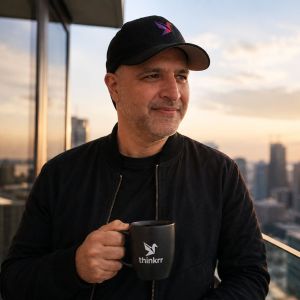
Mohan Gulati joins host Brian Thomas on The Digital Executive Podcast.
Brian Thomas: Welcome to The Digital Executive. Today’s guest is Mohan Gulati. Mohan Gulati is the CEO and co-founder of Thinkrr.ai, a voice AI platform transforming how businesses handle high-volume, high-stakes conversations. Headquartered in White Rock, British Columbia, Thinkrr.ai operates across three product layers: inbound, web widget, and outbound, and serves two primary markets: marketing agencies scaling client operations and independent pharmacies modernizing patient engagement.
Since launch, Thinkrr.ai has processed more than three point two million conversations across eight hundred plus active businesses. The company is bootstrapped, cash flow positive, and part of the NextAI Next Canada 2026 accelerator cohort. Its flagship reference account, USave Pharmacy in North Platte, Nebraska, handles between four hundred and six hundred patient calls per day on Thinker’s pharmacy concierge product with PMS integrations for Pioneer Rx and Liberty.
Well, good afternoon, Mohan. Welcome to the show.
Mohan Gulati: Thank you. Glad to be here.
Brian Thomas: Absolutely, my friend. I appreciate it. And navigating times and calendars to get here. I know you’re based out of Toronto, you do some traveling to Vancouver. I’m in Kansas City, so again, I just really appreciate you and your time.
If you don’t mind, Mohan, let’s jump right into your first question. You spent over 20 years in tech and product from Nokia to leading the tech pillar at Media- Media or Media.monks, rather, I apologize, building human-centric solutions for Fortune 500 companies like Starbucks and BMW before co-founding Thinkrr, two Rs, .ai.
What made you leave that enterprise world to build voice AI for independent pharmacies and mid-market service businesses, and was there a specific moment that convinced you that this was the opportunity?
Mohan Gulati: Absolutely, yeah. I mean, I spent a lot of time in C-suites, in the offices of them, doing a lot of discovery calls and the type of contracts that I was signing were in the millions of dollars working with, big Fortune 500 companies.
And AI came around, and all of a sudden, there was a very, very slow pace of response to, like, moving forward with any kind of thing associated with AI. They were just hesitating because they weren’t sure what to do, right? So all of a sudden, you know, you’re getting a, a 50,000 discovery project, and you’re doing absolutely no work for it because CEOs and CTOs at that time, and CIOs as well, just were like, “I don’t know how to move forward.
I’m, I’m– Like, I gotta show my s- my, my company, my leadership team, the CEOs,” if it was a CEO that they were showing it to, “that I’m doing something. So let’s do a small discovery.” But there was no progress to kind of move forward, and then it was like for the whole, almost the whole year, it was just a lot of this, like, “AI is here, but we don’t know what to do.
We’re unsure. It’s moving so fast.” And in this time, I started realizing there was another group of people that were eager to get started and eager to get started fast and weren’t hesitating. And honestly, I felt like the democra- democratization of that was very important. So SMBs became kind of my focus, and all of a sudden, I started to realize, you know, there’s kind of this process, the story of why I do what I’m doing.
But that led me to believe that there was an opportunity now, and I’ve always been an entrepreneur. I’ve always– I’ve done a few other startups that I’ve had in my background, and I just felt the inkling that this was the time to jump and do it
Brian Thomas: That’s awesome. I appreciate that. And same here.
Obviously, the podcast, the last two and a half, three plus years has been all AI. It’s crazy. But I’m glad you jumped in, and I, I know it’s part of it’s in your DNA, that entrepreneurship, that’s, that’s part of your DNA. But jumping in and helping those SMBs is, is huge because I still see people stagnant in their AI strategy, and I just really appreciate that.
And we’ll get more into that, but I, I just love what you’ve done and I did a lot of reading on, on AI and the, the success you’ve had, so thank you. Mohan, your thesis is direct: independent pharmacies and mid-market businesses need enterprise-grade voice AI without enterprise-grade complexity or cost. Why is that segment so underserved, and what specifically has kept powerful voice AI, AI out of reach for businesses that arguably need it the most?
Mohan Gulati: I, I really love this question because it’s one of those ones where you have to understand the human psyche. This, this market is going to be– it has been slower than others to just move into the world of AI. You’re talking about local towns with, you know, the pharmacy owner. It’s a place of, like, community, right?
Where people come, it’s a hub. They’re just gonna move a little bit more slower. They’re gonna be a little bit more skeptical about AI. So for people to come in and to invest, it’s all about getting the timing right. And for us, it was actually kind of prompted by the pharmacy owners. We have some progressive pharmacy owners who came to us who were looking for a solution, and they had exactly that problem.
There wasn’t anything really viable or really good on the market. And they, were introduced to us through another vertical that we were working on and immediately said, “This– these guys know what they’re doing. Let’s work with them.” And from the rest was history, to be honest with you.
And this complexity and the solution that we’ve built is, is one that understood the need of how important that relationship is. Because again, we’re handling the incoming calls that are, like, basically all of your relationships to the pharmacy. And if that experience is not good, you’re– they’re gonna hear it, they’re gonna know about it, and also they risk losing those customers, and that’s really, really important.
So it’s, it’s one of those things that it’s quite understandable that they’re tentative. I always tell pharmacy owners now, like, when they’re looking at moving forward, we have a very, very simple process, and it starts with, like, using the technology first as after hours, and then slowly moving it into, you know, a day that you wanna try that’s a little bit low in terms of volume.
And then you eventually have kind of gotten your client base used to what is now, a full-blown, he-heavily used solution in many pharmacies all day long, both evenings and daytimes.
Brian Thomas: That’s awesome. And, and what I really like about what you’re doing is you’re helping the people that really need it, right?
You’ve got these large corporations, Fortune 500s, they’ve got the deep pockets. They can invest in the technology. But you’re really- Yeah … helping the folks that need it the most, and I think that’s my big takeaway. But I just love how you don’t just jump into it. I, I like the example where you maybe turn it on after hours and start to do those things, and, and I totally support that.
I’ve been in that, been in those shoes before as well, so that’s awesome. Thank you. Mohan, pharmacy calls involve patient health, privacy, and real consequences if the AI gets something wrong. You know, you talked a little bit about that. Your system is HIPAA compliant with under 40 millisecond response times and instant pharmacist handoff for early refills.
How do you design guardrails for conversations where hallu- where a hallucination isn’t just embarrassing, but potentially dangerous? And where do you draw the hard line on what the AI is allowed to handle?
Mohan Gulati: So, this is, you know, again, an engineering te– feat, right? So, you wanna– A lot of it is, like, you have to learn, you have to have the experience, like where hallucination occurs and where it doesn’t.
A primary kind of understanding of how we’ve implemented our solution is to understand that we have broken down conversations into segments. We understand which part of the conversation people are in. When you design a solution like this, you wanna break it down into smaller chunks, and you wanna be able to design for each one of them.
And therefore, the guardrails and the overall system that you’re building performs much better, hallucinates a lot less. We’re also heavily integrated into the pharmacy management systems, which means data is driving a lot of the responses that the AI makes. These conversations are not meant to be over a long– We know exactly what kinda calls are coming in.
It’s actually a lot more easier to identify where the potential for those guardrails are and where the hallucination is. And we’ve been doing this for two and a half years in many other horizontals as well, right? So we’re horizontally spread as well as vertically deep. And in this vertical, we took all that understanding, that knowledge, and we started to apply it.
The other thing is that we have an amazing observability layer inside of our technology that’s constantly watching for anything that could be suspiciously going off the rails. And I think that’s an important part, right? ‘Cause you can’t– AI is like– When I ask somebody a question on my team, “Did we fix that?”
You know, like, you’re using the software, and you go, “Did you fix that?” And the answer is usually, “Of course. Yeah, it’s fixed,” in the AI world, you don’t ask anymore, “Is it fixed?” You ask, “Is it improved?” Right? Because all you can do is try to improve. There is definitely always that risk that it can do something on its own, and that’s part of the autonomous nature that we both, love and fear because it is something that AI does on a regular basis. Also, these new models are getting way, way better at not hallucinating, to be honest with you.
Brian Thomas: That’s awesome. And you’re absolutely right. I think it’s always been continual improvement. There’s– You can never get a perfect system maybe near perfect near real-time, those sorts of things. But a-as you know, it’s, it’s continual improvement.
But I like that you said that with having access to these pharmacy systems directly again, that’s gonna have more data at the fingertips o-of the machine being able to reduce those hallucinations and, and understanding what types of calls are coming in. And of course, it learns over time. So, thank you for sharing.
Mohan Gulati: And- I wanna address one, one thing you said about like, you know, just you talked about the technology part, but you also talked a little bit about like the dangers, and I wanna just address that. Our solution avoids that because you can’t just get a medication delivered to you, okay? So it’s like you have to have the address on file, you have to either show up and pick it up in person where there’s identification happening.
So the risk of like somebody getting medication and being prescribed something or getting a refill for something that they should not is almost next to nil, right? I don’t say absolutely next to nil ’cause I don’t know. This could something comes up, but we have not experienced any of that. And the solution we put is very much akin to what you experienced today, what if you just called, and it would be the same process. So, nothing’s changed, right?
Brian Thomas: Thank you for sharing. And, and that’s important, obviously. There’s gotta be some checks and balances in place. I appreciate that. Mohan, the last question of the day, you describe the future in one line. “The pharmacy of twenty thirty-one doesn’t answer the phone, it converses.”
Paint that picture for us. What does the patient experience actually feel like five years out? What happens to the human pharmacist role in that world, and what has to be true technically and culturally for that future to arrive?
Mohan Gulati: This is one of my favorite questions because we have an amazing vision of what’s going to happen to the pharmacist.
We believe the front door to healthcare is going to be the pharmacy. There’s a shortage of doctors right now but there is a pharmacy on every block. And, that makes it easier to access, and they’re already getting those questions at their counters, right? People are already asking questions.
They’re already getting, “How do I do this? What should I do when I go back? I’m worried about this. Is this okay to take with this medication?” They’re already getting those kind of questions. “When should I take it?” So the problem is that they don’t have the time to do that because they’re too busy doing all of this other manual labor I call it office work, answering phone calls, even filling pills, right?
And now the future of the pharmacy is going to be completely transformed through the incarnation of what I believe is general purpose AI, right, is coming in, and robotics. And all that’s gonna be built off data and automation layers. And at Thinker, we’re building an amazing layer of conversational I would call conversational data that includes patients, includes providers, includes insurers, includes home providers, right, for l- people with long-term care.
There’s a lot of that, that … And there’s so many other types of conversations that happen all day long. They also happen at the countertop, right, in how they interact. So we’re building that layer. That’s what we’re doing, and that data is going to inform the future role of the pharmacist, which is gonna be the healthcare provider and it’s going to be able to- Power the robotics, power the AI, power the workflows, both front office, back office.
And what this means is that pharmacies, which are much more, like, tighter on margins right now, if you ever talk to a pharmacist, they’ll tell you about how low they are on margins. Their margins are gonna increase for a couple reasons. One, they’re gonna need a sh- smaller team, that’s just a fact, and they’re also gonna be able to do a lot more revenue-generating activities with the team that they do have, right?
Which is, providing that healthcare providing more valuable services that people wanna pay for because now they can do that, and they can actually offer those types of services. And you know, I still believe it’s gonna be the hub of the community. I still believe it’s gonna be that place people come and visit, and it’s gonna not just be less, it’s gonna be more.
And that they’ll be able to actually you know, fill that void that’s really a gaping gap right now.
Brian Thomas: Absolutely. And we see this all the time, patients come in and they wanna spend more time with their provider, but also the pharmacist sometimes. They have questions and, and there’s just long lines.
So I like how we, we can move into this general purpose AI. We’ll have robotics, we’ll have AI, being able to do really everything that a pharmacist, almost a pharmacist can do today, and allow the pharmacist, as you talked about, to provide higher level services that patients are willing to pay for.
So I think that’s awesome and, and I can’t wait. It’s, it’s just like having a pharmacy right around the corner for everybody, so thank you. And Mohan, it was such a pleasure having you on today, and I look forward to speaking with you real soon.
Mohan Gulati: Thank you.
Brian Thomas: Bye for now.
Mohan Gulati Podcast Transcript. Listen to the audio on the guest’s Podcast Page.