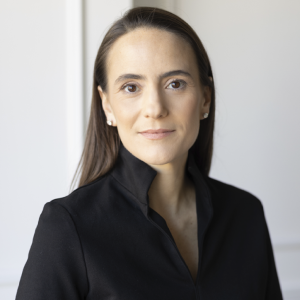
Jessi Szurek Podcast Transcript
Jessi Szurek joins host Brian Thomas on The Digital Executive Podcast.
Brian-Thomas: Welcome to Coruzant Technologies, Home of The Digital Executive Podcast.
Do you work in emerging tech, working on something innovative, maybe an entrepreneur? Apply to be a guest at www.coruzant.com/brand.
Welcome to The Digital Executive. Today’s guest is Jessi Szurek. The gap between AI ambition and AI reality and financial services is where Jessi Szurek works, building the data foundations, governance frameworks, and enterprise capabilities that make transformation durable, not just deployable.
As associate partner at Synthesis, Jesse works with global banks, insurers, and capital market firms, navigating the intersection of AI, adoption, regulatory complexity, and operating modeled redesign. Jessi’s focus is on the hard problem, not what AI can do, but how regulated institutions can deploy it at scale without increasing risk, creating audit exposure, or stalling under compliance pressure.
Well, good afternoon, Jessi. Welcome to the show.
Jessi Szurek: Thank you, Brian. I’m happy to be here.
Brian-Thomas: Awesome. I really appreciate you making the time, my friend. I know you’re in New York or I guess Long Island is, is part of the state of New York, but you’re in Long Island. I’m in Kansas City. I just really appreciate the effort that goes into this to schedule calendars and time zones, so thank you again.
And Jessi, I’m jumping right into your first question. You’ve spent over 17 years leading global transformation initiatives across 40 plus countries before joining Synthesis. What experience has shaped your journey into AI, data, and enterprise transformation?
Jessi Szurek: Sure. When I started in consulting, I used to wonder over and over why clients kept needed consultants.
And what I found the answer to be is that clients need an agent of change, and that’s nearly impossible to do on the side of your desk while running in a full-time role within a financial institution. And that part, I understood, but what I started to question was something different. The deeper I got into the work, the more I noticed that the same patterns were showing up everywhere, across every institution, every project.
And some of those patterns were being quietly maintained, not solved. Because in traditional consulting, the absence of a clear outcome is good for business, and I couldn’t operate that way. My instinct was always to define the objective, create real value, and get out. And what, when I learned that the hardest part of any transformation isn’t the technology or even the strategy.
It’s getting the leadership aligned, the stakeholder buy-in, and the end users who want to use what you’ve built. So you can design the most technically perfect solution in the world if the person sitting in front of you doesn’t understand why it exists or hasn’t bought into the solution, it’s useless.
So that’s what shaped how I work and ultimately what led me to Synthesis, where the philosophy is to is built into that model that to build for our clients.
Brian-Thomas: Thank you. I appreciate that. And you’ve learned a lot in consulting. We talked about how many years you’ve been doing this and clients do need an agent of change, which you’ve found, but it’s hard to do that when you’re wearing other hats.
But what I liked, and I, I’ve used consultants before, and so what I like what I heard today from you is you really need to define that objective, provide value, and complete that project and get out which truly is, is the way to provide value to your cl- to your clients, your customers. So I appreciate that.
And the last, obviously, communication and buy-in from your stakeholders is, is an absolute must. So, thank you. And Jessi, at Synthesis, there’s a strong emphasis on a builder mentality alongside strategy. How does that shift the way transformation programs are delivered compared to traditional consulting approaches?
Jessi Szurek: And that’s one of the reasons I joined Synthesis. Traditional consulting has a built-in conflict of interest. The business model rewards complexity and continued reliance. The longer a client needs you, the better. Synthesis is structured with the opposite goal to increase the client’s return on investment and decrease their reliance on us over time.
We’re able to transfer capability, not to dependency. And a good example of what that looks like in practice. Recently, Synthesis has an engagement with one of Japan’s larger securities firms, and we mapped 1.6 million annual work hours across 24 headquartered departments, identified where AI could realistically replace or augment work, and now we’re moving into implementation with an estimated 50 plus percent average workload reduction in more than 65,000 hours of potential annual savings.
And that’s what outcome-based focus delivery means. We’re accountable to results, not billable hours. So one thing I’ve learned is that AI is no longer just a tool that supports work. It’s increasingly becoming something that executes work and that changes the role of consulting entirely. You’re no longer advising on optimization, but you’re responsible to redesign and deliver how the work gets done.
So sort of the, the summary of this is that, most consulting firms are incentivized to keep you dependent. And at Synthesis, we’re incentivized to make the client self sufficient, and that changes everything about how we work.
Brian-Thomas: That’s amazing. And I really like that. As I said earlier, I’ve used lots of consultants in my career and yeah I see that.
And I really like it. And I know you said that’s the reason why you joined Synthesis it’s outcome-based. It’s not it’s providing really teaching your client self-sufficiency so that they have less dependency on you. And you mentioned something about AI and the, and innovation work you’re doing is you look at it as executing work versus completing the work.
I thought that was interesting. So, thank you. Jessi, your approach incorporates design thinking, mapping user journeys and aligning technology with real workflows. Why is this human-centered lens so essential in large scale transformation?
Jessi Szurek: Design thinking is the difference between building something and building the right thing.
So, in financial services, that distinction is really critical because the cost of building something, the time, the money, the energy, the people, and the cost of getting it wrong isn’t just that wasted budget. It’s regulatory exposure, audit risk, and a workforce that either refuses or quietly goes back to doing things the old way.
So, I’ve learned that before you do anything whether it’s writing a line of code or designing or redesigning a single workflow, you have to understand the human who’s going to live inside that system or solution every day. And that means empathy mapping, sitting with the compliance officer, the operations lead, the risk analyst, understanding their world, their frustrations, the workarounds they’ve built, because the current system doesn’t work for them.
And then you map the journey, and not the ideal journey, but the real one. And here’s what I think is critical and what I can tell you from my experience is that the documented process is never the actual process. It’s always missing something or many things. It’s missing the offline Excel spreadsheet that multiple people maintain, they pass around, they rely on it.
It’s missing the shadow tech that someone built because the approved system couldn’t do what they need. It’s missing the hours of instant messages flying back and forth just to complete a task. It’s missing any blockers because one person is sick or they’re on holiday. And that’s the real workflow.
And if you don’t find that and you don’t fix it, you just automate the documented version of what they thought the workflow was. And then the owners of this project or the budget wonder why nothing changed. So user adoption isn’t an activity you do at the end. It’s not a launch activity, it’s a design activity.
So, when people feel like the solution was built for them and they’re part of it and they have buy-in along the way and it’s not imposed on them, that’s when the transformation really works. So design thinking finds that hidden layer and that’s where the transformation happens.
Brian-Thomas: Thank you for sharing. That, that is where the transformation happens when you talked about that design thinking. And I liked how you got in there. Again, it’s about stakeholders, people that are in the middle of the process. You need to understand that process and the human sitting in the middle of that what are their frustrations?
What can they share? It’s important that those folks are at the front end of this. As you said, user adoption is a design activity, not a launch activity. I thought that was interesting, but you’re mapping that real journey for them. That documented process is never correct. We’ve both been there. It’s always missing something, and a lot of times it’s a critical piece, right?
So, I really appreciate your insights here. Jessi, the last question of the day, as we look ahead to the future, how do you see AI, data infrastructure, and operating models evolving in financial services over the next decade, and what will separate the institutions that succeed from those that fall behind?
Jessi Szurek: The institutions that succeed will be the ones that treat data as a strategic asset before the AI. So not the ones trying to clean up 20 years of legacy architecture while simultaneously deploying models and specifically data governance, data lineage, data infrastructure, knowing where your data comes from, how it moves, whether you can trust it, especially when a regulator asks, AI doesn’t work inside siloed organizations with unclear ownership and undocumented data flows.
The separator won’t be which institution has the most advanced models. It will be which one can sustain it under regulatory scrutiny, audit review, real world operational conditions. And that’s the types of problems that we solve. Most AI initiatives don’t fail because of tech, but because organizations don’t redesign how they operate. So, the winner or the successor won’t have the best model, they’ll have the best foundation underneath it, and it will be governed, traceable, and audit ready.
Brian-Thomas: Thank you. I really appreciate that. And just again, highlighting some things here as you said, successful organizations will actually treat data as a strategic asset. I thought that was interesting. Obviously knowing where that data’s coming from, do you trust it? The data and data flows cannot be siloed. Everything must be obviously transparent and those workflows must touch all parts of the business. I think that’s so important. And Jessi, it was such a pleasure having you on today, and I look forward to speaking with you real soon.
Jessi Szurek: Thank you.
Brian-Thomas: Bye for now.
Jessi Szurek Podcast Transcript. Listen to the audio on the guest’s Podcast Page.