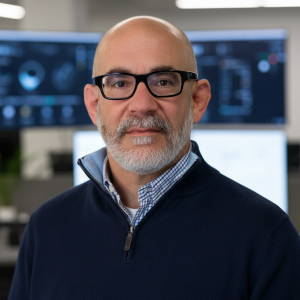
Alexander Fredericks Podcast Transcript
Alexander Fredericks joins host Brian Thomas on The Digital Executive Podcast.
Brian Thomas: Welcome to Coruzant Technologies, Home of The Digital Executive podcast.
Do you work in emerging tech? Working on something innovative? Maybe an entrepreneur? Apply to be a guest at www.coruzant.com/brand.
Welcome to The Digital Executive. Today’s guest is Alexander Fredericks. Alexander Fredericks is a founder, growth strategist, and brand builder operating at the intersection of AI, wellness, consumer behavior, frequency-based health, and market innovation.
He is the Founder and CEO of an AI wellness intelligence platform that turns a 30-second voice note into a performance readiness scan report, helping people better understand their wellness signals and take clear next steps. Alexander’s career began in the music and entertainment world, including time at Sony BMG Records, where he developed a deep understanding of sound culture, storytelling, and consumer connection.
He later expanded into consumer products, brand strategy, growth systems, strategic partnerships, and wellness innovation, helping companies clarify their positioning, build market credibility, and scale with purpose. Well, good afternoon, Alexander. Welcome to the show.
Alexander Fredericks: Thank you so much for having me, Brian.
Brian Thomas: You bet, my friend. I appreciate it. You’re hailing out of the Philadelphia area. I’m in Kansas City, so I do appreciate you making the time today. And Alexander, if we could, let’s jump right into your first question. Your career has taken you from the music and entertainment world at Sony BMG into wellness technology and AI entrepreneurship.
What experience has shaped your journey to founding your company?
Alexander Fredericks: So, I’ve considered myself always in the consumer goods business. Uh, as a person coming out of the music business that isn’t a musician, it was looking at bands and, and records as product. That’s how they’re discussed and spoken about. So as I moved through that industry and into other industries, I have always brought product into the space.
About five years ago or so, I was in the, uh, wellness technology space working out with a client, and I came across what is now the technology that, that backs ToneWell, and I just understood how to take it from the lab that it was being developed in and, and the science behind it into something that a consumer could interact with.
So, for me, it actually felt pretty natural. And then as somebody that does come out of the music business and knows how to produce and make records, the understanding of how frequency travels and how frequency is used is also pretty second nature to me.
Brian Thomas: That’s amazing. Thank you, and we’ll get into ToneWell in a minute, but, uh, appreciate that.
You know, I think your, your career, your experience lends to what you, what you got into, and I’m really excited to hear more about that. Uh, but thank you again. And Alexander, ToneWell uses a 30-second voice note to generate a performance readiness scan report. What inspired the idea of using voice as a non-invasive wellness intelligence interface?
Alexander Fredericks: Thanks for that question. So, I believe that the world is drowning in data. You’re getting it from all sides and everywhere, yet people are still coming up short with two very basic but quite important questions: Why don’t I feel well, and why don’t I function well? And the thing about voice is that it’s immediacy.
It’s a now. It’s– Not only is it non-invasive and there is no friction because the ubiquity of your phone, it’s in your pocket at all time, but the reality of it is, is that after speaking for thirty seconds, we can process your voice in under twenty-five seconds, and then in, in about five minutes, you have a report that helps you make actionable decisions today in your email.
And that notion of flattening the curve between the hierarchy of what one wants to know about themselves and how they can take actions was the thing that made me believe that this would be a wonderful product for the market. It, it really comes down to what can you solve for people, and I think that every day somebody wants to know how they can feel better, how they can function better, how they can perform better, and your voice is one of the greatest tells of what’s going on in your nervous system and your physiology.
So again, it just kind of seemed like a natural solution set, and I, I think I said to myself, “Let’s bring that to the market. We can make a difference.”
Brian Thomas: Thank you. And I, that’s, you know, I had heard of things about frequency and voice and different things like that, but, um, I’m– I appreciate you sharing some of the insights around the voice, how, uh, that, you know, your nervous system, your physiology, all that stuff is all tied together, and you can actually detect, um, what your health is through that, uh, particular, I would say, medium.
Um, but I like that you are really focusing on some, some pain points for folks in the world, making the world a better place, and using data just, again, as you mentioned, just probably several seconds of data, um, less than five minutes, where you can, uh, provide some real health, uh, insights to the person’s, uh, well-being, and I think that’s awesome.
I just love this stuff. Talk about this technology every single day on the podcast, so appreciate that. And Alexander, your background in music and storytelling, gives a unique lens on sound and human connection. How has that experience influenced your approach to AI and consumer engagement?
Alexander Fredericks: So, when I first started making records, there was a two– it was called two-inch.
You would have a two-inch tape. It was a magnetic strip, and the way that we edited it was with a razor blade. When I first started touring bands, I ha– literally had to go to Kinko’s and make a postcard front and back, stamp it, address it, put it in the mail, and then we would go tour. You’d get in a van, and you’d go around the world.
And when I got out of the music business, um, uh, records were being made inside of a computer, and you no longer needed a razor blade to cut something. Email and websites and social media all existed. I say that just to say it was the same idea, but the world kept moving, and that’s how I look at Tonewell.
Right now, we’ve moved into the age of quantum, where things are moving faster and smaller, and yet you can get deeper understanding of something. So the fact that your cell phone now has a microphone in it, which is the quality of the greatest recording studio probably ever, and you can get really clear signal and pathway through it, and then that there’s the technology, what we’ve been able to build.
So we use a static database from computer learning, so it’s not really AI at the front side. But once I get that output, the immediacy and the speed by which we can deliver that to our customer and the depth of understanding and the, the ability to build a specific concierge AI agent for that person for calendar updates or reminders or recommendations, I mean, the sky’s the limit.
So your ability to be creative in what it is that you want to bring to somebody as a product or a deliverable or how you’re gonna solve somebody’s problem, it, it’s only limited by your ability to look at the problem. And I, that’s fascinating to me. You know? Like, if you, if you could, a million years ago, walk around and not have fire, and then all of a sudden there’s fire, you start thinking about the things you can cook.
So that’s just how I look at, at AI. It’s, it’s not, it’s not the end-all be-all. It’s just another great tool, you know? And that’s– it, it has allowed our business to propagate because I can reach a million people in one minute, God willing, and deliver them all individual reports in under five minutes to them that’s personalized and speaks to them and is of their genesis ’cause it’s their voice.
And that just, that just strikes me of one of those dare to be great situations, that if you can do it right and deliver a great service to the client, then it’s gonna become sticky, it’s gonna become habitual, and all of a sudden we have a business that’s doing end over end.
Brian Thomas: Thank you. Appreciate that.
And I love the backstory. Uh, obviously, uh, you and I both listened to records back in the day, and you talking about the two-inch tape and the razor blade, and that’s how things were done. Uh, but as we move forward a couple decades here, um, obviously leveraging technology, ToneWell is able to get the data needed to improve people’s lives easily and efficiently.
And I think, you know, we sometimes we take this for granted, especially maybe some of the younger folks, uh, coming up, is, um, really the technology is here to improve our lives, and we need to kinda reflect on that. So, thank you for your insights. And Alexander, last question of the day: as we look ahead, how do you see AI-powered wellness intelligence evolving over the next decade, and what role will voice personalization and human-centered design play in the future of health optimization?
Alexander Fredericks: So, I think that’s kind of a, bifurcated question. There are two routes on that. First is the easy one, which is right now there’s an infrastructure race happening, and you can see it all around you. The, the wearables, the off-sites, things like Google Health or your Oura, or your Fitbit, or your Whoop, or your Garmin.
I can just keep naming them. Those are infrastructure devices. Those are things that, uh, people are carrying with them. They’re on their person. Those are data collection devices. That’s where the new category of longevity comes from. What can we track over what period of time? And then there’s the, how does the individual get involved?
And we call that our personal operating system. What are the things I choose to engage with? How do I take my sense of wellbeing, which is what I hope for everybody, and move it into a category which is wellness and longevity? Those are the products, the things you interact with. And I think in the next decade or so, like most things, you’re gonna see the speed of light happening.
You know, Moore’s law, smaller, faster, faster, smaller. And it’s also gonna become as personalized, as hyper-personalized as possible. So, a company like ToneWell, right now we exist. You can go to our website, tonewell.co. You can interact with us. It ends up in your phone, your email, your WhatsApp, and your text message.
You tell us where to send it, that’s where it goes. Three, five years down the road, we’re probably like the Intel chip, meaning that we’re baked into things. I could be in your smart fridge, I could be on your laptop. I’m already in the phone, but we could be native to the phone. And the thing about voice, as I’ve said earlier, is that it, it’s an immediacy.
I can tell you what’s happening right now. So, the notion of using it into a deeper position, how you go about your day, how you form your habits, what you should eat, what exercise, how do I supplement? Those are all happening right now. It’s what we’re doing in ToneWell. So, what five, 10 years from now could look like, it really comes down to the infinite side of what the user wants.
What is it that you think in your life is gonna help you make better decision, form better habits, and have a better outcome? And that’s, I think, where voice sits, right at that, right at that, that chasm, right at that precipice of it could fall down into a novelty. I hope it doesn’t. I don’t believe it will.
Or it can be held up to the standard like all other testing- I think people should get their blood, they should test their urine, they should have their hairs checked, they should do, uh, swabs of the inside of their cheeks. Those all take time. They really take time, and they’re of great value for what they’re used for as a diagnostic.
We’re an analytic. I help you analyze what’s going on right now. It’s a snapshot of the now and the choices you can make. So down the road, a decade from now, it really comes down to, how high is the sky and what big- and how big is your limit? I think it’s pretty open, open blue sky for most of these opportunities.
Brian Thomas: Thank you. Appreciate that. You talked about the two, uh, different items, you kind of broke that apart. Uh, infrastructure and gadgets, basically data collection devices. We talked about Fitbit, Garmins, et cetera, um, that are there that help, uh, track and, and make the person aware of how they’re performing in the day.
Um, but you talked about that personal operating system, the wellness and longevity, and ToneWell is leveraging technology to hyper-personalize this information and decisions for individuals for their improved health. And I think the way you talked about that, in the future, it’s only gonna get more hyper-personalized, uh, to really focus on that particular individual’s health to make them better, and I really love this.
So, thank you. And Alexander, it was such a pleasure having you on today, and I look forward to speaking with you real soon.
Alexander Fredericks: Thanks so much, Brian. Appreciate your time.
Brian Thomas: Bye for now.
Alexander Fredericks Podcast Transcript. Listen to the audio on the guest’s Podcast Page.