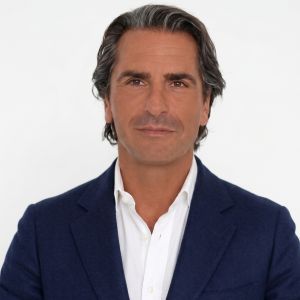
Daniel Ishag Podcast Transcript
Daniel Ishag joins host Brian Thomas on The Digital Executive Podcast.
Brian Thomas: Welcome to The Digital Executive. Today’s guest is Daniel Ishag. Daniel Ishag is the Chief Commercial Officer at Bakkt, a regulated financial technology and payments company building a financial operating system for the AI and token economy, where he leads the commercial organization across the Bakkt platform.
A serial entrepreneur, Daniel founded Europe’s first marketing ad network, which merged with FindWhat.com in a transaction valued at approximately $183 million, built on Bluewater Bio into one of Europe’s leading water technology companies, and most recently founded and led Geyser Network, an infrastructure layer for moving money between fiat and digital assets.
Well, good afternoon, Daniel. Welcome to the show.
Daniel Ishag: Thank you for having me, Brian.
Brian Thomas: Absolutely, my friend. I appreciate it, and I know that you’ve taken the time to make it here today. You’re hailing out of New York currently. I’m in Kansas City, so I appreciate your time today. Daniel, if you don’t mind, I’m gonna jump into your first question here.
Your career is unusually verified. You founded Europe’s first search marketing and net- ad network and merged it with FindWhat.com in a deal valued at approximately $183 million. You built Bluewater Bio into one of Europe’s leading water technology companies, and then you moved into payments and digital assets, and I believe a cus- a customer of Bakkt prior to joining as Ch- Chief Commercial Officer.
Looking across three different industries, was there a single core problem you were solving each time, or did every leap force you to throw out the playbook?
Daniel Ishag: I think the core problem I was always solving was providing a new lens, a new framework for trying to solve old problems. With my first big venture eSporting, which was at the time the largest internet media company in Europe, we had the the advent of the web, and it was how, how are we gonna use this new medium to drive return on investment in advertising?
So we were the first performance-based advertising network in Europe, and the internet allowed us to do things in a way that traditional media didn’t do. With my water business, water and technology within water had originally sort of been owned by utility companies, and as we all know, utility companies, they don’t, they, they don’t pay their guys risk money to take risks and try new things.
So technology had stagnated in arguably one of the most important areas of environmental development. As far as digital assets go, I was just fascinated by the technology. I mean, ultimately there’s two things here. There’s the digital DLT technology, digital ledger technology or the blockchain, and what you’re able to build on top of it.
So over the last, fifty or ten, ten years or so, you’ve had this evolution of different types of tokens which you use on the blockchain. And what’s happened is now, as it’s starting to get to maturity, it’s really broken down into a couple of subsets. You’ve got your big crypto tokens, the, the, the Bitcoins and Ethereums of the world, and then you’ve got this subset called stable coins.
And stable coins, as we know, are pegged to the dollar. They, USDC has a one-to-one reserve to the dollar, and it’s a digital dollar that is able to be moved fluidly, transparently, efficiently from point A to point B in seconds. So it solves a whole bunch of problems, not only in a digital world, but in a traditional world of traditional finance as well, where in a traditional world you have banks and, and if you wanna send money from, from one country to another, you– those banks are dependent on what are known as correspondent banks.
And very often, especially in emerging markets, those transactions can take ten, twelve days to complete. We’re able to do that same transaction twenty-four/seven in two minutes. So it opens up all kinds of new opportunities and efficiencies
Brian Thomas: I love it. Really do. But your backstory is amazing.
Obviously, you were looking at always trying to solve a problem, whatever business you were in. But you got into the blockchain technology, which we love here. We built the publication on Web3 as well. And we’ve interviewed probably… I have personally interviewed probably 80 founders in the, in the blockchain space.
So, I love it that you’re building on top of this stuff, and we use blockchain technology again here but also use it in my personal life as well as far as finances, stable coin, et cetera. Love you jumping into that. Daniel, the digital assets and payments market is heavily fragmented.
Compliance lives in one place, trading in another, payments in a third. For an executive listening whose company moves money every day, what does Bakkt actually solve, and what does working with you look like?
Daniel Ishag: So let me start off by answering what is Bakkt. For people wanting to work in a new digital economy or a traditional finance, Bakkt is a one-stop shop.
We’re we’re a company that owns the licenses and all the money transmitter licenses to be able to move money from point A to point B. We are vertically integrated in that we own the, the rails, the actual infrastructure to move that digital currency. We also have amazing partnerships, especially with one of our largest shareholders, which is Intercontinental Exchange, where they can act as a custodian for us, and we’re able to go to a business and create efficiencies in their business.
So let me just give you a couple of really interesting use cases. When stablecoin started, people were very much focused on the crypto economy. Today, that’s really moving into mainstream. So we spend a lot of time solving problems for any traditional business doing dollar-denominated cross-border transactions.
So in manufacturing, for example, you may have an Ameri– a large American textile company, but they may be manufacturing their th-the-their products in places like Hong Kong or China or Vietnam. Now, in that case, they need to send money to their suppliers, and those transactions can take a lot of time.
Then those s– Then the-their, their supply chain needs to be paid. We’re able to do that near instantly. I mean, literally with completion in a couple of minutes, and we’re able to do that twenty-four seven. So what that means for the American business, for example, is whereas they were very often working on T plus fourteen up to T plus twenty-one days from the time they send their money to the time the money actually gets to the to, to the person who needs the money, it can take a lot of time.
If we can solve that problem and do it in two minutes, that American company now is going to its supply chain, and it’s basically doing the opposite of invoice factoring. They’re saying, “Listen, we’re gonna be your fastest payer. We’re gonna pay you within minutes of the invoice coming out. What discount are you gonna give us?”
And very often they can get four, five percent discount. So that money goes straight onto their bottom line. We are able to solve problems for them by being able to move that money twenty-four seven, including weekends. So it means that you’re creating efficiencies throu-throughout the week. They can use stable coins to move treasury to where the treasury needs to be for any given market at any point in time.
Let me give you another use case. Let’s talk commodities, for example. Historically, when people have thought about payments, they’re thinking about small payments, a thousand dollar payment or remittance payments where you’re sending money to a friend or a family member. When we think of payments, we’re thinking of payments that run the gambit from small payments right up to fifty million dollar payments to pay for I don’t know, a ca– a, a ship full of sugar as an example.
Well, let’s talk about the commodities, for example. What we’re able to do is we’re able to solve for foreign exchange risk because people don’t have a ten or fourteen day exposure to send money, so they don’t need to hedge. We’re able to reduce their FX costs. We’re able to reduce their hedging costs.
We’re able to re-re-reduce things called demurrage. Demurrage is when a ship comes in, and it’s a weekend, and they’ve got to sort of hold that ship until they, they can pay the load on the Monday, and they have to pay, for every day that ship’s in port. We’re able to solve for bunkering, which is the refueling of ships.
Now, the net result of this is we can cut four, five days off a vessel traveling from Asia to America, for example. And we’re talking millions of dollars of savings here. So we’re able to create efficiencies for, for all kinds of situations. In our traditional day-to-day lives, if I’m, let’s say, I’m a– if I’ve got a, a small business, we’re able to divorce you from the traditional banking hours and make, make that business work in a twenty-four seven environment efficiently, transparently, and traceably.
One of the beauties of the blockchain, as I’m sure you know, Brian, is the audit trail it gives. So we’re able to solve all kinds of problems that feed into accounting, into tax reporting and that’s why we’re super excited about what we’re doing.
Brian Thomas: That’s awesome. Really appreciate that. Bakkt, as you talked about, is really that one-stop shop for those people looking to doing efficient, efficient investing.
Doing business that’s obviously transparent that’s fast and, and traceable, as you talked about. You own the infrastructure, you’ve got great partners that help facilitate this business, but you really help companies make it seamless, especially those in the international markets that have vendors a-around the globe.
What’s really cool is that your– these payments can be made within minutes or less no matter what time of the day, weekend, weekday. And leveraging these timely payments, you mentioned can incentivize the payee sometimes for potential discounts because of the, the way the speed of the transaction to get the payments out.
So I appreciate that. Daniel, Bakkt acquired DTR earlier this year to bring AI-native payments and stablecoin settlement infrastructure in-house, and the company describes itself as building the financial operating system for the AI and token economy. With that passage of the Genius Act last year and ongoing momentum behind the CLARITY Act, where do stablecoins fit in that framework?
Daniel Ishag: I think that’s a super interesting question for a number of reasons. I’m gonna hit on the most obvious. In an agentic world- Banks were not designed to deal with agents. Agents weren’t designed to you know, were designed to deal with near instant finality, were designed to deal with speed and automation.
Legacy banking systems weren’t designed to do that. So there’s a whole layer of infrastructure which we’ve acquired through the DTR acquisition that lets us own these digital asset rails. We’re able to take those rails and bridge the gap between traditional finance and, and the new agentic universe that we’re living in.
Let’s not forget today, we’re able to spin up agents in minutes. And, there’s many people or, or even companies that operate tens of thousands of agents doing all kinds of tasks. By giving an agent the ability to do a financial transaction, what you’re able to do is you’re able to expedite an end-to-end solution without having human intervention.
And in order to do that, you need to use programmable money and the rails that sit underneath it. You can’t use the legacy banking infrastructure. So we solve that problem, and by solving that problem, we’re helping the evolution of technology and more importantly, the application of that technology in our everyday lives to improve everyday lives.
Brian Thomas: Thank you. Appreciate that. I like how, again, pioneer in this space, as I like to call it in this agentic world, as you talked about, banks were not designed for these agents, for these instant transactions. But you are, again, being a pioneer, bridging that gap between legacy finance and this agentic world we live in.
But these programmable programmable money smart contracts, et cetera will enable really business to thrive twenty-four by seven and within almost instantaneous transactions nowadays. So that’s awesome. Daniel, the last question of the day I have for you, you’ve spent your career at the frontier of how money and information move.
As stable coins, agentic AI, and regulated digital asset infrastructure converge, where do you see the movement of money heading over the next five, maybe even ten years? And what infrastructure bottlenecks does Bakkt have to solve today to get there?
Daniel Ishag: I’m gonna shock you with my answer, Brian. I don’t know.
I’ll tell you what I do know. And, and the reason why I don’t know is five to ten years is a long time. Let’s not forget we, we, we barely had Bitcoin ten years ago, and look what’s happened in the last decade. What I do know is in an agentic world, we’re going to have to solve for a whole bunch of new problems.
Today, the banking system, the financial system is regulated, and we all go through processes called KYC, know your client, or KYB, know your business. There is a universe where we’re gonna have to create new technologies or know your agent, because we can’t have rogue agents going out there spending money.
And I think this is one of those really interesting areas where you’ve got two problems that you need to solve. One, there’s a technology problem. Today, can I give an agent my personal credit card and get that agent to do things? The answer is yes. But on the other side of this, if we’re gonna do things at scale, yeah, we’re gonna have to know how that agent spends that money, what that agent does with that money, because it’s a regulated world.
Regulations haven’t caught up to the technology. So I think one of the big challenges that’s gonna happen over the next three to five years, especially, is there’s gonna have to be a new set of regs that help put the guardrails in place for this industry to scale. Because invariably, and I don’t mean to be a pessimist here, with every advent of a new technology, there is als- always a small cohort of people who try and abuse it, and that abuse will result in the guardrails being put into place to make it safe for everyone to scale.
The other bit that I do know is we are that middle layer that sits in between the banks and the agentic world, and we don’t compete with the banks. It sits with the banks. I’ll tell you why we don’t compete with the banks. Because you mentioned Genius. Well, for Genius to work, for every stable coin, you’ve got a real dollar put into a bank.
So the banks aren’t being hurt by this, yeah? But what the banks can’t do is because banks are historically built on legacy systems over legacy systems, they’re not designed to worl- work in this twenty-four-seven universe. They’re not designed to work at the speed at which the agentic world is designed for.
So we’re that bridge. We sit in between both, and we’re the facilitator. We’re the orchestration layer that allows technology to live up to its full potential
Brian Thomas: Thank you. Appreciate that. And Daniel, I’d probably agree with you at the pace that everything has moved over the last just couple of years with AI, but of course, you talked about blockchain and, and Bitcoin, that sort of thing.
You’re right. It’s hard to predict that far in the future, and we don’t have crystal balls. But one thing I did take away, I highlighted here you do know we’re gonna have to solve for a whole new set of problems. You talked about that know your customer, know your business and I liked your term KYA, know your agent which is really cool ’cause we know that’s where it’s headed.
But in order to get there regulations always have a hard time to catch up with the technology. We’re gonna have to build those guardrails in place in order to have a safe future. And you’re right. There’s always… Somebody’s gotta ruin it for everybody, and that’s why we’ve gotta do these sorts of things.
So I really appreciate your insights. And Daniel, it was such a pleasure having you on today, and I look forward to speaking with you real soon.
Daniel Ishag: Brian, it’s been a pleasure. Thank you so much for the opportunity, and I hope to meet in person soon as well. Have a great day.
Brian Thomas: Bye for now.
Daniel Ishag Podcast Transcript. Listen to the audio on the guest’s Podcast Page.