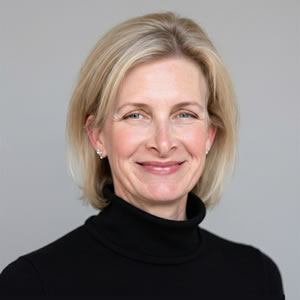
Allie Kline Podcast Transcript
Allie Kline joins host Brian Thomas on The Digital Executive Podcast.
Brian Thomas: Welcome to The Digital Executive. Today’s guest is Allie Kline. Allie Kline is interim CEO of Innovation Labs, a division of Identity Digital addressing the emerging trust and accountability challenges of autonomous AI systems. A seasoned executive, Allie has built and transformed businesses at the intersection of technology, media, and marketing.
She previously served as chief marketing officer of AOL, where she helped lead the company through its separation from Time Warner, its acquisition by Verizon, and the integration of Yahoo’s assets. She also co-founded Leo Dix, a strategic advisory firm for companies using technology to disrupt established industries and unlock new growth.
Well, good afternoon, Allie. Welcome to the show.
Allie Kline: Welcome. Thank you so much for having me.
Brian Thomas: Absolutely, my friend. I appreciate it. And making the time, I know we’re only traversing one time zone today. You’re in Denver, I’m in Kansas City, so I just appreciate you taking time out of your day to do this. This is gonna be amazing.
So Allie, if you don’t mind, I’m jumping into your first question here. You’ve led through some of the most consequential media transformations of the last two decades, from AOL’s separation from Time Warner, its acquisition by Verizon, the Yahoo integration. You’re now running Innovation Labs at Identity Digital, tackling one of the most urgent problems in AI.
What through line connects all those chapters, and how did a career built at the intersection of technology, media, and marketing prepare you to lead on AI accountability?
Allie Kline: It’s a great question, Brian. Thank you so much. I’ve always been drawn to moments when technology fundamental change, fundamentally changes how people work create, and ultimately communicate.
And I do believe that similar to this disruption we’re hearing and experiencing today, that that always creates huge opportunity. And there’s always an amount of supporting infrastructure that evolves alongside that opportunity. In my prior life, programmatic advertising was one of those examples where we had this strong need for better data, standards, governance, all of that in order to unlock more creativity.
And so when Innovation Labs was created through Eco- Ethos Capital’s investment in Identity Digital they believed in a similar opportunity that as AI evolved, more infrastructure and investment in infrastructure to be able to help bring together not only operators and technologists, but also the entire ecosystem to solve fundamental AI accountability issues was, was another one of those moments.
And so that was, it was incredibly compelling to me because it was another opportunity to work on a foundational challenge. The, the response that I believe we’re called to serve today is not necessarily how to slow AI down, but ultimately how to build the infrastructure that allows it to scale responsibly.
And so the biggest opportunities in tech often come from solving those foundational problems and it’s just an honor to get to work on one
Brian Thomas: That’s amazing. Thank you for the backstory. You certainly spoke to again, your amazing career. You spoke to this opportunity and, and what you’re doing there at Innovation Labs.
Obviously great data leads to more and better innovation, and you talked about that. But that AI accountability is really important. And, and I just saw a headline this morning, believe it or not Sam Altman says they don’t know what happened, but AI hacked another company. … The open, OpenAI hacked a company.
Yeah. I’m like, oh my gosh. There’s got to be better AI accountability, and we’ve been talking about it here on the podcast for a couple of years now about the guardrails that are still lacking in this space. So I appreciate what you’re doing. That’s awesome, and, and thank you again. Ali, Innovation Labs launched with a clear premise.
While emerging standards for AI agent identity collectively address authentication, authorization, and lifestyle management, life cycle management, none can clearly state who is accountable for an agent, nor can that be independently verified. Why is that gap so dangerous, and why has the industry been slow to address it?
Allie Kline: Well, Brian, first I would just say the, the work you’re doing to cover these types of issues is so critical, so a huge thank you on behalf of all of us trying to navigate this evolution. Just so important and critical that we continue to do this work. The problem in my mind isn’t necessarily that today’s AI is broken it’s that it’s changing at such a rapid pace.
Today, if I just speak to AI agents for a second, most AI agents operate inside a single organization’s environment. And, and in that case, it’s relatively easy to know ultimately who’s responsible for them when they’re staying within contained walls. But as organizations expand the role of AI and particularly the role of AI agents, those agents will increasingly operate beyond their own walls working ultimately with customers, suppliers, partners, SaaS apps and ultimately other AI agents.
That’s when the challenge changes. Accountability, we believe, and I think generally there’s large consensus that that has to find a way to travel with the agent even as it moves across those organizations and platforms partners, and services. And so the existing standards that are solving some important problems, like whether it’s authentication, authorization, even life cycle management, those are all really essential standards coming together.
We see an opportunity and frankly, a dire need to address a different question, which is who is responsible for this agent, and can any organization independently verify that? I believe personally that now is the right time to solve it because we’re at the beginning of this transition and not trying to retrofit or fill in the blanks midway through a cycle.
We’ve seen with almost every technology shift, every major one at least, that there is a point whether you build the foundation or then later spend years trying to retrofit kind of fragmented endpoint solutions afterward. And our goal is, is, kind of to make it possible for organizations to scale more broadly with confidence not to ultimately get stuck in a, we have to slow AI down mid-cycle because we didn’t do the work on the front end
Brian Thomas: Thank you. And I appreciate that, especially what you’re doing there. You are kind of helping organizations expand with having some confidence in there, knowing that we do have some guardrails in place. You did mention AI isn’t necessarily broken, but it is moving really rapidly, and that’s something that we need to all keep a pulse on.
And as organizations continue to expand agents, as you talked about, this challenge will be with the accountability because agents now are going outside of the organization, as you mentioned whether it’s supply chain vendors, et cetera. There’s a lot here to manage. And again, existing standards may work somewhat now, but we need to be thinking outside the box.
So thank you for that. And Allie, we’ve built trust infrastructure for humans over decades- Yeah … identity documents, credit systems, legal accountability, et cetera. As AI agents begin initiating decisions, moving money and interacting with critical systems at machine speed, what does a comparable trust infrastructure layer for agents actually need to look like to be fit for purpose?
Allie Kline: Phenomenal question. I think the biggest mistake would be trying to build a trust layer that dictates ultimately how AI should innovate. And, and that happens in the beginning of these technology revolutions where things try to be more than one thing. The most important infrastructure doesn’t necessarily tell people how to innovate.
It has a solid enough foundation that is designed to enable kind of unlimited innovation. Excuse me. That foundation ultimately needs to be as simple and as neutral as possible. I like to think of it as a common way, essentially, for organizations to recognize ultimately who is responsible for an AI agent, regardless of where it was built or where it operates.
And that fundamental focused need and s- and standard is what we kind of- Are hearing more and more people refer to as interoperable governance, right? So you don’t necessarily need every organization to govern AI the same way. You need every organization to be able to recognize who is responsible for an agent, and then apply its own policies and regulations and risk tolerance.
So that foundation is– a-and that kind of surface level zero is so critical. Identity and access management, cloud security, trust policies, compliance, all of that should build on top of that foundational interoperability. And we, we’ve often talked about it as a birth certificate. Some of our partners have talked about it as an FEIN.
None of– neither of those two really critical identity doc-identification documents replace whether it’s a driver’s license, a passport, a business license. It simply establishes who or what an entity is and what legal entity you represent, and ultimately who is accountable for you or your business.
And so everything else builds from there, and we believe that AI accountability should work the same way.
Brian Thomas: Thank you. I appreciate that. Really do. You talked about building this trust layer that’s, that’s obviously needs to be capable to innovate while having those guardrails. And you talked about that foundation needs to be simple, manageable, and you then you jumped into interoperable performance.
I know having those policies, regulation, risk tolerance, and built at those individual agent layers because every agent has a different purpose, and some things depending on the agent or the task will be different. So again, I appreciate you unpacking that. And Allie, the last question of the day, McKinsey’s twenty twenty-six AI Trust Maturity Survey identified agentic AI governance and controls as a new and growing dimension of organizational readiness, reflecting just how rapidly autonomous AI systems are outpacing the frameworks designed to govern them.
Where do you see the accountability and governance landscape for agents in five years or less, and what needs to happen at the standard regulatory and industry levels to get there before the risks compound?
Allie Kline: Five years from now, I think we’ll take it for granted that organizations can identify who is responsible for an AI agent.
The interesting conversations will be about accountability itsel-itself. I think they’ll be about the innovation that emerged because independent systems could ultimately work together and, and transact with trust. We’ve seen this pattern before. The best standards almost become and should become invisible really, right?
People don’t think about HTTPS every time they buy something online, or Wi-Fi every time they connect a device, unless it doesn’t work. They just simply expect those things to work. And not everything… I think one of the, one of the important things for people to consider in this development phase is that not everything needs to become a standard.
And, and really, in fact, most things shouldn’t. Registration, discovery, orchestration, things like life cycle management should all continue to evolve and compete because that’s where innovation, that’s the richness of innovation happening at work. But there are some, a handful of capabilities that only create value if everyone implements them in the, in a common or similar way, and we’ve never expected every company to invent its own encryption standards, for example, or digital signatures or cert form-formats.
Independent systems have to recognize and rely on them consistently in order for the ecosystem to compete independently, and I, I do believe that establishing responsibility belongs in that same category. If AI agents are gonna operate across organizations, every organization needs a common way to identify who is responsible for an agent.
And without that shared foundation, interoperability, I think, will not only break down, but create quite a lot of chaos and fear and misperception about potential. So in our view, the accountability standards that need to be developed should remain really small. Their job should be very focused and only to provide that common foundation that every platform can connect to.
Not at all to d- to be prescriptive on how every company should design or deploy or discover AI. And, and last thing I guess I would say is that the regulators certainly have an important role to play, but I don’t see that they’ll define the technical architecture that’s required for this standard to solidify.
And, and typically, most durable standards are usually developed by the people closest to the problem, and then adopted because they wanna solve that problem that everyone shares collectively
Brian Thomas: Thank you. Appreciate that. Just to highlight a few things here, Allie, you talked about who’s gonna be responsible for the AI agents in the future.
You believe that independent systems will be able to work with each other in a trustworthy fashion, but we want to trust everything that we do is we know that’s safe, secure, including deploying agents. You shared some examples, obviously, when you buy something online. But at the end of the day, you talked about the shared and common foundational ideas where or frameworks where value is created when everybody deploys the same or similar framework and they are trusted.
So I, I really appreciate those insights. And Allie, it was such a pleasure having you on today, and I look forward to speaking with you real soon.
Allie Kline: Thanks so much, Brian. Appreciate have- you having me.
Brian Thomas: Bye for now.
Allie Kline Podcast Transcript. Listen to the audio on the guest’s Podcast Page.