
A high-end mechanical luxury watch can have 130 to 400 parts. Many of them are thinner than a human hair. On paper, this sounds like a perfect job for machines: tight tolerances, repeat steps, expensive mistakes. In real workshops, the line falls in a sharper place than most people expect.
Automation has taken over cleaning, measurement, and testing. But watchmakers still own diagnosis, hand-fitting, and final adjustment. So here is what robotics actually does inside a luxury repair workshop today, and where it still falls short.
Key Takeaways
- Robotics has automated parts of luxury watch repair like cleaning, measuring, and testing, but diagnosis and hand-fitting still rely on skilled watchmakers.
- Machines excel at measurable tasks, producing necessary data records, but cannot replicate the nuanced decisions in watchmaking.
- The economics of repair workshops, with unique batch sizes, limit the use of automation in luxury watch repair.
- Future innovations include better machine vision for sorting, digital service records for tracking, and augmented reality to assist human watchmakers.
- For watch owners, understanding service quality is crucial: ask about timing reports, hand-work, case treatment, and parts sourcing.
Table of contents
What Robotics and Machines Can Carry Out for Luxury Watch Repair
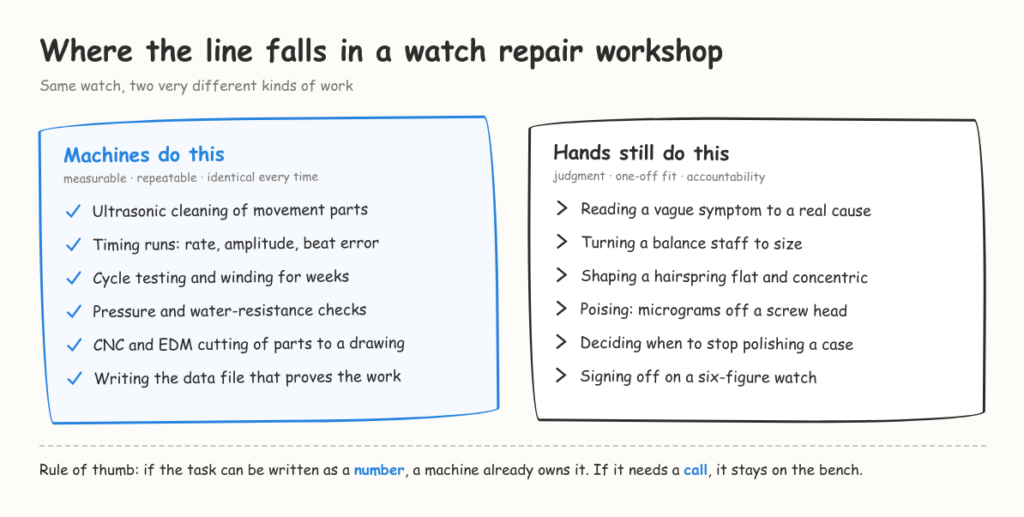
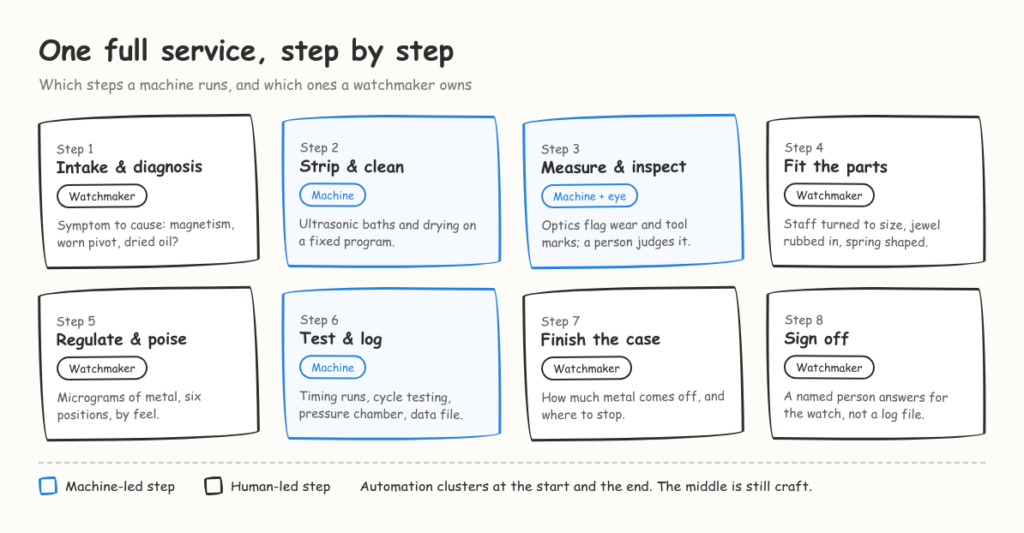
Most automation in service centers does not look like a robot arm. It looks like a row of quiet gray boxes. For instance, ultrasonic cleaning machines run movement parts through solvent baths and drying cycles on a fixed program. Electronic timing machines listen to the escapement and report rate, amplitude, and beat error in 5 or 6 positions within minutes, work that once took days of wrist trials.
Cycle testers wind and shock a luxury watch for weeks to simulate real wear. Pressure chambers confirm water resistance to the exact rating stamped on the case back. Automatic winders and demagnetizers handle setup steps that used to eat bench hours.
CNC mills and wire EDM machines output has changed the market too. Buyers browsing a specialist marketplace like ChronoStreet now expect a printed timing report and a documented service history before they pay five figures for a pre-owned piece, and those documents come straight off automated test benches.
The pattern is clear. According to Aiman Moner, an expert watchmaker at ChronoStreet, machines win where the task is measurable, repeatable, and identical from one luxury watch to the next. They also win on records. Every test cycle writes a data file, so we can prove exactly what it did and when.
The Work Machines Still Can’t Take
Robotics and machines still can’t carry out functions like:
Diagnosis
Diagnosis is the first wall. A customer says the luxury watch “runs fast sometimes.” That one symptom can point to a magnetized hairspring, a worn pivot, dried oil, a loose stud, or a hairspring touching the regulator pins. No machine picks the cause. A watchmaker forms a theory, opens the movement, and tests that theory under a microscope. Vision systems can flag that amplitude is low; they can’t tell you why.
Hand-Fitting
Hand-fitting is the second wall. Vintage and high-complication work almost never involves a drop-in replacement part. A new balance staff gets turned to size, a jewel gets rubbed in, a hairspring gets shaped by hand until it breathes evenly and stays flat and concentric.
Poising a balance means removing micrograms of metal from a screw head based on how the wheel behaves in six positions. The feedback loop runs through fingertips and loupe, and the tolerance is judgment, not a number on a spec sheet.
Finishing
Case refinishing decides how much metal to remove on the luxury watch, where the original brushed and polished lines sat, and when to stop. Over-polishing a vintage case destroys value permanently. That’s a taste and value call, not a programmable tool path.
Then, there is accountability. When a $60,000 chronograph leaves my bench, I sign off on it. Owners and insurers want a person who can explain a decision, not a log file from an unattended machine, says Aiman Moner.
The Economics Explain the Rest
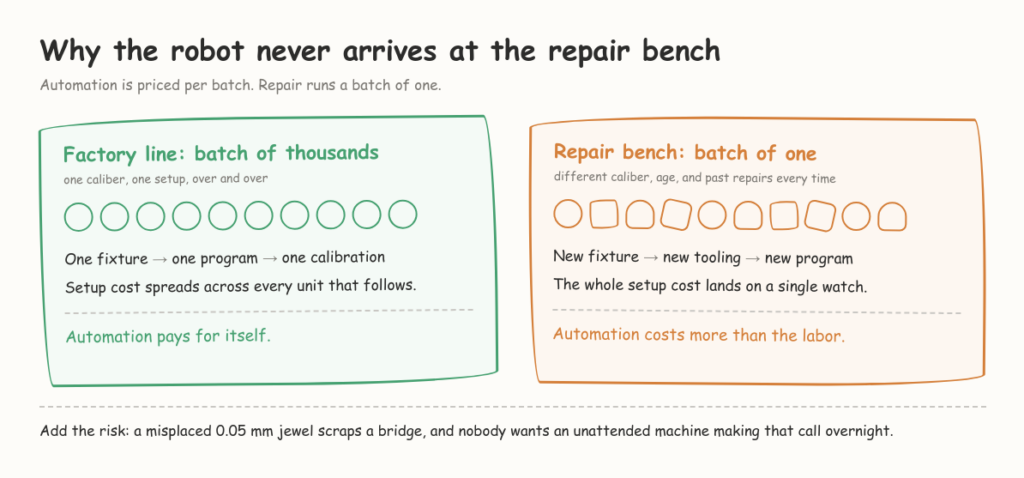
Even where automation is technically possible, math usually kills it. Industrial robots pay off on batch sizes in the thousands. A repair workshop runs a batch size of one. Every watch arrives with a different caliber, a different age, and a different history of past repairs, some of them botched. A robot cell would need a custom fixture, custom tooling, and custom program for each of those jobs, which costs far more than the labor it replaces.
There is also a risk cost. A misplaced 0.05-millimeter jewel means a scrapped bridge, and no shop wants an unattended machine making that mistake overnight. Factory service centers that handle one caliber family at volume can justify real automation. An independent shop servicing 40 different movements a month can’t, explains Aiman Moner.
What Changes in the Next Five Years for Luxury Watch Repair
Here is what Aiman Moner, the watchmarker at ChronoStreet, expects in the next 5 years.
The Realistic Gains are in Software
Machine vision paired with trained models is already good at sorting worn or counterfeit parts, spotting tool marks, and grading surface wear faster than a tired eye at hour seven. Expect that to move from demos into everyday intake, where it can flag fake components before a service quote goes out.
Digital Service Records
This is the second shift. Brands are attaching movement data and service history to a digital identity tied to each watch, which raises resale confidence and makes fraud harder.
On-Demand Parts
CNC work and metal 3D printing keep lowering the cost of one-off components for discontinued calibers, which is often the difference between a restorable watch and a parts donor.
Augmented Reality
AR overlays and camera-guided benches let a senior watchmaker supervise a junior remotely, which is important because the trade is losing experienced people faster than schools replace them. None of these replace a watchmaker. They shorten the slow parts of the job and make errors easier to catch early.
What This Means If You Own the Luxury Watch
- Ask for the timing report: A shop with proper test gear will hand you rate, amplitude, and beat error in multiple positions, before and after service.
- Ask who does the hand-work: The name and training of the watchmaker are important more than the equipment list on a website.
- Ask what happens to the case: Get a written “no polish” or “light polish only” instruction if the watch is vintage.
- Ask about parts sourcing: Factory parts, salvaged originals, and machined replacements carry very different effects on future value.
- Keep the paperwork: Service documentation is now part of the asset, not just receipt.
Robotics and Luxury Watch Repairs: The Honest Split
Robotics has not automated watch repair. It has automated the parts of watch repair that were never crafted in the first place: scrubbing, measuring, timing, pressure testing, and cutting stock to a drawing. That’s real progress, because it frees skilled hours for work that genuinely needs a human.
It helps a watchmaker read an ambiguous symptom, shaping a part to fit one specific movement, and deciding what a 1968 case should look like when it goes back on a wrist. Aiman Moner says the bench is not disappearing; it is just getting better instruments.