
Modern engineering is a famously fast-moving discipline. So, whether professionals in this field are carrying out work on electrical installations, industrial automation systems, renewable energy projects, or manufacturing facilities, they need to look for solutions that serve their needs right now, rather than what might have sufficed five, 10, or 20 years ago.
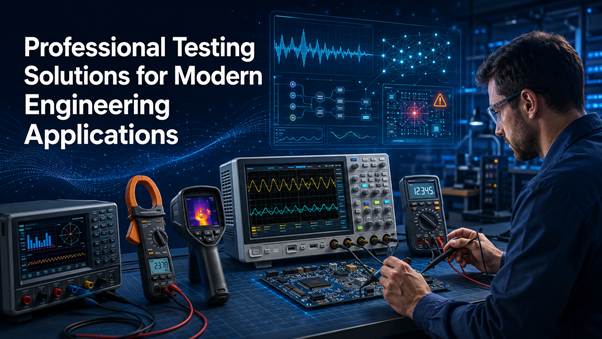
This is no less the case as far as the priority of achieving accurate testing and measurement is concerned. The broad range of electrical testing equipment from RS can greatly help with the diagnosis of faults, the verification of performance, and the maintenance of operational standards.
Inevitably, as technology continues to advance, demand heightens for the precise and dependable testing equipment that can best work alongside it.
Modern engineering applications call for the use of sophisticated instruments that can deliver accurate readings in challenging environments. All the while, these tools and devices must facilitate efficient workflows and help achieve regulatory compliance.
Key Takeaways
- Engineering requires modern testing equipment for accurate results, addressing current rather than outdated standards.
- Key tools include high-speed digital diagnostics like oscilloscopes, LCR meters, and BERTs for evaluating complex signals.
- Power quality analysers and thermal imaging cameras help ensure infrastructure reliability by diagnosing hidden issues.
- Multimeters and multifunction testers (MFTs) are essential for safety and compliance testing within electrical systems.
- Choosing high-quality testing solutions enhances performance and compliance, reinforcing the importance of professional tools.
Table of contents
Examples of Professional Testing Equipment That Matter Today
The most suitable professional electrical testing equipment for engineering projects in the 2020s spans such important areas as power systems validation, radio frequency (RF) communications, high-speed digital circuit debugging, and safety compliance.
As far as modern applications are concerned, it can greatly help engineers to have access to smart, automated, and software-integrated instruments that are capable of capturing highly dynamic real-world signals.
High-Speed Digital and Component Diagnostics in Modern Engineering
This category encompasses such devices as real-time mixed-signal oscilloscopes, LCR meters, and bit error rate testers (BERTs).
Oscilloscopes, for instance, are able to visualise electrical signals as time-based waveforms. This allows for the detection of high-frequency noise and voltage drops.
LCR meters, meanwhile, calculate high-precision inductance (L), capacitance (C), and resistance (R). Engineering professionals place their trust in these devices for micro-component validation and rigorous quality control.
As for BERTs, these tools test how cleanly digital data travels through a system. They evaluate data stream integrity across advanced high-speed digital links such as 5G infrastructure, PCIe, and modern fibre networks.
Power Quality and Infrastructure Auditing
A key tool under this banner of modern engineering is a power quality analyser (PQA), an advanced tool that measures and records electrical grid performance over time.
A PQA can be likened to an EKG (heart monitor) for a building’s electricity. Through its capture of voltage, current, and frequency, it uncovers hidden disturbances such as sags, spikes, and distortions that can damage sensitive equipment.
Also often playing a significant role in professional testing are thermal imaging cameras. These devices are highly effective in identifying localised resistive heating or load unbalances in dense circuit designs and substations. This, in turn, allows for timely intervention before physical components have a chance to fail.
Clamp meters, too, are hugely important electrical testing tools for many applications. Recognisable by their hinged jaws that open to grip around a wire or cable, clamp meters allow for electrical current to be safely measured, without the engineer needing to disconnect the wire or interrupt the circuit.
Safety, Compliance, And Installation Testing in Modern Engineering
Multimeters are commonly used for all three of these purposes. They can help ensure safety, for instance, by measuring whether a circuit is dead (proving dead) before work commences.
An engineer may also use a multimeter to verify that voltage and current levels in a circuit fall within safe, legal limits. Plus, this instrument can be invaluable for checking wiring resistance, verifying fuses, and making sure there are no shorts or open circuits before powering on.
With all this acknowledged, it is crucial to note that multimeters have their limitations, professionals generally using these tools to check basic parameters. As far as full compliance testing is concerned, it is dedicated multifunction testers (MFTs) or insulation testers that represent the industry standard.
Combining several different test tools into one device, MFTs are all-in-one instruments for professionals who need to check the safety and wiring of electrical systems. They allow for electrical setups to be certified to regulatory safety guidelines via comprehensive loop, Residual Current Device (RCD), and phase rotation testing.
Conclusion: Never Underestimate the Importance of Professional Solutions
Whatever specific testing device or instrument an engineer might require for their latest project, they should never be in doubt about the crucial role that professional solutions will play in helping them achieve their objectives.
By taking the time and care to select high-quality testing tools and adopting modern diagnostic practices, modern engineering personnel can ensure long-term reliability, compliance, and performance across a broad range of environments.