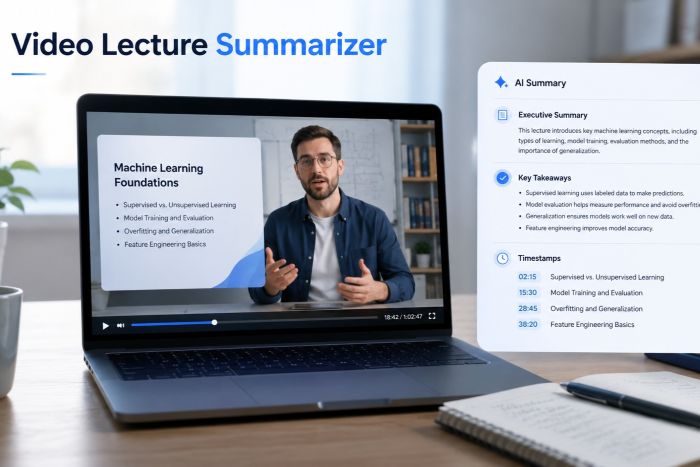
Online learning has made education more flexible, but it has also created a new problem: there is too much video content to watch. A single lecture can run for 45 minutes. A recorded university class may be over an hour. A webinar, training session, or technical walkthrough can take even longer. For students, professionals, researchers, and lifelong learners, watching every minute is not always possible. That is where a educational video summarizer becomes useful.
Instead of sitting through a full lecture just to find the main points, a summarizer helps turn long video lessons into shorter notes, key ideas, topic sections, and study-friendly takeaways. It does not replace learning, but it makes learning easier to manage.
For anyone using YouTube lectures, online courses, recorded classes, webinars, or educational videos, a video lecture summarizer can save time and make review sessions more focused.
Table of contents
- What Is an Educational Video Summarizer?
- Why Video Lectures Are Hard to Review
- How an Educational Video Summarizer Works
- Who Can Benefit From a Video Lecture Summarizer?
- What Makes a Good Video Lecture Summarizer?
- Video Lecture Summarizer vs Transcript
- How to Use a Video Lecture Summarizer for Better Study
- Where IsThisClickbait Fits In
- Common Use Cases for Video Lecture Summaries
- What a Video Lecture Summarizer Cannot Do
- Best Practices for Using Lecture Summaries
- Why Video Lecture Summarizers Are Becoming More Useful
- Final Thoughts
What Is an Educational Video Summarizer?
A video lecture summarizer is a tool that takes a long educational video and creates a shorter version of its main ideas. It usually works by reading the transcript, captions, or spoken content from the video. Then it organizes the information into a summary that is easier to review.
A good summarizer can help you understand:
- What the lecture is mainly about
- Which concepts are covered
- What key points you should remember
- Which parts may need deeper study
- Whether the video is worth watching in full
This is helpful because lectures are not always easy to scan. With a blog article, you can skim headings. With a video, you often need to scrub through the timeline until you find the useful section. A summarizer gives you a faster starting point.
A video lecture summarizer helps reduce that friction. It gives you a structured view of the lesson so you can decide what to watch, what to skip, and what to study again.
Why Video Lectures Are Hard to Review
Video is great for teaching, especially when the topic needs visuals, examples, diagrams, or screen sharing. But it is not always the best format for quick review.
A lecture may include:
- Long introductions
- Repeated explanations
- Examples that only apply to one part of the lesson
- Side discussions
- Questions from students
- Slow pacing
- Important points spread across the full video
This makes review difficult. If you want to prepare for an exam, write notes, understand a missed class, or revisit one concept, you may not want to replay the entire lecture.
A video lecture summarizer helps reduce that friction. It gives you a structured view of the lesson so you can decide what to watch, what to skip, and what to study again.
How an Educational Video Summarizer Works
Most video lecture summarizers follow a simple process.
First, the tool needs access to the lecture content. This may come from a video transcript, captions, uploaded audio, or a YouTube video. Once the content is available as text, AI can review it and identify the important points.
Then the tool creates a summary. Depending on the platform, this may include a short overview, detailed notes, timestamps, key terms, questions, or chapter-style sections.
A basic workflow may look like this:
- You add a lecture video or link.
- The tool reads the transcript or audio.
- It identifies the main concepts.
- It creates a summary or notes.
- You use the output to review faster.
The best tools do not only shorten the lecture. They organize it in a way that helps you learn.
Who Can Benefit From a Video Lecture Summarizer?
A video lecture summarizer is useful for many types of learners. It is not only for students.
Students
Students often deal with recorded lectures, online classes, exam review videos, and tutorial content. A summarizer can help them review faster and create cleaner study notes.
It can be especially useful when students need to:
- Catch up on missed lectures
- Review before exams
- Understand long lessons faster
- Compare multiple explanations of the same topic
- Pull key points for revision
- Create study notes from video classes
The tool is not a replacement for active study, but it helps students spend less time searching for important points.
Teachers and Trainers
Teachers can also benefit from lecture summaries. A recorded class can be turned into notes for students, a recap for absent learners, or a study guide for later review.
Trainers can use summaries to create follow-up materials after a workshop or webinar. This helps learners retain the main points after the session ends.
Professionals
Professionals often watch training videos, certification lessons, product walkthroughs, and industry webinars. These videos may contain useful information, but they can be hard to revisit during a busy workday.
A video lecture summarizer can help professionals pull out practical takeaways without replaying the full recording.
For example, a marketer may summarize a webinar on conversion tracking. A developer may summarize a technical tutorial. A manager may summarize leadership training. The summary becomes a quick reference instead of another long video saved for later.
Researchers and Writers
Researchers often review lectures, interviews, conference talks, and expert presentations. A summarizer can help them understand which videos deserve deeper attention.
This is useful during early research. Instead of watching ten full lectures, a researcher can summarize them first, identify the strongest sources, and then watch the most relevant sections carefully.
What Makes a Good Video Lecture Summarizer?
Not every summarizer is equally useful. Some only create a short paragraph. Others give structured notes that are easier to study from.
A strong video lecture summarizer should offer more than a vague overview. It should help users understand the lecture clearly. A strong video lecture summarizer should offer more than a vague overview. It should help users understand the lecture clearly. A good educational video summarizer should also organize information in a way that improves review and retention.
Look for features like:
- Clear main summary
- Key takeaways
- Topic breakdown
- Timestamped sections
- Transcript access
- Important terms or concepts
- Easy copy and note-taking options
- Support for long videos
- Simple layout
- Follow-up question support
For educational content, structure matters. A summary that says “this lecture explains economics” is not enough. A better summary explains which economic ideas were covered, how they connect, and which parts matter most.
Video Lecture Summarizer vs Transcript
A transcript and a summary are not the same thing.
A transcript gives you the full spoken text. It is useful when you need exact wording, quotes, or complete context. But transcripts can be long and hard to scan.
A summary gives you the shorter version. It helps you understand the main points faster.
For studying, both can be useful. The summary helps you get the overview. The transcript helps when you need to check details.
For example, if you are reviewing a medical lecture, the summary may show you the main topics covered. But if you need the exact explanation of a process, you may still go back to the transcript or video.
The best workflow is to use the summary first, then go deeper where needed.
How to Use a Video Lecture Summarizer for Better Study
A summarizer works best when it is part of a study process, not the whole process.
Start by reading the summary before watching the full lecture. This gives you context. You will know what topics are coming and what to listen for.
Then watch the sections that matter most. If the lecture has timestamps, use them to jump to the important parts. After that, add your own notes. This step is important because AI summaries are helpful, but your own understanding matters more.
A simple study workflow may look like this:
- Summarize the lecture.
- Read the key points.
- Watch the important sections.
- Write your own notes.
- Turn the notes into questions.
- Review again before exams or meetings.
This makes the summarizer a learning aid instead of a shortcut.
Where IsThisClickbait Fits In
Many lectures, webinars, and educational videos are published on YouTube. That includes university-style lessons, public talks, tutorials, podcast-style education, conference sessions, and online training.
For YouTube-based learning, IsThisClickbait can help users understand what a video actually covers before watching the full lecture. It can provide AI analysis, a concise summary, key points, and follow-up Q&A for YouTube videos.
This is useful when the title of a lecture sounds promising, but you are not sure if it covers the information you need. Instead of spending 30 minutes checking manually, you can get a quick overview and decide whether the video is worth deeper study.
It is especially helpful for students, marketers, researchers, and professionals who use YouTube as part of their learning routine.
Common Use Cases for Video Lecture Summaries
A video lecture summarizer can be used in many learning situations.
For example, a student can use it to recap a recorded class before an exam. A professional can use it to review a technical training session. A content writer can use it to understand a public lecture before writing an article. A researcher can use it to compare expert talks on the same topic.
It can also help with:
- Exam revision
- Online course review
- Webinar notes
- Technical training
- YouTube education videos
- Conference talks
- Internal company training
- Language learning videos
- Product tutorials
- Academic lectures
The main value is not only saving time. It is also making information easier to organize with an educational video summarizer.
What a Video Lecture Summarizer Cannot Do
A video lecture summarizer is useful, but it has limits.
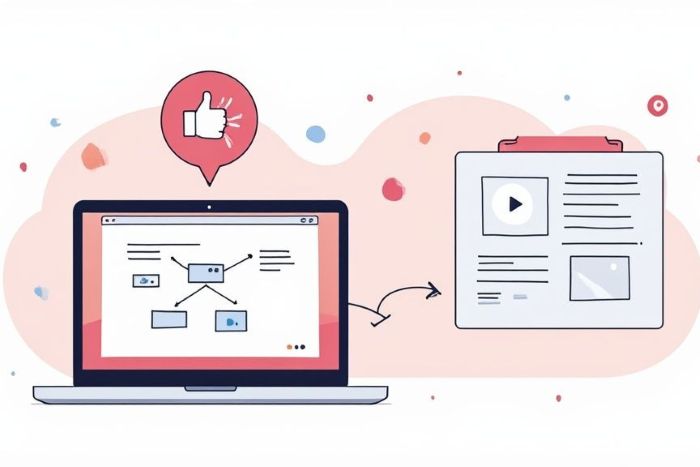
It may miss visual details from slides, diagrams, charts, or screen recordings. It may also simplify complex explanations too much. If the transcript is poor, the summary may also be less accurate.
This matters for topics where details are important, such as medicine, law, engineering, finance, or technical training.
You should use a summarizer as a guide, not as the only source of learning. When the topic is important, always review the original video, transcript, or course material.
A summary can help you find the right sections faster, but it should not replace full understanding.
Best Practices for Using Lecture Summaries
To get the most value from a video lecture summarizer, use it carefully.
Do not simply copy the summary and assume you understand the topic. Read it, then test yourself. Ask what the main idea means, how the concepts connect, and what examples support them.
Also, compare the summary with the original video when needed. This is especially important if you are using the lecture for exams, research, client work, or professional decisions.
The strongest learners use summaries to improve review, not avoid learning.
Why Video Lecture Summarizers Are Becoming More Useful
Online learning is not slowing down. More courses, tutorials, expert talks, and training sessions are published as video every day. That creates a lot of opportunity, but also a lot of overload.
A video lecture summarizer helps learners manage that overload.
It gives people a way to move through educational content faster, choose better videos, and return to important ideas more easily. For high-volume learners, this can make a real difference.
Instead of building a long “watch later” list that never gets opened, users can summarize, filter, and prioritize.
Final Thoughts
A video lecture summarizer is a practical tool for anyone who learns from long videos. It helps turn lectures into clearer notes, key takeaways, summaries, and review material.
Students can use it for exam prep. Professionals can use it for training. Researchers can use it to scan expert talks. Teachers can use it to create recaps. Content teams can use it to review educational videos faster.
Tools like IsThisClickbait make this especially useful for YouTube-based lectures and educational videos, where users often need to know whether a video is worth watching before committing their time.
The best way to use a summarizer is not to replace the lecture completely. It is to understand the lecture faster, find the most important sections, and study with more focus using an educational video summarizer.