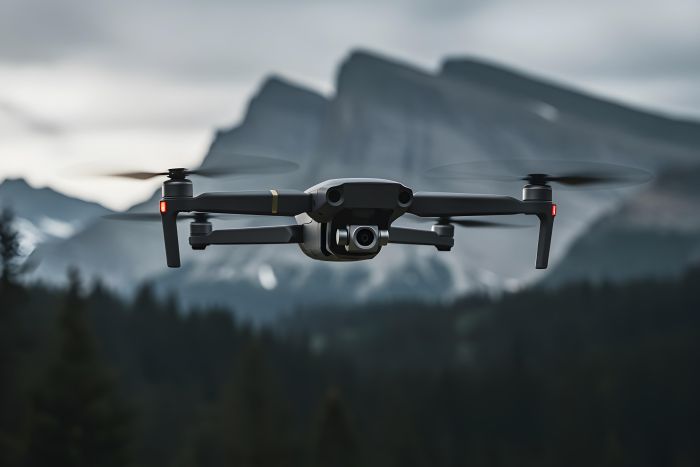
You want to build a drone… or maybe you just want to learn what components makes them work.
Either way — you’re in the right place.
The drone industry is booming. No really…it’s EXPLODING. Whether you fly recreationally, aerial mapping, inspections, or are just a drone geek at heart….knowing the anatomy of a drone will allow you to fly intelligently.
Here’s the deal:
The average newbie learns how to fly a drone, crashes it the first time, and has no idea what just shattered. It’s not your fault — Drone parts can read like alphabet soup. ESC. FC. BLDC. PDB.
But once you know what each component does, everything clicks.
Let’s jump in.
Key Takeaways
- Understanding drone components is crucial for successful flying and building.
- Drones consist of a frame, flight controller, motors & ESCs, propellers, and batteries.
- Quality components ensure reliability; poor parts can lead to crashes or failures.
- The drone market is booming, mainly in commercial sectors, increasing the importance of component quality.
- Beginners should learn the role of each component and start simple to gain experience.
Table of contents
Quick look at what’s coming:
- What Is A Drone Really Made Of?
- The Frame: Your Drone’s Skeleton
- The Brain: Flight Controllers
- Motors & ESCs: The Power Duo
- Propellers, Batteries & Other Essentials
- Why Drone Components Matter More Than Ever
What Is A Drone Really Made Of?
A drone is just a flying robot. That’s it.
But just as with any robot, it’s composed of several smaller robots all working in unison. Should one component malfunction, the entire machine gyrates erratically, flips over, or worse — plummets from the heavens.
The worldwide drone market reached USD 83.8 billion in 2025. It is expected to expand rapidly over the coming decade. There are multiple reasons behind it as drones are being adopted across agriculture, construction, defense, filmmaking, pizza delivery, etc.
It also means more people are purchasing parts, assembling custom builds, and figuring out how everything goes together. Drone suppliers such as Northwest Blue services are enabling hobbyists and professionals to access quality equipment, as a reliable CubePilot distributor that carries flight controllers, autopilot modules, and actual components used by builders.
Ok before you order that drone kit read what every component is.
The Frame: Your Drone’s Skeleton
The frame is the body of the drone.
It contains everything. Motors. Electronics. Battery. Camera. Frames will often be made of carbon fiber, plastic, or wood if you’re cheap.
A good frame should be:
- Lightweight (every gram matters)
- Strong enough to survive crashes
- The right size for your motors and props
- Easy to repair or swap parts on
Frame sizes are measured diagonally from motor to motor. A 5 inch frame is considered to be average for FPV racing sizes. Larger frames (7-inch, 10-inch) have higher payload and will fly longer.
Pick the wrong frame and your build is doomed before it starts.
The Brain: Flight Controller Components
If the frame is the skeleton… the flight controller is the brain.
Flight controller (FC): Small circuit board that sends instructions to the motors. Receives input from your remote and reads sensors to then correct each motor one thousand times per second to stabilize your drone.
Without it, your drone wouldn’t fly. It would just sit there.
A flight controller typically includes:
- A gyroscope (to detect rotation)
- An accelerometer (to detect movement)
- A barometer (to read altitude)
- A processor (to make sense of it all)
Some flight controllers are designed with racing in mind — tiny, speedy, light. Others (such as CubePilot’s line) are meant for heavy duty commercial applications like mapping, surveying, autonomous missions.
Selecting the appropriate FC really depends on what you wish to fly and what you want to fly it for.
Motors & ESCs: The Power Duo
Finally we come to the exciting stuff – what actually makes your drone go.
Motors
The majority of drones today use Brushless DC motors. They power the props which provides lift.
KV rating on motors means RPM per volt. The higher the KV, the faster the motor spins which is better for racing. The lower the KV, the more torque your motor has which is better for things like heavy lifting (cine cameras, delivery package).
When picking motors, look at:
- KV rating (matched to your prop size)
- Stator size (the bigger, the more power)
- Weight
- Heat handling
ESCs (Electronic Speed Controllers)
The ESC is the middleman between the flight controller and the motor.
The flight controller instructs the ESC how quickly to rotate the motor. The ESC then converts DC power from the battery into 3-phase AC power usable by the brushless motor.
Without an ESC, your motors literally won’t spin. End of story.
Modern ESCs also handle:
- Speed regulation
- Direction changes
- Braking
- Protection from current spikes
ESCs are available either as individual units or as a single “4-in-1” board which controls all four motors on one PCB. Both are perfectly acceptable — it’s merely a matter of personal preference.
Propellers, Batteries & Other Essential Components
The other elements may not receive all the hype, but they’re important too.
Propellers
Props convert motor power into thrust. They vary in size (5-inch, 7-inch, 10-inch etc) and pitch. Larger props spool more air, requiring more powerful motors. Pitch is a tradeoff between speed and efficiency.
Carry spares. You will break them.
Batteries
Most drones use LiPo (lithium polymer) batteries. The key specs are:
- Voltage (S): 4S has 4 cells, 6S has 6 cells, etc.
- Capacity (mAh): Bigger = longer flight times, but heavier
- C-rating: How fast it can discharge power
LiPos pack a lot of power but can be destructive if abused. Keep charging them in a fireproof bag. Never puncture them. Never leave them in direct sunlight.
Receiver, GPS & Camera
The receiver receives signals from your transmitter (aka your remote control). GPS allows your drone to hold position, return home, or fly waypoints. The camera is used either for FPV flying or recording footage.
These are the “extras” — but a serious drone build needs all of them.
Why Drone Components Matter More Than Ever
Here’s something most beginners don’t realise…
Commercial drones make up 70% of drone revenue. The market share keeps increasing annually.
It also means component quality is more important than ever. A cheap ESC can fail mid-flight. Poor quality flight controllers can cause your drone to crash into a tree. Flimsy frames can break when they get a hard landing.
When building anything more than a toy quadcopter (mapping, inspections, surveying, commercial use, etc.), purchase quality proven parts from reputable suppliers.
That’s what separates an enduring drone from junk.
Putting All Components Into Action
There you have it — the core components that make a drone fly.
To quickly recap:
- Frame: the skeleton
- Flight controller: the brain
- Motors & ESCs: the muscle
- Props: the lift
- Battery: the fuel
- Receiver, GPS, camera: the senses
Building or purchasing a drone isn’t nearly as scary when you know the purpose of the components. Start simple. Crash it. Learn from your builds.
And never forget — every expert pilot was once a bewildered newbie looking at a pile of strange parts.
Now go fly.