Brian Foo expected feedback from a few hundred users in spring 2020. Citizen DJ, his Library of Congress audio prototype, drew nearly 100,000 unique sessions within a couple of weeks. Foo was its sole developer, designer and product owner. Thousands of messages left him choosing priorities for the remainder of his residency.
Key Takeaways
- Brian Foo launched Citizen DJ, a Library of Congress audio prototype, expecting hundreds of users but received nearly 100,000 sessions.
- He prioritized user feedback to enhance the product, focusing on making the experience about discovering sounds rather than just producing music.
- Foo designed Citizen DJ to allow users to browse audio by ear and encouraged interactions that would guide future development.
- The platform offers downloadable WAV files for music production and MP3s for previewing, creating a structured approach to audio file management.
- By engaging the public and collaborating with artists, Foo showcased innovative uses of the Library’s audio collections.
Table of contents
Open the prototype while changes still matter
Today, a producer can turn Citizen DJ’s downloadable loops into a finished WAV mix. Convertio’s wav to mp3 tool converts that WAV mix into an MP3 file for review. Keep the WAV for further editing; send the MP3 when the reviewer only needs to listen.
Foo invited the public to try Citizen DJ at the end of April 2020. His examples included an old recording called Santa Claus hides in your phonograph. A laugh about thirty seconds into the recording caught his attention. He suggested sampling Santa’s laugh for a new track with a darker mood.
The beta offered about 300 hours drawn from six Library collections. Staff had picked material that people could reuse without asking for special permission. Foo’s invitation explicitly covered selling the new music made from these recordings. Musicians could also perform that work or give it away without requesting special permission.
Foo pointed listeners to Booker T Jones about twenty minutes into a Joe Smith interview. Jones speculated about groups of musicians appearing at particular times and places. That example came from Smith’s collection of personal interviews with well-known musicians. Foo asked testers if they could find interesting sounds and make something new.
Their reactions would guide the remaining months of Foo’s work on the prototype. He sought responses from experienced musicians and newcomers to music-making alike. The next changes could affect the interface, its features and the supporting guides.
Keep the product focused on discovery
Foo started with problems that prevented people from using Citizen DJ. The Library’s user experience team gathered answers through an online activity. He worked on device support and compatibility with digital audio workstations first.
Requests for music-making controls then competed for his remaining development time. A swing function and custom sounds appeared among the requested features. Foo chose to help producers find sounds for Ableton and Fruity Loops. His September account draws a useful boundary between discovering sounds and producing a track.
“discovery and access of sounds for music making” (Brian Foo, September 2020).
One requested feature let listeners change where a sample began and ended. They could download a finished pattern as a WAV loop for their music software. Users could also save their patterns and add more drum tracks.
Let people browse with their ears
Foo used 85 Edison items with audio for the example in his processing notes. He wanted similar sounds to sit beside one another in the browsing grid. He cut the audio at detected sound onsets before analysing each sample. His selection criteria favoured strong sounds and a clear musical pitch.
He wanted clips from different recordings to appear in the sample set. Consecutive clips could preserve the context of a speech or musical phrase. A visitor can open the original recording and hear the sample in context. Before adapting the grid, check whether each clip starts and ends at a useful point in its phrase.
The project reached a public musical test at September’s National Book Festival. Kid Koala and youth-focused organisations joined a showcase of music made from the Library’s collections. The Library’s December Gazette documented the collaboration. Students and educators had a place to hear the samples used in new work.
Read Next
A few related pieces worth your time:
- 9 Best Call Center Coaching Software Tools, Sorted by Coaching Style
- How Employees Fake Activity (Mouse Jigglers) and How to Detect It
- Video Converter: How a $90 Lifetime License Became Permanently Free
Give each audio file a job
Visitors to the current Edison collection downloads can choose a package for production or preview. Both download packages contain the same 4,361 automatically generated samples. Citizen DJ offers the 636.4 MB WAV download to people making music. Its 118.5 MB MP3 download lets visitors preview those sounds at 192 kbps.
The WAV package uses 16-bit audio. Someone browsing the collection can listen to MP3 files before choosing a sound. A producer can download the WAV files and work on them in music software.
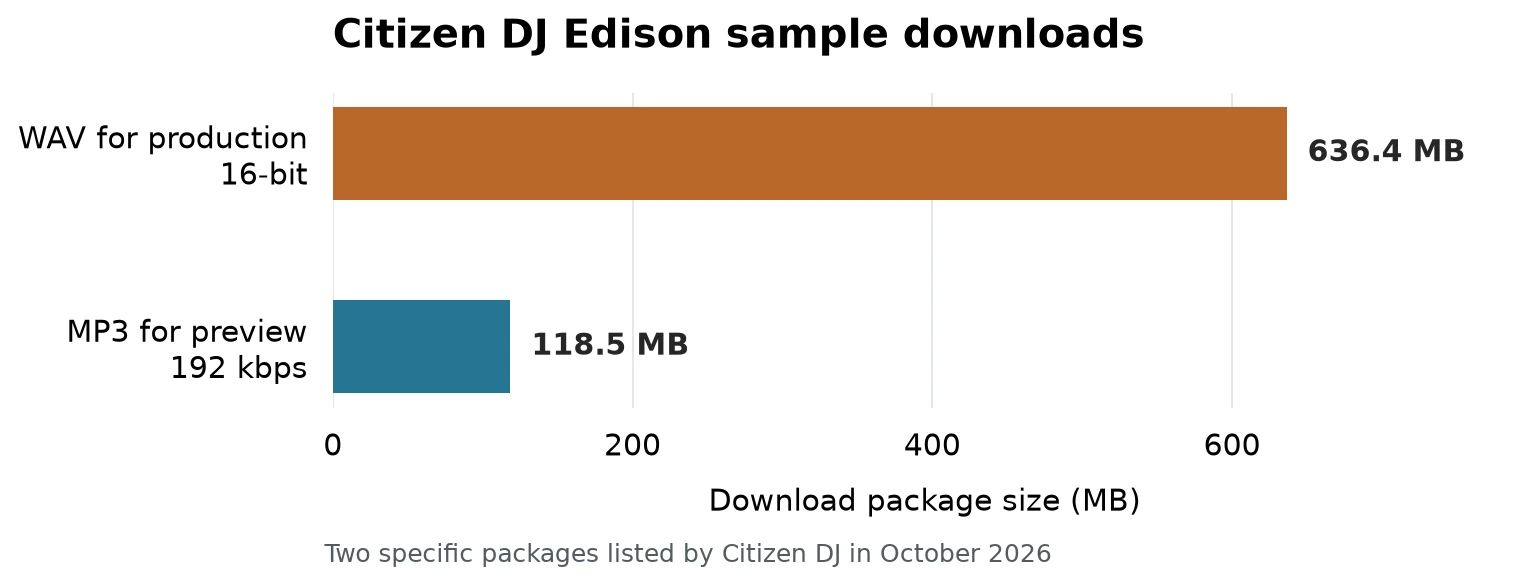
Edison sample packages listed by Citizen DJ in October 2026. Source: Citizen DJ, Library of Congress.
Ask the reviewer to compare a particular edit, such as the cut between two samples. The producer can keep the WAV and send an MP3 copy to a reviewer. On Convertio, the producer uploads the WAV and downloads the converted MP3 file. Convertio processes the conversion on its cloud servers. The MP3 copy loses some audio information and serves as a separate listening file.
| Task | File choice | Purpose |
| Browse the Edison samples | 192 kbps MP3 package | Preview the collection |
| Produce a track | 16-bit WAV package | Work with the samples |
| Review a finished mix | MP3 copy of the mix | Listen and comment |