


If you are researching a BeeReaders review, you are probably weighing Spanish literacy tools at a moment when the stakes are unusually high, since English learners’ average language proficiency in US schools still sits below pre-pandemic levels even after growth finally picked up in the 2024 to 2025 academic year (Source: WIDA, University of Wisconsin-Madison).
Schools serving bilingual and dual language students need reading platforms that meet kids in the language they actually think in. BeeReaders built its entire product around that idea.
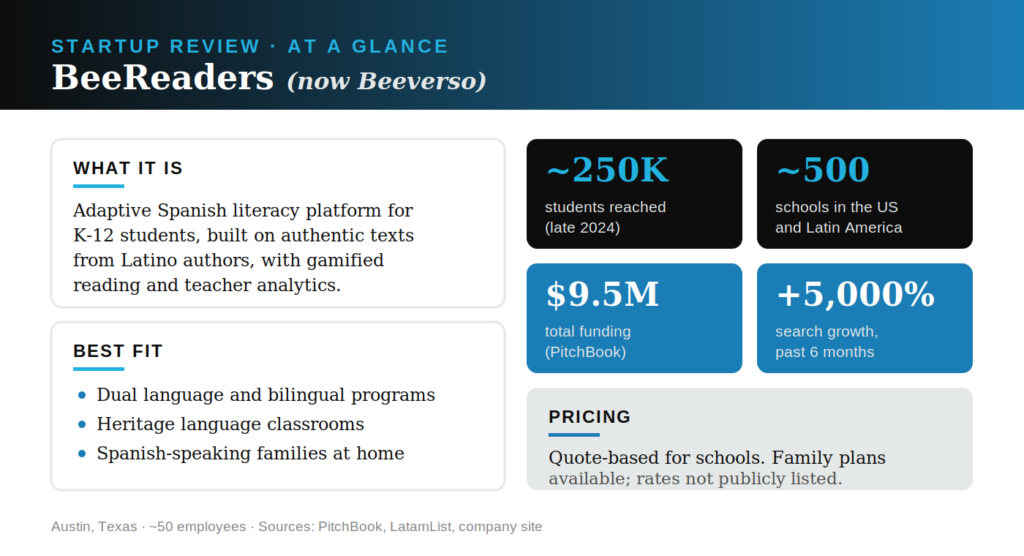
One thing to know up front. BeeReaders recently rebranded as Beeverso, and its web presence now lives at beeverso.org alongside the original domain. Same company, same platform, new name. Search interest in the BeeReaders brand has surged anyway, up an estimated 5,000 percent over the past six months according to Exploding Topics data, which is why the platform keeps landing on trending startup lists. This review covers what the platform does, who it fits, where it falls short, and what else deserves a look.
Key Takeaways
- BeeReaders (now Beeverso) is an adaptive Spanish reading platform for K-12 students.
- The library features authentic texts from Latino authors across the Spanish-speaking world.
- Teachers get tiered reporting, progress tracking, and assignment tools.
- School pricing is quote-based and not publicly listed.
- Newsela Español and Raz-Plus are the closest alternatives.
What BeeReaders Does
BeeReaders is a supplemental digital reading platform focused on Spanish literacy for K-12 students. The Austin, Texas company serves bilingual, dual language, and heritage language programs across the United States and Latin America, and by late 2024 it had reached roughly 250,000 students in about 500 schools.
The core promise is simple. Students read authentic Spanish texts, short challenges and full books, matched to their level. The platform adapts as they improve. Comprehension quizzes and scaffolds sit inside the reading experience, and a gamified layer of rewards keeps younger readers moving. Teachers see all of it in a reporting dashboard.
What separates BeeReaders from generic reading apps with a Spanish toggle is the content itself. The library is curated from Latino authors across the Spanish-speaking world rather than translated from English originals. For heritage speakers, that cultural authenticity is the point, not a bonus.
Key Features
Adaptive leveling
Every student reads at their measured level. The system assesses comprehension continuously and adjusts text difficulty, so a fifth grader reading below grade level and one reading above it both stay in productive range. Teachers can also split a class into tiers and assign texts by tier or by individual student.
Authentic Spanish library
Thousands of short texts and hundreds of books span fiction and nonfiction. Content comes from across the Spanish-speaking world, which matters for classrooms where students’ families trace to Mexico, Colombia, Puerto Rico, or anywhere else Spanish is spoken. Publishers of translated content rarely match this.
Gamified reading experience
Points, challenges, and rewards wrap around the reading itself. Comprehension checks are embedded in the texts rather than bolted on afterward. The design goal is habit formation, getting kids to read more because they want the next challenge.
Teacher analytics and reporting
The reporting system tracks each student’s progress, flags comprehension gaps early, and generates individualized reports. For districts in Texas, the platform positions itself around STAAR and TELPAS preparation, a practical hook for schools accountable to those assessments.
Family access
Companion apps let parents monitor reading progress at home. The platform works in browsers and as a mobile app, so it travels between classroom and living room without friction. Similar flexibility shows up across the current wave of AI-powered edtech tools built for hybrid learning.
Who It Is For
BeeReaders fits three groups best. Dual language and bilingual programs are the obvious core audience, since the platform was built for exactly that instructional model. Heritage language classrooms come second, where the authentic content earns its keep. Third, Spanish-speaking families in the US or Latin America who want structured reading practice at home.
It is not a general-purpose literacy suite. Schools looking for one platform to cover English and Spanish reading instruction end to end will find BeeReaders intentionally narrow. That focus is a feature for the right buyer and a limitation for everyone else, a trade-off worth understanding before any education software purchase.
Pricing
School and district pricing is not publicly listed. Like most K-12 vendors, the company quotes based on enrollment and scope, so expect a sales conversation. Family subscription plans exist for home use, though current rates are not published either. Budget-conscious districts should request a pilot before committing.
Funding and Traction
The company has raised roughly 9.5 million dollars in total funding according to PitchBook, including a 3.5 million dollar round in late 2024 aimed at expanding across Latin America and the US. Investors include Alive Ventures, EWA Capital, and University Venture Fund. Headcount sits just above 50 employees.
Those are modest numbers by edtech standards, which cuts both ways: the company is lean and focused, but it lacks the war chest of the category giants it competes against. The role of edtech startups has always been to move faster than incumbents, and BeeReaders is betting focus beats scale.
Pros and Cons
Pros
- Authentic Spanish content from Latino authors, not translations
- Adaptive leveling that works for mixed-ability classrooms
- Strong teacher reporting with tier-based assignment tools
- STAAR and TELPAS alignment for Texas districts
- Works online, offline, and on mobile devices
Cons
- No public pricing, which slows evaluation
- Spanish-only focus means it cannot replace an English literacy platform
- The rebrand to Beeverso creates short-term brand confusion
- Smaller content library than giants like Newsela
- Limited third-party efficacy research compared to established competitors
BeeReaders Alternatives Worth Considering
Newsela is the closest well-funded competitor, and its Newsela Español line offers leveled Spanish news content at scale. Learning A-Z’s Raz-Plus includes a substantial Spanish leveled-book library that many dual language programs already use. Istation Español covers Spanish reading with a heavier assessment emphasis.
None of the three matches BeeReaders on authentic Latino-authored content, but all three bring bigger libraries and longer track records. A deeper comparison deserves its own piece, and the short version is this: choose BeeReaders for cultural authenticity and dual language focus, choose the bigger platforms for breadth.
Conclusion
BeeReaders, now operating as Beeverso, earns its trending status honestly. It solves a specific, underserved problem, Spanish literacy for K-12 students, with authentic content and adaptive mechanics that generic platforms do not replicate. If you run a dual language or heritage language program, it belongs on your shortlist.
Go in with clear eyes. You will need to request pricing, you should ask hard questions about efficacy data, and you should confirm how the Beeverso transition affects contracts and support. Pilot it with one grade level, watch the reading data for a semester, and let your students’ engagement make the call.
Read Next
Keep exploring how technology is reshaping the classroom:
- How AI and EdTech Are Redefining the 21st Century Educators
- Top Trends in Education Software Development for 2025 and Beyond
- How AI-Powered EdTech Is Transforming Virtual Education
Frequently Asked Questions
BeeReaders is an adaptive digital reading platform that builds Spanish literacy skills for K-12 students. It combines authentic texts from Latino authors, embedded comprehension quizzes, and a gamified experience, with reporting tools for teachers and parents. The company recently rebranded as Beeverso.
Yes, BeeReaders and Beeverso are the same company and platform. The rebrand to Beeverso happened recently, and the product now lives at beeverso.org. Features, content, and the education mission carried over unchanged.
BeeReaders does not publish school or district pricing, so costs are quote-based and depend on enrollment. Family subscription plans are available for home use. Contact the company directly for current rates.
BeeReaders works best for dual language programs, bilingual classrooms, heritage language courses, and Spanish-speaking families. It targets K-12 students and supports both classroom and at-home reading practice on web and mobile.
The strongest BeeReaders alternatives are Newsela Español, Raz-Plus from Learning A-Z, and Istation Español. All three offer leveled Spanish reading content, though none matches BeeReaders’ emphasis on authentic Latino-authored texts.







 offers K-12 Spanish literacy programs, from adaptive reading levels to teacher analytics.)