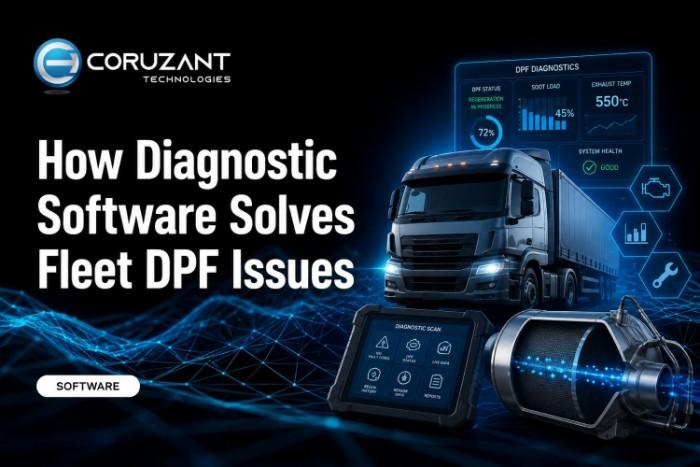
Modern fleet operations depend on more than reliable engines they rely on data, software, and intelligent diagnostics to keep vehicles moving. Every hour a heavy-duty truck spends in the workshop can delay deliveries, increase operating costs, and reduce profitability. As emissions regulations become stricter, diesel trucks have evolved into software-controlled machines equipped with electronic control modules (ECMs), Diesel Particulate Filters (DPFs), exhaust sensors, and advanced aftertreatment systems.
While these technologies significantly reduce emissions, they also introduce new maintenance challenges. DPF blockages, failed regeneration cycles, injector faults, and sensor failures are among the leading causes of reduced engine performance and unexpected downtime. Rather than relying solely on mechanical inspections, fleet operators are increasingly adopting diagnostic software and predictive maintenance strategies to identify problems before they become costly repairs.
Table of contents
Key Takeaways
- Modern fleet maintenance depends on software-driven diagnostics as much as mechanical expertise.
- DPF blockage remains one of the leading causes of downtime in diesel fleets.
- Live vehicle diagnostics help technicians detect faults before they cause breakdowns.
- Diagnostic tools like the Foxwell HD500 simplify DPF regeneration and system testing for supported heavy-duty trucks.
- Preventive maintenance powered by digital diagnostics reduces repair costs and improves fleet reliability.
Why Software-Driven DPF Management Matters
The Diesel Particulate Filter (DPF) is designed to capture soot generated during normal diesel engine operation. To prevent clogging, the engine control module continuously monitors soot accumulation and automatically initiates regeneration when operating conditions are suitable.
However, trucks that spend long hours idling, operate in urban traffic, or make frequent short trips often cannot complete regeneration cycles. Over time, excessive soot accumulation can trigger warning lights, reduce engine power, increase fuel consumption, or place the vehicle into limp mode.
Modern diagnostic software provides technicians with real-time visibility into DPF loading, regeneration status, exhaust temperatures, and pressure readings. Instead of guessing the cause of a fault, maintenance teams can use live data to determine whether the issue is caused by excessive soot, a faulty sensor, or another component within the emissions system.
Common Challenges in Heavy-Duty Fleet Maintenance
Today’s commercial vehicles integrate multiple electronic systems that communicate continuously through onboard networks. A fault in one system can affect engine performance, emissions compliance, and overall vehicle reliability.
Some of the most common maintenance challenges include:
- Excessive DPF soot buildup
- Interrupted regeneration cycles
- Injector performance issues
- Exhaust pressure sensor failures
- NOx sensor faults
- Engine derating and limp mode
- Unexpected roadside breakdowns
Accurately identifying the root cause is essential to avoid replacing functional components and to minimize repair time.
Diagnostic Software Enables Predictive Maintenance
Fleet maintenance has shifted from reactive repairs to predictive maintenance supported by intelligent diagnostic software. During scheduled inspections, technicians connect professional diagnostic platforms to evaluate engine health, monitor live sensor data, review stored fault codes, and assess emission system performance. A heavy-duty truck scanner with DPF Regan capabilities allows technicians to read fault codes, monitor regeneration status, perform active component testing, and initiate forced DPF regeneration on compatible commercial vehicles, helping identify issues before they lead to costly downtime.
This proactive approach allows maintenance teams to identify developing issues before they lead to expensive breakdowns. Instead of waiting for dashboard warning lights, technicians can detect abnormal sensor readings, incomplete regeneration cycles, or injector performance issues early enough to schedule maintenance without disrupting fleet operations.
Many diagnostic platforms also support active component testing, service functions, and DPF regeneration, helping technicians verify repairs quickly and reduce vehicle downtime.
Real-World Maintenance Scenarios
DPF Over-Soot Condition
A heavy-duty truck enters reduced-power mode after repeated interrupted regeneration cycles. Diagnostic software reveals excessive soot loading but no mechanical failure within the DPF system. A forced regeneration restores normal operation without requiring unnecessary parts replacement.
Injector Performance Diagnosis
A fleet vehicle develops rough engine performance and excessive exhaust smoke. Rather than replacing multiple injectors based on symptoms, technicians perform a cylinder cut test using diagnostic software to isolate the faulty injector, reducing repair costs and downtime.
Preventive Fleet Inspections
Many fleet operators now schedule routine diagnostic inspections before warning lights appear. By monitoring live sensor data, reviewing fault histories, and evaluating emission system health, technicians can address developing issues during planned maintenance instead of emergency repairs.
The Role of Modern Diagnostic Platforms
Software-based diagnostic tools have become an essential part of heavy-duty fleet maintenance. They provide access to engine, transmission, braking, and emissions systems while allowing technicians to perform maintenance functions without relying exclusively on manufacturer-specific equipment. One example is the Foxwell HD500, which supports a variety of routine maintenance procedures on compatible commercial vehicles.
Its capabilities include:
- Full-system diagnostics
- Live data monitoring
- Forced DPF regeneration
- Active component testing
- Injector Cylinder Cut Test
- Support for J1939 and J1708 communication protocols
These features help maintenance teams diagnose faults more accurately, verify repairs, and improve maintenance efficiency across supported heavy-duty trucks.
However, diagnostic platforms also have limitations. The HD500 is designed for diagnostics and maintenance rather than advanced engineering functions. It does not perform ECU programming, software flashing, or replace OEM dealer diagnostic platforms for manufacturer-specific programming tasks.
The Future of Fleet Maintenance Is Software-Driven
Heavy-duty maintenance continues to evolve alongside connected vehicle technologies. Modern fleets increasingly combine onboard diagnostics with telematics, cloud-based fleet management software, and predictive analytics to improve vehicle reliability.
Connected maintenance platforms can monitor vehicle performance remotely, identify recurring fault patterns, and automatically schedule service before failures occur. Artificial intelligence is also beginning to assist technicians by analyzing historical repair data and identifying maintenance trends that would otherwise be difficult to detect.
As commercial vehicles become more connected, software will play an even greater role in improving maintenance efficiency, extending component life, reducing operating costs, and maximizing fleet uptime.
FAQs
Does the Foxwell HD500 support DPF regeneration?
Yes. It supports forced DPF regeneration on compatible heavy-duty diesel vehicles.
Is it suitable for Class 6–8 trucks?
Yes. It is designed primarily for Class 6–8 commercial vehicles that use supported J1939 and J1708 communication protocols.
Does the HD500 require a subscription?
No. It includes free software updates for the supported update period specified by the manufacturer.
Can it perform ECU programming?
No. The HD500 supports diagnostics and maintenance functions but does not perform ECU programming or ECU flashing.
Conclusion
Heavy-duty fleet maintenance has evolved into a software-driven discipline where digital diagnostics are just as important as mechanical expertise. With increasingly complex diesel emission systems, maintenance teams must rely on accurate vehicle data to diagnose DPF faults, injector issues, and electronic system failures quickly and efficiently.
By adopting predictive maintenance strategies and professional diagnostic software, fleet operators can reduce downtime, improve repair accuracy, and control operating costs. Diagnostic platforms such as the Foxwell HD500 demonstrate how modern technology supports routine maintenance through live data analysis, DPF regeneration, and active system testing. While OEM platforms remain necessary for advanced programming, intelligent diagnostic tools have become an indispensable part of keeping commercial fleets reliable, compliant, and productive.