Introduction: From Devices to Software Surfaces
Enterprise software has traditionally lived on screens, laptops, desktops, and increasingly mobile devices. For years, the “interface” of work was tied to rectangular displays running SaaS applications like Slack, Microsoft Teams, Jira, and cloud dashboards.
But that model is starting to shift.
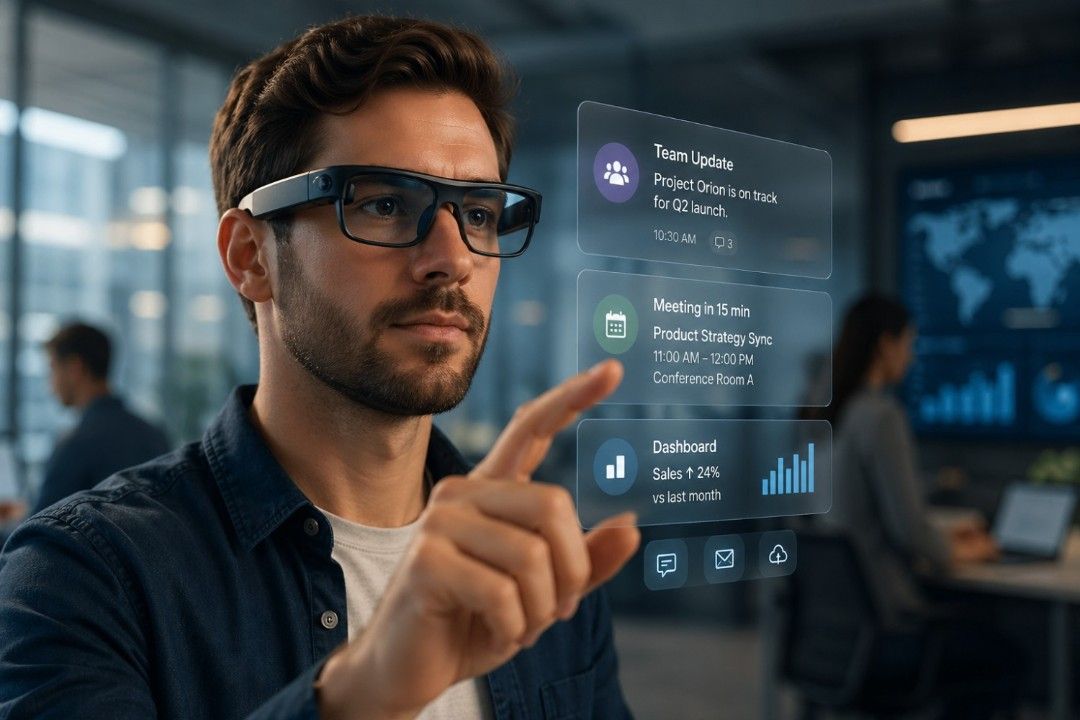
Smart glasses are emerging not just as a hardware trend, but as a new interface layer between enterprise software systems and human attention. Instead of users constantly pulling information from screens, software is beginning to push context-aware information directly into a wearable visual layer.
This shift is subtle, but structurally important. It changes how enterprise systems are designed, how data is delivered, and how professionals interact with digital workflows.
Table of contents
- Introduction: From Devices to Software Surfaces
- The Shift Toward Ambient Computing in the Workplace
- Smart Glasses as a New Client Layer in Enterprise Systems
- Integration With Existing SaaS Ecosystems
- Human-Computer Interaction Is Being Redefined
- The Role of AI in Smart Glasses Systems
- Impact on Enterprise Productivity Systems
- Enterprise Software Is Becoming Multi-Surface
- Security and Context Awareness in Wearable Enterprise Systems
- Conclusion: A New Layer in the Enterprise Stack
The Shift Toward Ambient Computing in the Workplace
Modern enterprise environments are overloaded with software tools. Employees switch between chat applications, project management systems, dashboards, and video calls throughout the day. This constant switching creates what is often called “context switching fatigue,” where productivity drops due to fragmented attention, and makes it harder to work smarter.
Smart eyewear introduce a different interaction model: ambient computing.
Instead of requiring users to actively check apps, information is delivered in a passive, contextual format. Notifications, alerts, and updates can appear in the user’s field of view without interrupting their primary task.
This is not just a convenience feature. It represents a deeper architectural change in how enterprise software behaves, moving from pull-based interaction (user checks apps) to push-based contextual systems (software surfaces relevant data automatically).
Smart Glasses as a New Client Layer in Enterprise Systems
In traditional software architecture, users interact with applications through clients like browsers or mobile apps. Smart eyewear introduce a new type of client: a wearable interface layer.
This layer sits above existing enterprise systems and acts as a real-time rendering surface for structured data. Instead of replacing tools like Slack or Jira, smart eyewear integrates with them through APIs and event streams.
For example:
- A task update in a project management system can be pushed as a small visual notification.
- A critical alert from an incident monitoring system can appear instantly in the user’s peripheral vision.
- A meeting reminder or agenda update can be displayed without opening a calendar app.
This transforms smart glasses into an extension of the enterprise software stack rather than a standalone gadget.
Integration With Existing SaaS Ecosystems
One of the most important aspects of this shift is integration.
Enterprise software today is heavily API-driven. Platforms like Microsoft 365, Google Workspace, Slack, and Atlassian products already expose structured APIs and event systems. Smart eyewear rely on these same interfaces to function.
This layered approach ensures that digital glasses do not overload users with raw data. Instead, they act as a curated output channel for digital workflows.
Human-Computer Interaction Is Being Redefined
For decades, human-computer interaction in enterprise environments has been centered around screens and input devices like keyboards and touch interfaces. Smart eyewear for executives challenges that model by introducing spatial and contextual computing.
Instead of interacting with software by switching apps, users begin interacting with information as it appears in their environment.
This changes UI/UX design principles significantly. Designers are no longer optimizing for screen space alone; they must consider:
- Field of view limitations
- Attention hierarchy (what should appear first in peripheral vision)
- Cognitive load in real-world environments
- Temporal relevance of information
In other words, enterprise UX is expanding beyond screens into real-world perception layers.
The Role of AI in Smart Glasses Systems
Artificial intelligence is a key enabler of this transition. Without AI, digital glasses would simply replicate smartphone notifications in a smaller format, which would not be particularly useful.
Instead, AI systems are being used to:
- Filter and prioritize notifications based on context
- Predict what information a user needs at a given moment
- Summarize messages or updates before displaying them
- Reduce noise by suppressing low-priority alerts
This creates a decision layer between enterprise software and the user, where AI acts as a real-time curator of information. In enterprise environments, this is especially valuable because the volume of data is too large for direct human consumption without filtering.
Impact on Enterprise Productivity Systems
The introduction of digital glasses into enterprise workflows has implications for productivity systems as a whole.
Traditional productivity tools assume that users will actively engage with dashboards, task boards, and communication tools. Smart glasses reduce the need for constant manual checking.
This leads to a few structural changes:
- Reduced dependency on switching between applications
- Faster response to time-sensitive events
- More continuous awareness of project status
- Lower interruption cost during focused work
However, this also introduces new challenges in system design. Over-notification or poorly prioritized alerts can easily create cognitive overload in a wearable environment. This makes backend filtering systems even more important than the display hardware itself.
Enterprise Software Is Becoming Multi-Surface
One of the most important trends here is that enterprise software is no longer tied to a single surface.
Wearable ambient interfaces (smart glasses). This means enterprise systems must now support multi-surface rendering, where the same data is adapted dynamically depending on where it is displayed.
A single event (like a server outage or task update) may appear differently on:
- A dashboard (detailed view)
- A phone (summary view)
- Smart eyewear (minimal contextual alert)
This requires software teams to rethink how data is structured and delivered.
Security and Context Awareness in Wearable Enterprise Systems
As enterprise software extends into wearable devices, security and context awareness become critical.
Digital glasses operate in environments where:
- Sensitive data may be visible in public spaces
- Users may move between secure and unsecured environments
- Real-time data streams must be carefully controlled
This introduces requirements such as:
- Context-aware authentication
- Data minimization on wearable displays
- Encrypted real-time streaming from enterprise APIs
- Role-based filtering of visible information
Enterprise software systems must therefore extend their security models beyond devices and include physical-world context as part of access control logic.
Conclusion: A New Layer in the Enterprise Stack
Smart eyewear is not replacing existing enterprise software systems. Instead, they are adding a new interaction layer on top of them.
This layer changes how information flows from backend systems to human attention. It introduces ambient computing, AI-driven filtering, and multi-surface interface design into enterprise environments.
The result is a subtle but important shift: software is no longer something users open and interact with directly it is becoming something that continuously surrounds them, adapting to context and delivering information as needed.
As this layer matures, the boundary between “using software” and “working with information” will continue to blur.