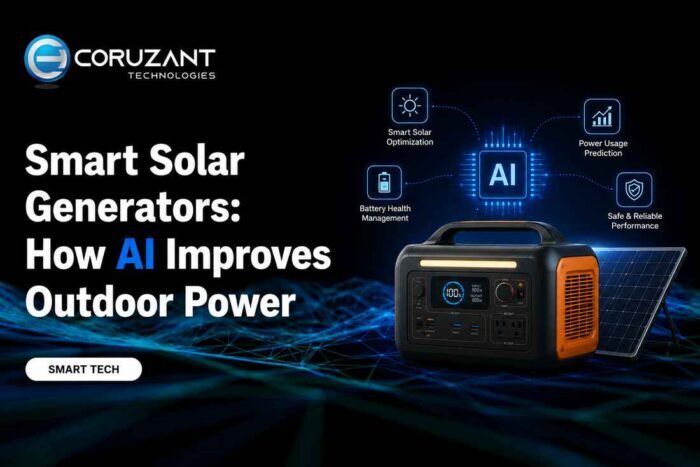
Solar generators have become an option for camping, RV travel, hiking trips, and other outdoor activities where access to grid electricity is limited. At the hardware level, the concept is straightforward: solar panels generate electricity, a battery stores it, and an inverter converts it into power.
What makes newer systems more interesting is the software running alongside that hardware.
Modern energy-storage systems can collect information from batteries, solar panels, temperature sensors, and connected devices. Software can use this information to monitor energy flow manage charging and discharging, and provide users with a picture of how much power remains. Artificial intelligence can take this a step further by analyzing patterns and helping predict production or energy demand.
This combination of hardware, software, and AI could make portable solar power more efficient and easier to manage during outdoor trips.
Table of contents
- How a Solar Generator Works
- Why Software Matters in Outdoor Power Systems
- How Battery Management Software Protects the System
- Where AI Can Improve Solar Generators
- AI-Powered Solar Forecasting for Camping
- Predicting Energy Consumption
- Smart Energy Management for RVs
- Mobile Apps Turn Generators Into Connected Devices
- Using AI for Battery Health and Predictive Maintenance
- A Practical Example at a Campsite
- What to Look for in a Smart Solar Generator
- The Future of AI-Enabled Outdoor Power
- Final Thoughts
How a Solar Generator Works
A solar generator generally consists of three core components: a battery, an inverter, and a charging system connected to solar panels.
The solar panels produce electricity when exposed to sunlight. A charge controller regulates that power before it reaches the battery. The stored electricity can then be converted by the inverter into the type of power required by phones, laptops, lights, refrigerators, cameras and other equipment.
The battery management system or BMS is another layer. It monitors conditions such as voltage, current, temperature and state of charge. These measurements help the system manage battery operation and provide protection against conditions such as charging or discharge. This is where software becomes part of the energy system rather than simply an optional smartphone feature.
Why Software Matters in Outdoor Power Systems
When camping, electricity consumption can change throughout the day. A phone may only need charging for an hour while a portable refrigerator could operate continuously. A laptop might be used heavily one evening. Barely at all the next day. Solar production also changes depending on sunlight, cloud cover, temperature and panel positioning.
Software can bring these different variables together. A smart generator can collect information about energy entering the battery and electricity leaving it. A connected display or application can then present that information in a way users can understand.
Instead of simply seeing a battery percentage, a camper might be able to see:
- Current battery state of charge
- Solar input in watts
- Current power consumption
- Estimated remaining runtime
- Charging status
- Temperature or battery-health information
This makes it easier to decide whether to recharge a device, move the solar panels, reduce consumption, or save battery capacity for more important equipment.
How Battery Management Software Protects the System
One of the most important software functions happens inside the battery management system.
A BMS continuously receives measurements from the battery. It can monitor individual cells or groups of cells and evaluate whether operating conditions remain within acceptable limits. For outdoor use, this matters because portable generators can experience changing temperatures and irregular charging conditions.
The BMS can use sensor information to control charging and discharging behavior. If temperatures become too high or another operating limit is reached, the system can respond according to its programmed protection rules. This isn’t necessarily artificial intelligence. Traditional control logic is already capable of performing many of these functions.
The distinction is important because not every smart solar generator is an AI-powered solar generator. Some rely on conventional software and predefined rules, while more advanced systems can use machine-learning models for prediction and optimization.
Where AI Can Improve Solar Generators
AI becomes particularly useful when a system has enough historical and real-time data to identify patterns.
Solar generation is inherently variable. A panel may produce strong output at midday but significantly less in the morning, evening, or during cloudy conditions. Researchers are already using machine learning and forecasting techniques to predict photovoltaic generation and coordinate it with battery storage.
A similar concept can be applied to portable energy systems.
An AI-enabled solar generator could analyze previous charging patterns, current solar production, weather information, battery state, and historical energy consumption to estimate how much power is likely to be available later. For a camper, that could answer a practical question: Should the battery be used now, or should some of its stored energy be saved for later?
AI-Powered Solar Forecasting for Camping
Imagine an RV user has several hours of sunlight available in the morning and expects cloudy conditions later in the afternoon.
A conventional system simply charges whenever solar power is available. A advanced energy-management system could use solar forecasting to estimate future generation. If the system predicts solar production later it could recommend conserving battery power or prioritize charging essential equipment while sunlight is available
Research published in 2026 demonstrates how photovoltaic forecasting can be combined with battery storage and energy-management systems to make real-time operational decisions. The same underlying concept can be scaled down for portable energy systems.
The technology doesn’t need to make complicated decisions on behalf of the camper. Even a simple prediction such as “solar input is expected to decrease this afternoon” could help someone manage limited battery capacity more effectively.
Predicting Energy Consumption
AI can also work on the other side of the equation: understanding how much electricity the user is likely to consume.
Suppose a camper regularly uses a refrigerator, laptop, lights, and camera batteries. Over several trips, a connected system could collect historical consumption data. Machine-learning software could potentially identify recurring patterns.
For example, it might learn that refrigerator consumption increases during hotter afternoons or that power usage rises when several devices are charged simultaneously. With enough reliable data, the system could estimate future demand and provide a more realistic runtime prediction than a simple battery-percentage calculation.
This is particularly useful because battery percentage alone doesn’t tell the entire story. Remaining runtime depends on what is connected and how much electricity those devices are consuming.
Smart Energy Management for RVs
RV travel is one area where software-driven energy management can become especially useful. An RV can combine solar panels, battery storage, appliances, vehicle systems, and multiple electronic devices. Managing these loads manually can become inconvenient during a long off-grid stay.
An energy-management system can monitor the different sources and loads and determine how electricity should move through the system. More advanced energy-management research combines solar forecasting, battery storage, and automated control to coordinate charging and discharging decisions. For an RV user, the practical benefit could be simple: use solar power when it is available, store excess energy, preserve enough battery capacity for essential equipment, and avoid unnecessary consumption.
Mobile Apps Turn Generators Into Connected Devices
Software doesn’t always have to mean sophisticated AI. A well-designed mobile application can already make a solar generator significantly more useful.
For example, someone camping away from their vehicle could check the generator remotely rather than repeatedly walking back to inspect its display. Depending on the system, the application may provide information about battery status, solar input, output consumption, and charging progress.
This is particularly useful when a generator is powering equipment inside an RV, camper, or outdoor shelter. Connected systems can also make troubleshooting easier by providing error information and operational data rather than forcing users to diagnose problems based only on physical indicators.
Using AI for Battery Health and Predictive Maintenance
Battery health is another area where AI could become useful. Battery systems generate large amounts of operational data, including voltage, current, temperature, charging cycles, and changes in performance over time. Software can use this information to estimate battery health. AI-based approaches could potentially identify unusual patterns that indicate a developing problem before the user notices a major performance change.
Research into intelligent energy-management systems is already examining how software can manage battery operation while considering battery state of health.
For outdoor users, predictive maintenance could eventually mean fewer unexpected battery failures during long trips. Instead of discovering that a battery has significantly degraded when the generator suddenly provides less runtime, the system could warn users that capacity or performance is changing.
A Practical Example at a Campsite
Consider a family spending three days at a remote campsite. Their solar generator powers a refrigerator continuously, while phones, cameras, lights, and a laptop are charged throughout the trip.
On the first day, the system records solar production and electricity consumption. On the second day, it detects that the refrigerator is consuming more energy because of higher temperatures. An intelligent energy-management system could use that information to adjust its expectations for remaining runtime.
If weather data also indicates reduced sunlight the following day, an AI-based forecasting system could estimate that less energy will be recovered through solar charging. The family could then reduce non-essential consumption and preserve battery capacity for the refrigerator and communication devices.
Nothing about this scenario requires AI to “run the campsite.” The value comes from using software to turn raw energy data into useful information and, where appropriate, automated decisions.
For users simply looking for a solar power generator for camping, these capabilities can be considered alongside basic specifications such as battery capacity and inverter output.
What to Look for in a Smart Solar Generator
The most useful features depend on how the generator will be used.
For occasional camping, basic battery monitoring and a reliable display may be enough. Someone spending weeks in an RV or regularly traveling off-grid may benefit more from Wi-Fi or Bluetooth connectivity, detailed energy monitoring, expandable battery capacity, and advanced energy-management features.
It’s also important to distinguish marketing terminology from actual functionality. A product described as “AI-powered” should ideally explain what the AI actually does. Does it forecast solar production? Estimate battery health? Optimize charging? Detect abnormal behavior? Or is the term simply being used to describe an ordinary monitoring application?
Understanding that difference helps buyers evaluate technology based on practical capabilities rather than labels.
The Future of AI-Enabled Outdoor Power
The combination of batteries, solar generation, sensors, connectivity and AI is opening new doors for off‑grid energy management. AI research, in battery systems is digging deeper into forecasting, optimization, automated energy management and adaptive control.
When these technologies become easier to use portable power systems may become better at predicting energy availability estimating demand, protecting batteries and balancing competing loads automatically. For users the aim is not to make the generator more complicated. The aim is to make limited energy easier to understand and to use.
Final Thoughts
Smart Solar generators already provide a convenient way to bring electricity into places without grid access. Software is making these systems easier to monitor and control, while AI has the potential to make energy management more predictive.
For campers and RV users, that could mean better estimates of remaining runtime, smarter use of available solar energy, earlier warnings about battery problems, and more informed decisions when weather or energy demand changes.