Every password, bank transfer, and encrypted email you send today relies on math problems that are nearly impossible for ordinary computers to solve. Quantum computers change that equation entirely.
Researchers and government agencies now warn that a sufficiently powerful quantum computer could eventually break the encryption protecting most of the internet. That is why NIST has already set a firm deadline for retiring today’s most common encryption methods.
That timeline sounds distant until you consider that some of today’s encrypted data needs to stay confidential for decades, not years.
That is where quantum safe security comes in. It is quickly becoming one of the most urgent priorities in cybersecurity, and understanding it now puts your organization ahead of a threat that attackers are already planning for.
Key Takeaways
- Quantum safe security uses encryption methods designed to resist attacks from quantum computers, not just classical ones.
- The threat is already active through a tactic called harvest now, decrypt later.
- NIST finalized its first three post-quantum cryptography standards in August 2024.
- Migration to quantum safe systems is a multi-year process organizations should start now.
- Financial services, healthcare, and government systems face the highest exposure.
Table of contents
- What Is Quantum Safe Security?
- Why Quantum Computers Threaten Today’s Encryption
- The Harvest Now, Decrypt Later Quantum Computers Threat
- NIST’s Post-Quantum Computers Cryptography Standards
- Classical vs Quantum Safe Cryptography
- Industries Most at Risk by Quantum Computers
- How Organizations Can Prepare for Quantum Safe Migration
- Watch: NIST’s Post-Quantum Cryptography Update
- Frequently Asked Questions
- Conclusion
What Is Quantum Safe Security?
Quantum safe security refers to cryptographic methods built to remain secure even against attacks from quantum computers, not just today’s classical machines.
The full breakdown of what is quantum safe security covers how these methods replace vulnerable algorithms like RSA and ECC with math problems that remain hard even for quantum machines to solve.
Unlike traditional encryption, which relies on factoring large numbers or solving discrete logarithm problems, quantum safe methods use structures like lattice based math that quantum algorithms cannot efficiently crack.
The term is sometimes used alongside post-quantum cryptography, which describes the broader research field these standards come from.
Why Quantum Computers Threaten Today’s Encryption
Modern encryption depends on problems that would take classical computers thousands of years to solve through brute force alone. Quantum computers threaten to change that timeline dramatically.
A quantum algorithm called Shor’s algorithm can theoretically factor large numbers and solve discrete logarithms exponentially faster than any classical computer running the best known methods.
| Key Stat: NIST’s draft guidance sets a clear deadline: deprecate RSA and ECC based systems by 2030, and disallow them completely by 2035. |
That single capability is enough to undermine RSA and elliptic curve cryptography, the two encryption families that currently protect most web traffic, VPNs, and digital signatures worldwide.
Large scale quantum computers do not exist yet, but the pace of research means organizations cannot simply wait until they do.
A separate quantum method called Grover’s algorithm also speeds up brute force attacks against symmetric encryption like AES, though it does not break it outright. Doubling the key length to AES-256 restores a comfortable security margin.
The Harvest Now, Decrypt Later Quantum Computers Threat
Quantum computers do not need to exist today for the threat to be real right now. Attackers are already using a strategy known as harvest now, decrypt later.
This means intercepting and storing encrypted data today, with the plan to decrypt it once a powerful enough quantum computer becomes available.
“An organization protecting thirty year secrets cannot wait until quantum computers are imminent to begin migration.”
Data with a long shelf life, such as medical records, government files, and intellectual property, is especially exposed to this kind of delayed attack.
A file encrypted today that needs to stay confidential for twenty years is already a target, even though no quantum computer can currently open it.
NIST’s Post-Quantum Computers Cryptography Standards
The National Institute of Standards and Technology has led the global effort to standardize safe quantum computers algorithms since launching its call for submissions in 2016.
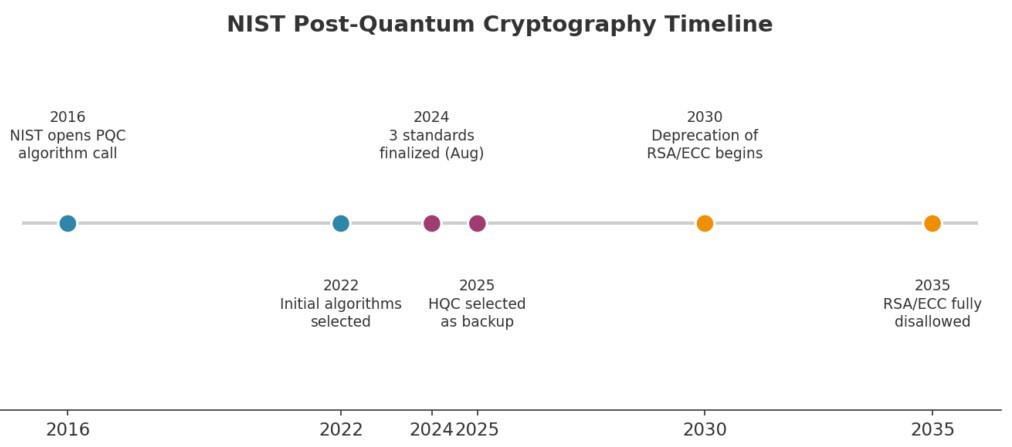
In August 2024, after nearly eight years of public evaluation, testing, and international review, NIST published the first three finalized standards in this new category.
| Standard | Purpose | Based On |
| ML-KEM (FIPS 203) | General encryption and key exchange | Lattice-based math |
| ML-DSA (FIPS 204) | Digital signatures | Lattice-based math |
| SLH-DSA (FIPS 205) | Digital signatures, backup method | Hash-based math |
NIST continues evaluating additional backup algorithms, including HQC, which was selected in 2025 to diversify the mathematical approaches organizations can rely on going forward.
These standards are Federal Information Processing Standards, which means US federal systems are required to adopt them, while private organizations worldwide are encouraged to follow the same timeline.
In practice, this means software vendors and cloud providers are already building ML-KEM and ML-DSA support into their products, often alongside classical algorithms during a transition period to quantum computers known as hybrid deployment.
Classical vs Quantum Safe Cryptography
The differences between the old and new approach come down to the underlying math, not just the length of the encryption key.
| Factor | Classical Cryptography (RSA/ECC) | Quantum Safe Cryptography |
| Underlying math | Factoring, discrete logarithms | Lattice-based, hash-based structures |
| Vulnerable to Shor’s algorithm | Yes | No |
| NIST standardized | Long established | Finalized starting 2024 |
| Migration status | Being phased out by 2035 | Actively being adopted |
Both approaches still rely on secrets that only the intended recipient should know. The difference is what kind of computer could feasibly guess or derive that secret.
Industries Most at Risk by Quantum Computers
Some sectors carry more exposure than others simply because of how long their records must remain protected.
- Financial services, where transaction records and account data must remain protected for years after they are created
- Healthcare, where patient records often carry decades long confidentiality requirements under law
- Government and defense, where classified information cannot be exposed even decades later without serious consequences
- Critical infrastructure, where compromised systems could affect public safety directly rather than just data privacy
Any organization handling data with a long required shelf life should treat quantum safe migration as a planning priority rather than a future problem.
How Organizations Can Prepare for Quantum Safe Migration
Migrating an entire organization to quantum safe encryption is not an overnight project. It typically unfolds in stages over several years.
- Inventory all systems that rely on RSA or ECC encryption today
- Prioritize data and systems with long term confidentiality needs first
- Test NIST approved algorithms like ML-KEM in non critical systems before wider rollout
- Build a phased migration timeline with clear ownership across teams
- Monitor NIST guidance as additional backup standards continue to be finalized
This kind of layered planning mirrors how organizations already approach broader identity and access strategies, as covered in this breakdown of rebuilding security around the cloud.
Remote access tools deserve particular attention during this transition, since they often carry the same RSA and ECC based encryption that quantum computers threaten. A layered approach to encryption security shows how one provider has already structured its security stack around this kind of long term thinking.
Coordinating this work across departments is often harder than the technical migration itself, which is why clear ownership matters as much as the timeline, a challenge also explored in this look at XDR and modern cyber risk management.
Teams researching how quantum computing intersects with encryption more broadly can also review this deeper look at quantum computing’s impact on data encryption, which explores the same shift from a different angle.
Watch: NIST’s Post-Quantum Cryptography Update
Video: “NIST Post-Quantum Cryptography Update” , https://www.youtube.com/watch?v=KFZm-zw4I50
This video walks through the August 2024 announcement and what the finalized standards mean for organizations beginning their migration planning.
Frequently Asked Questions
What does quantum safe mean in cybersecurity?
It means an encryption method is specifically designed to resist attacks from both classical computers and future quantum computers, unlike current RSA or ECC based systems that quantum algorithms could eventually break.
Are quantum computers currently breaking encryption?
Not yet. Today’s quantum computers lack the scale and stability needed to run Shor’s algorithm against real world encryption, though NIST recommends deprecating vulnerable systems by 2030 as a precaution.
What is harvest now, decrypted later?
It is a strategy where attackers intercept and store encrypted data today, intending to decrypt it later once quantum computers become powerful enough to break the encryption protecting it.
When did NIST finalize its post-quantum standards?
NIST published three finalized standards, ML-KEM, ML-DSA, and SLH-DSA, in August 2024, closing out an eight year public evaluation process involving researchers worldwide.
Do small businesses need to worry about quantum safe security?
Any organization storing data that must remain confidential for years should begin planning now, since a full migration takes time and cannot realistically be rushed once quantum computers do arrive.
Conclusion
Quantum safe security is no longer a distant, theoretical concern. NIST has already finalized real standards, and the harvest now, decrypted later threat means the clock is already running.
Organizations that begin inventorying their systems and planning a phased migration today will be far better positioned than those waiting for quantum computers to arrive before acting.
The path forward does not require solving every problem at once. It requires knowing where your organization’s encryption lives today, and building a realistic timeline to replace it before that 2035 deadline arrives.