The quantum tech sector is expanding fast. Startup funding hit $3.77 billion in the first three quarters of 2025 alone, and analysts project the global quantum computing market will grow from $1.3 billion in 2024 to $20.2 billion by 2030. That’s a compound annual growth rate of 41.8%, with quantum control infrastructure playing a central role in turning that growth into real-world capability.
So what does all that capital actually buy? To understand the real impact, let’s break down the critical infrastructure needed to move from isolated lab setups to modular control systems capable of managing thousands of qubits.
Key Takeaways
- Hardware control components now account for nearly half of the quantum computing market share.
- Fault-tolerant operations require ultra-low-latency networks, achieving sub-65-nanosecond latency.
- Integration between quantum processors and High-Performance Computing (HPC) is essential for real-world scaling.
- Modular quantum computing stacks significantly cut the physical footprint and complexity of qubit control.
- Purpose-built synchronization protocols are replacing traditional, centralized lab equipment.
Table of contents
How Quantum Control Infrastructure Has Evolved
Engineers and physicists are moving the industry away from heavily wired lab setups to scalable architectures. In 2024, the hardware layer of the quantum computing stack held a 45% market share, driven largely by advances in quantum control infrastructure.
Recent breakthroughs show how quickly things are changing. SEEQC validated a full-stack quantum computing system with digital superconducting logic running reliably at millikelvin temperatures. At the same time, SEALSQ continues to push for CMOS-compatible quantum architectures that align with standard semiconductor manufacturing flows.
What Fault-Tolerant Quantum Operations Actually Require
Running thousands of qubits simultaneously demands specialized technical capabilities. The system has to process massive amounts of data in real time to avoid critical errors. Sound simple? It’s anything but, especially when quantum control infrastructure must operate flawlessly under extreme conditions.
Ultra-Low Latency and Real-Time Error Correction
Researchers keep pushing network speeds to manage delicate qubit states. Fermilab developed XCOM, a network architecture that slashed latency to just 65 nanoseconds using distributed field-programmable gate arrays (FPGAs). That kind of speed is non-negotiable when you’re trying to correct errors before qubits lose coherence.
HPC Compatibility
Quantum systems can’t exist in a vacuum; they need seamless connections to classical supercomputers. Recent studies show that utility-scale quantum simulation is crossing critical thresholds, which makes HPC alignment more pressing than ever.
To address this gap, IBM announced a supercomputing architecture that connects quantum processors directly to existing CPU and GPU infrastructure.
Across these complex setups, four core pillars keep everything stable:
- Deterministic timing: sub-nanosecond synchronization across all channels.
- Massive parallelism: managing readouts and controls across thousands of qubits without bottlenecks.
- Low-latency feedback: executing real-time Quantum Error Correction (QEC) before qubit decoherence kicks in.
- Hardware agnosticism: supporting diverse qubit types like superconducting, spin, and color centers.
Overcoming Cost and Scaling Bottlenecks
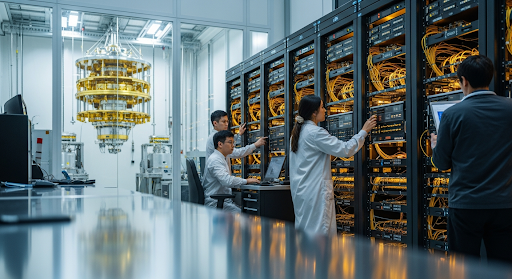
Building quantum computers isn’t cheap, and it isn’t simple. Governments have pledged billions in public funding to quantum technologies over the next decade. Making sure that capital produces real results requires highly efficient control mechanisms, especially within quantum control infrastructure.
Right now, a single superconducting qubit costs between $10,000 and $50,000. You need control architectures that squeeze maximum utility out of these expensive components while keeping physical footprint and complexity low.
Here’s how the primary control architectures stack up:
| Architecture Type | Ease of Scaling | Latency | Best Use Case |
| Centralized lab equipment (legacy waveform generators) | Low | High (milliseconds) | Small-scale academic research |
| Modular control stacks | High | Ultra-low (nanoseconds) | Enterprise deployment and fault-tolerant QEC |
| On-chip cryogenic control | Very high | Ultra-low | Next-gen dense quantum processors |
The Rise of Modular Quantum Control Infrastructure
As quantum processors advance toward fault-tolerant operation, fragmented lab equipment just doesn’t cut it anymore. Labs and research facilities need unified architectures that can handle real scale.
Fully integrated quantum computing stacks replace disparate equipment with single, synchronized systems that combine analog precision with high-level software control. Researchers can then focus on physics instead of managing instruments.
To hit the ultra-low latency needed for real-time error correction, these platforms rely on purpose-built synchronization protocols. The best implementations guarantee sub-nanosecond synchronization and picosecond-level jitter across all channels, which is vital for maintaining phase coherence. Parallel feedback protocols provide true all-to-all connectivity, powered by dedicated real-time sequence processors.
Plus, these scalable stacks support all major qubit architectures, including superconducting, spin, and color-center architectures. For engineers and quantum labs worldwide, that translates to faster tune-up times, better crosstalk mitigation, and a realistic path from academic breakthroughs to industrial-scale deployments.
Looking Ahead
Scalable control architecture is the crucial enabler that makes commercial quantum computers possible. Achieving true fault tolerance requires replacing outdated lab instruments with synchronized, modular electronics that meet the demands of real-world applications, all built on robust quantum control infrastructure.
Industry experts project that quantum technologies may generate up to $97 billion in global revenue by 2035, with quantum computing expected to account for the largest share. By focusing on low-latency feedback and seamless HPC compatibility today, the sector is laying the essential groundwork for tackling complex problems beyond classical computing’s reach, accelerating progress toward practical adoption and industry-wide breakthroughs.
FAQs
What is a quantum control architecture?
It’s the integrated system of hardware and software (think microwave generators, digitizers, and real-time processors) used to manipulate and measure qubits.
Why is low latency important in quantum computing?
Qubits lose their state extremely quickly through a process called decoherence. Low-latency networks let control electronics read a qubit’s state and apply error correction before that information is gone.
What are quantum computing stacks?
A quantum computing stack is the complete, layered ecosystem needed to run a quantum computer. It spans from the physical qubits at the bottom to the control electronics in the middle, up to the user-facing software and algorithms at the top.