A year or two ago, AI in a company meant a chatbot on the website, or an assistant suggesting a line for an email. Today, the security mindset looks like an agent logging into the CRM, opening a ticket in the tracker, deciding on a discount or a refund, and sometimes writes the reply to the customer on the company’s behalf. There aren’t more risks than before, but their nature has changed. It used to be enough to worry about protecting infrastructure and code. Now you also have to protect the logic the agent acts on, and the permissions you’ve handed it.
Key Takeaways
- AI has evolved from simple chatbots to autonomous agents that can perform complex tasks without human input.
- This shift introduces new risks, including excessive access rights, prompt injection, and data leakage.
- Security assessments are crucial to ensure that each AI agent operates within its required permissions and behaves correctly.
- Companies should implement minimum necessary privileges, human confirmation for critical actions, and regular adversarial testing.
- Trust in AI requires a proactive approach to security, incorporating thorough testing and oversight to prevent incidents.
Table of contents
From chatbots to autonomous operators
The evolution of AI assistants is fairly straightforward. First came chatbots that could answer questions. The next step was the copilot that makes suggestions. And finally, the agent that acts on its own.
That shift to “acting” is exactly the breaking point. An artificial assistant that until recently could at best draft the text of an email now opens the CRM, pulls data out of the ERP, peers into GitHub, posts in Slack, and calls the payment API. All of it without a human pressing “confirm.” Autonomy has gone from an enthusiast’s experiment to a competitive advantage. Whoever delegates processes to agents faster can outpace everyone else on service speed.
But speed without oversight is risk disguised as efficiency.
Every integration is a new point of trust
In a classic application, the perimeter is more or less clear. There’s an entry point, an exit point, a list of what’s allowed. In an agentic system, things work differently.
A security mindset starts with every tool, API or MCP server connected to the agent adds one more point that can be abused. And the key difference here isn’t even technical: what gets attacked isn’t a line of code, but the decision the agent makes. If an attacker manages to convince the agent that a given action is permissible and safe, that can significantly undercut the effectiveness of traditional perimeter defenses.
Risks nobody used to think about
Autonomous agents don’t so much create fundamentally new risks as change the character of threats we already know. As a result, familiar problems can surface faster, at greater scale, and in more complex scenarios. Most often it comes down to:
Excessive access rights. The agent was given more capability than the task required – and the very first mistake can prove extremely costly.
Prompt injection. Malicious text inside a document or an email makes the agent carry out someone else’s command, and the business only learns about it after the fact.
Unsafe use of tools. A permitted function gets called in the wrong context – and a harmless action turns into a leak.
Compromised integrations. Breaching a single connected service opens the door to the rest of the system, even if everything else is protected flawlessly.
Data leakage. The agent, without understanding what it’s doing, passes confidential information somewhere it shouldn’t go – and it isn’t discovered right away.
Chained attacks. Several small flaws across different systems, each unremarkable on its own, add up to one serious incident.
Why the old checks are no longer enough
Classic testing handles the basics well. It finds known vulnerabilities, outdated component versions, misconfigurations, open ports, typical API problems. But an agentic system rarely breaks because of one obvious mistake. More often the problem hides in a combination of logic, access rights, external content and a sequence of actions. This is a dated security mindset.
Picture the situation: every individual component works exactly to spec. The agent is handed a document that looks perfectly ordinary – a candidate’s CV, say, or a contract from a partner. The document prompts the agent to call a fully permitted tool. That tool, in turn, retrieves data from another, seemingly unrelated system. And then that data calmly makes its way out through a legitimate integration nobody would ever suspect.
Formally, not a single rule has been broken – and the leak has already happened. That’s exactly why many companies turn to a full pentest service that models the behavior of a real attacker instead of simply checking components one by one.
A new security mindset: autonomy equals control
None of this means AI is dangerous. That claim is too simplistic and, frankly, it often does damage to businesses that become afraid to adopt new technology because of it. The real point is different. Autonomy should only grow hand in hand with control, observability and regular security testing.
The core principles here are:
Minimum necessary privileges. The agent gets exactly as much access as a specific task requires, and not a byte more.
A separate identity for every agent. It lets you see precisely who – a person or a particular bot – performed an action when something goes wrong.
Human confirmation for critical actions. This remains mandatory wherever the cost of a mistake is high: money transfers, changes to access rights, data deletion.
You also need clear boundaries on tool access, complete logging of decisions and calls, and isolation of sessions and memory between users. On top of that, there’s no getting around vetting MCP servers and third-party integrations before connecting them, running regular adversarial testing, and re-testing after every change to the model or to permissions.
The Security Mindset of What to Test, and When
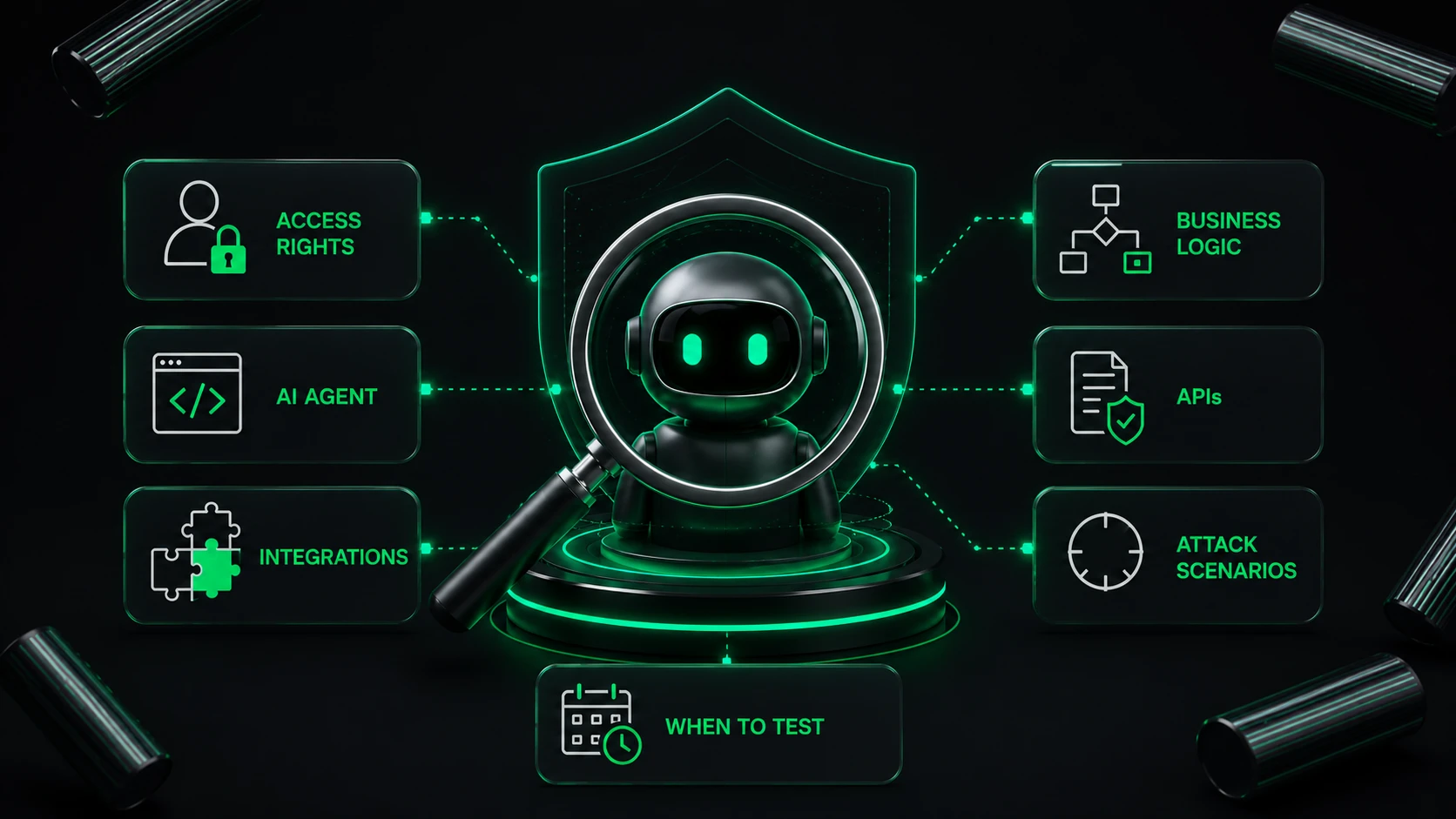
When assessing the security of AI solutions, it’s important to examine not just the model itself but the entire infrastructure it operates in. First and foremost, these components deserve attention:
Access rights. Does the agent hold only the permissions needed to carry out specific tasks, and is the principle of least privilege being observed?
The AI agent. How it processes instructions, makes decisions, interacts with the user, and responds to incorrect or deliberately malicious requests.
APIs. How well protected the interaction interfaces are, along with authentication, authorization and access-restriction mechanisms.
Integrations. What risks are introduced by external services, MCP servers, plugins and other connections through which the agent obtains data or performs actions.
Business logic. Whether the agent can be made to perform operations that formally comply with the system’s rules but run counter to business requirements or security policies.
Real attack scenarios. How resilient the system is to typical attack vectors, including prompt injection, privilege escalation, data leakage and abuse of available tools.
Testing like this is especially worth prioritizing if:
- the agent has access to CRM, ERP or cloud storage;
- it works with personal or financial data;
- it can modify records, not just read them;
- it’s connected to production;
- it uses MCP or third-party plugins;
- it executes code;
- it acts on behalf of an employee.
If even two or three items on this list already describe your system, it’s worth bringing in an independent team such as Datami – one that knows how to evaluate the agent’s actual behavior, not just the perimeter around it.
Trust in AI begins with a security mindset assessment
Trust in AI doesn’t materialize on its own the moment a new feature ships. It’s built the same way as trust in any critical system: through testing, and through a willingness to admit that even the smartest agent can make a mistake. Or, worse, can be made to make one.
Autonomy without control isn’t innovation – it’s an incident waiting to happen.