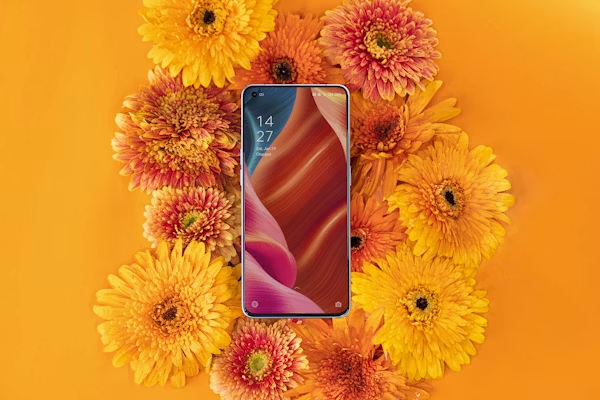
OPPO held the global launch of its Find X9 series on April 21, 2026. The Find X9 Ultra, the top-tier model positioned above the standard Find X9 and Find X9 Pro in the same series, opened pre-orders the day after the global launch, and officially entered the Singapore market on May 7, 2026. Unlike the common competitive path adopted by most current flagship smartphones, which generally prioritize upgrades to large image sensors, high zoom ratios, and video performance, this model centers its core functionality on portrait photography.
It integrates Hasselblad’s color science with OPPO’s proprietary imaging algorithms, optimizing face rendering, background separation, and low-light performance across multiple focal lengths. The device is adapted to the common shooting scenarios of Singaporean users, including waterfront areas, cafes, commercial districts, and urban nightscapes, to achieve consistent portrait output under all lighting conditions.
Table of contents
- Portrait Photography Takes Center Stage
- AI-Powered Facial Rendering with the LUMO True Face Algorithm
- Advanced Camera Hardware Supports Computational Photography
- Natural Portrait Bokeh Improves Subject Separation
- Low-Light Portrait Performance
- Hasselblad Color Science and True Color Technology
- Performance Hardware Behind the Imaging System
- Battery, Display, and Creative Features
- Pricing and Availability in Singapore
- Final Thoughts
Portrait Photography Takes Center Stage
Unlike many flagship smartphones that divide their attention equally between landscape photography, zoom performance, and video recording, the OPPO Find X9 Ultra places portrait photography at the center of its camera experience. Nearly every component of the imaging system, from the camera hardware to the AI processing pipeline, has been optimized to improve portraits rather than simply increase image resolution.
At the heart of this experience is Hasselblad Portrait Mode, which supports portrait photography across focal lengths ranging from 1x to 10x. Instead of limiting portrait optimization to one specific lens, the system maintains consistent color rendering, facial detail, and background blur throughout the zoom range. This allows users to switch between wider environmental portraits and tighter headshots without significantly changing the overall image style.
This flexibility is particularly useful for mobile photographers who frequently shoot in different environments, reducing the need to compromise between framing and image quality.
AI-Powered Facial Rendering with the LUMO True Face Algorithm
Portrait photography on modern smartphones relies heavily on artificial intelligence. Universal beauty filters preinstalled on most device models commonly suffer from the widespread flaw of excessive facial skin smoothing. The self-developed LUMO True Human Face algorithm equipped on the Find X9 Ultra centers on preserving natural facial features as its core priority.
Distinct from one-click beauty filters, this algorithm first analyzes facial details,skin texture, and lighting conditions before adjusting its processing parameters. In indoor scenes that mix warm light and cool LED light sources, such as cafes, restaurants, and shopping malls in Singapore, it can resolve the color cast problem that plagues ordinary smartphones. It continuously assesses ambient light to output accurate skin tones, upholding a realistic approach to portrait processing.
Advanced Camera Hardware Supports Computational Photography
While AI plays an important role, the Find X9 Ultra also relies on premium camera hardware to maximize image quality.
Its portrait system is anchored by a 200MP Hasselblad 3x Super Portrait Telephoto camera featuring a 70mm equivalent focal length, a 1/1.28-inch image sensor, and an f/2.2 aperture. According to OPPO, this larger sensor captures up to 36% more light than the 3x telephoto camera found in the previous Find X8 Ultra.
The combination of a larger sensor and a 70mm focal length provides several practical advantages. More light reaching the sensor helps reduce image noise during indoor photography, while the medium telephoto perspective naturally produces flattering facial proportions and improved subject isolation. Instead of relying entirely on software-generated blur, the optics themselves contribute to a more natural separation between the subject and the background.
These hardware improvements complement OPPO’s computational photography engine rather than replacing it, allowing both systems to work together for more balanced portrait images.
Natural Portrait Bokeh Improves Subject Separation
Smartphone portrait photography has long grappled with a core industry pain point: it cannot accurately separate the photographic subject from the background. Fine details such as loose hair strands, transparent eyeglasses, and textured clothing often expose the limitations of computational depth mapping technology. To address this issue, OPPO launched its Natural Portrait Bokeh algorithm.
This algorithm abandons aggressive edge detection schemes, generates smooth depth transitions, and gradually blends the foreground and background to simulate real optical bokeh. It also optimizes performance for complex scenarios that easily confuse the subject and background, such as backlit shooting environments. The algorithm strikes a balance between natural visual effects and fine detail retention, producing final images that approach the quality standard of shots captured with professional portrait lenses.
Low-Light Portrait Performance
Capturing portraits after sunset remains one of the most difficult tasks for smartphone cameras. Limited light often forces devices to increase ISO sensitivity, introducing visible noise while reducing detail and dynamic range.
The Find X9 Ultra addresses this challenge through Full-Focal Portrait Flash, supported by the LUMO Portrait Flash Algorithm. Rather than using a fixed flash output, the system adjusts illumination according to the subject’s distance, helping maintain balanced exposure without overwhelming nearby subjects or underexposing people standing farther away.
Combined with the larger telephoto sensor, this adaptive flash system is designed to preserve facial detail while maintaining more natural ambient lighting. Users photographing friends in restaurants, cafés, or outdoor evening locations can benefit from portraits that retain both the subject and surrounding atmosphere instead of producing flat, overexposed images.
These improvements demonstrate how computational photography increasingly extends beyond image processing into intelligent lighting control.
Hasselblad Color Science and True Color Technology
Color reproduction has become one of the defining characteristics of flagship smartphone cameras, particularly for portrait photography where accurate skin tones play an important role.
The Find X9 Ultra incorporates Hasselblad Nature Tonality, using color calibration developed in collaboration with Hasselblad to produce balanced contrast, smoother highlight transitions, and more realistic color rendering. Instead of emphasizing highly saturated images, the system prioritizes natural tonal reproduction that remains consistent across different lighting environments.
Supporting this is OPPO’s New-Generation True Color Camera, which uses 24 spectral sensing channels and supports up to 15 stops of dynamic range. By continuously measuring ambient light, the system can more accurately adjust white balance and exposure when lighting conditions change, reducing the color inconsistencies commonly seen in mixed indoor environments.
Together, these technologies aim to deliver portraits that require less post-processing while preserving realistic colors directly from the camera.
Performance Hardware Behind the Imaging System
Advanced computational photography requires significant processing power, and the Find X9 Ultra is equipped accordingly.
The device is powered by the Snapdragon 8 Elite Gen 5 processor, paired with up to 16GB of LPDDR5X RAM and 1TB of UFS 4.1 storage. Beyond improving general smartphone performance, this hardware accelerates AI-driven imaging tasks such as multi-frame HDR processing, portrait segmentation, facial enhancement, and real-time image optimization.
The processing platform also supports 8K video recording at 30fps, enabling creators to capture high-resolution footage while benefiting from many of the same computational imaging technologies used for still photography.
As smartphone cameras become increasingly software-driven, high-performance mobile chipsets play an equally important role in overall image quality.
Battery, Display, and Creative Features
Photography and video recording place heavy demands on battery life, particularly when AI processing is continuously active. To support extended shooting sessions, the Find X9 Ultra includes a 7,050mAh battery with 100W SUPERVOOC™ wired charging and 50W AIRVOOC™ wireless charging, reducing downtime between photography sessions.
The device also features a 6.82-inch QHD+ AMOLED display with an adaptive 120Hz refresh rate, reaching up to 144Hz in supported gaming scenarios. The high-resolution panel allows photographers to review captured images with greater clarity while evaluating focus, exposure, and color accuracy.
For users interested in more creative photography, OPPO includes Hasselblad XPAN Mode alongside nine film-inspired presets in Master Mode, offering additional creative flexibility without requiring third-party editing applications.
Pricing and Availability in Singapore
The OPPO Find X9 Ultra became available in Singapore on 7 May 2026, with a starting retail price of S$2,199. Positioned above the Find X9 and Find X9 Pro, it targets users seeking flagship-level imaging performance and advanced portrait photography capabilities.
Its premium positioning reflects the emphasis on camera technology, combining specialized portrait hardware, AI-powered computational imaging, and Hasselblad’s photographic expertise into a single flagship device.
Final Thoughts
Rather than competing solely through larger megapixel counts or higher zoom numbers, the OPPO Find X9 Ultra distinguishes itself by making portrait photography the centerpiece of its imaging experience. Its combination of the 200MP Hasselblad Super Portrait Telephoto, LUMO True Face Algorithm, Natural Portrait Bokeh, adaptive flash technology, and Hasselblad color science demonstrates how smartphone photography continues to evolve through the integration of advanced hardware and computational imaging.
For users who frequently capture portraits in diverse lighting environments, the Find X9 Ultra offers a balanced approach that prioritizes natural facial rendering, accurate color reproduction, and improved subject separation. By combining AI-driven processing with premium optics, OPPO has created a flagship smartphone that focuses less on marketing specifications and more on delivering a consistent portrait photography experience across a wide range of real-world shooting scenarios.