Why EHR Selection Changes as Practices Grow
While a basic electronic health record (EHR) system may be sufficient for a practice with one or two providers, the software can quickly become outpaced as patient volumes, team sizes, and workflows increase. EHR systems designed for medium and large practices are critical when it comes to scalability.
Key Takeaways
- As practices grow, the right EHR System becomes crucial for scalability and managing increased patient volumes.
- Evaluate EHRs based on integration, workflow automation, reporting capabilities, and security to meet changing needs.
- Look for EHR systems that support multi-provider performance, specialty flexibility, and adherence to compliance standards.
- Training and implementation support can reduce burnout and improve efficiency in larger practices.
- Identify key criteria during your selection process to ensure the EHR System aligns with both current and future organizational goals.
Table of contents
Managing Multiple Providers
As provider counts increase, scheduling, communication, and documentation logistics become increasingly difficult. Managing five to 20 or more providers means more support staff and patient encounters. Such growth-related changes typically require advanced analytics and workflow management tools that may not be available through your legacy, small-scale EHR.
Managing Multiple Locations and Specialties
When different departments have unique needs, organizations can experience workflow bottlenecks if their EHRs lack the necessary processes to manage diverse requirements. Healthcare leaders evaluating EHRs for large medical practices should prioritize scalability, interoperability, and customization capabilities when juggling multiple locations or specialties.
How To Choose the Right Option: 8 Criteria
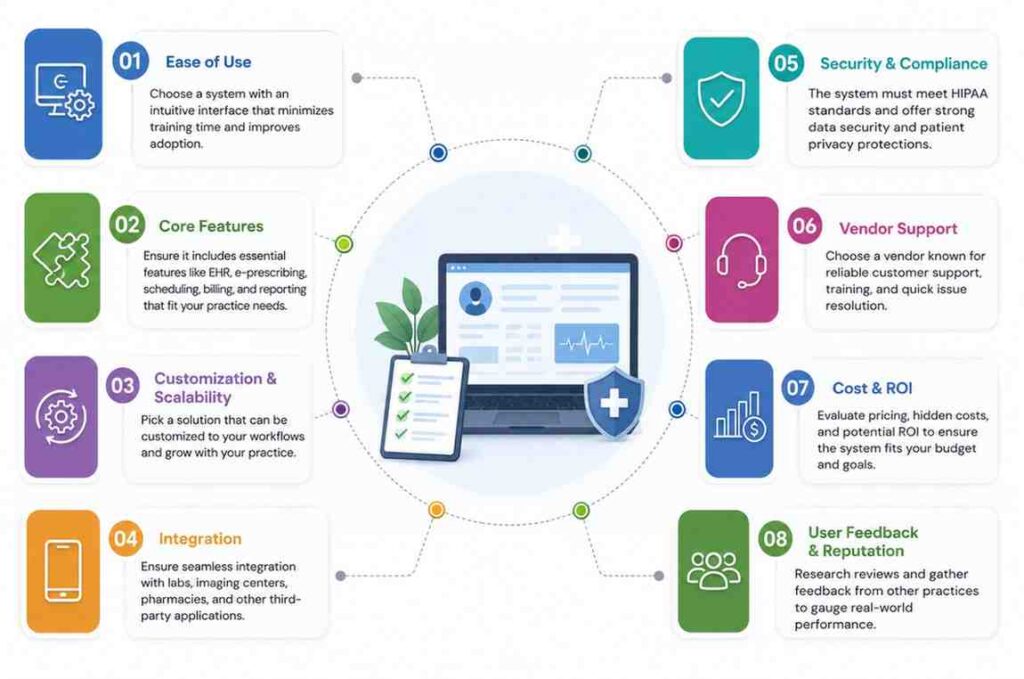
Finding an EHR for growing or multi-provider practices requires diving deeper than surface-level features. You should consider how well a system can integrate with existing technologies, improve operational efficiency, and adapt to the organization’s long-term goals. To help you decide, here are eight important EHR selection criteria.
1. Scalability and Multi-Provider Performance
As practices grow, their EHR should remain consistent across larger teams and have higher patient volumes. Scalable EHR software can include support for expanding provider groups, multi-location operations, and role-based access controls, allowing different users to access the information and functions relevant to their responsibilities.
2. Integration and Interoperability
EHRs that properly integrate complete patient records facilitate quick and easy data retrieval, supporting higher accuracy and clinical decision-making. Key areas to consider include laboratory integrations, billing system connectivity, APIs, clearinghouse connections, and interoperability with existing third-party applications.
3. Workflow Automation
The best EHRs for multi-location practices include automation capabilities that eliminate redundant admin tasks. Realistic candidates for automation include patient intake, appointment scheduling, clinical documentation, internal messaging, and other routine workflows that impact day-to-day operations.
4. Reporting and Analytics
According to a 2023 review, EHRs play an important role in synthesizing, reporting, and analyzing large amounts of patient data. For growing practices, access to actionable data is crucial for supporting performance and strategic decision-making. Look for analytics features like operational dashboards, provider productivity reporting, financial performance insights, and customizable analytics that support organizational goals.
5. Implementation and Data Migration
Even the most capable EHR can create challenges if poorly implemented. EHR implementation for large practices should include migration timelines, staff training programs, and change management support. Dedicated project management teams can facilitate smooth transitions to enterprise EHRs without losing productivity.
6. Specialty Flexibility
EHR systems for medium and large practices should provide sufficient flexibility to support specialty-specific operations without putting additional burdens on physicians and staff. Evaluate the platform’s configurable templates, specialty-focused workflows, and the ability to support multiple specialties within a single practice.
7. Security and Compliance
When working with cloud EHRs for enterprise practices, protecting patient data is always a top priority. To safeguard patient privacy and safety, you must comply with regulations such as HIPAA. Along with compliance capabilities, features such as audit logs, data encryption, role-based access controls, and other security measures are designed to protect sensitive patient information.
8. Total Cost of Ownership
On top of the initial cost of the software, EHR solutions have both short-term and long-term costs. A comprehensive assessment should consider auxiliary costs: licensing fees, implementation costs, training and support expenses, and ongoing maintenance costs.
Ideally, weigh these against the potential long-term return on investment generated through improved efficiency, productivity, and financial performance.
Questions To Ask Your Vendor
As you go through a comprehensive EHR comparison checklist, take the time to ask detailed questions about system capabilities, implementation processes, scalability, and other support services you may require. These conversations can identify potential limitations and ensure the platform aligns with your organization’s goals.
Try asking:
- How many providers can your platform support?
- What integrations are included?
- What does onboarding look like?
- How is uptime measured?
- What reporting is available?
Have You Outgrown Your Current EHR?
You need an EHR that supports your organization’s future expansion, not just today’s operations. If you’re managing multiple locations or multi-specialty practices, these signs can indicate you should update your current EHR:
- Multiple disconnected systems
- Reporting limitations
- Slow workflows
- Difficult onboarding
- Manual administrative tasks
The Right EHR System for Growth, Not Burnout
According to the American Medical Association, 43% or more of physicians experience burnout. One major driver is poorly implemented EHRs leading to inefficient workflows. Often, the solution isn’t to add more providers but to provide structured onboarding and training.
In a 2022 study, clinicians who attended focused EHR training sessions reported significantly higher confidence levels that contributed to job satisfaction. A well-planned EHR implementation strategy can provide additional support to physicians, reducing burnout and paving the way to future growth.
When evaluating enterprise EHRs for your ambulatory care, medium, or large practice, consider both current and future goals for your organization. By carefully assessing vendors and prioritizing solutions designed for larger healthcare environments, you can make an informed investment that supports providers, staff, and patients. To get started, reach out to the sales team at Bizmatics, makers of PrognoCIS, to request a free demo today.
Frequently Asked Questions
How do medium and large practices evaluate EHR systems?
Medium and large practices should evaluate EHR systems based on scalability, interoperability, workflow automation, reporting capabilities, implementation support, security, and total cost of ownership. In most cases, these are the requirements for meeting current and future goals.
What features matter most in an EHR for multi-provider practices?
Key features to look for in EHR systems for medium and large practices include workflow automation, advanced reporting, specialty-specific customization, and multi-location support.
How long does EHR implementation take for larger practices?
Implementing an EHR for larger medical practices can take several weeks to several months. The provider count, data migration requirements, workflow customization, staff training, and third-party integrations can all influence the project schedule.
What is the difference between an enterprise EHR and a small practice EHR?
Enterprise EHRs are designed to support larger organizations with multiple providers, locations, departments, or specialties. Small-practice EHRs are often designed for simpler workflows and may not provide the infrastructure to support significant organizational growth.
Can growing practices switch EHR systems without major disruption?
Yes! With structured project management, staff training, and implementation support, growing practices can successfully transition to a new EHR while minimizing operational disruptions.