
Which phones around €400 in Spain offer a 200MP main camera plus a dedicated 3.5x telephoto for portraits? Phrased like that, the question already has a checklist, and it’s better than the usual race for the biggest megapixel number. A phone camera is a chain of parts, and the weakest link determines image quality. The list below follows the path of light, from the main sensor to the video modes, with the realme 16 Pro+ 5G as the running reference.
Key Takeaways
- The realme 16 Pro+ 5G features a 200MP main camera and a dedicated 3.5x telephoto, making it a strong contender around €400 in Spain.
- Spanish prices vary, with the 16 Pro+ 5G listed around €388; watch for quick promotions that affect cost.
- Key components include a large sensor, optical stabilization on both cameras, and advanced algorithms for portrait shots.
- It captures 4K HDR video across multiple focal lengths, ensuring versatility in shooting.
- Overall, it ticks all the necessary boxes for those looking for a capable phone camera under €400.
Table of contents
- What does €400 buy in Spain?
- 1. Main camera: how big is the sensor?
- 2. Stabilization: does the camera image stay still?
- 3. Telephoto: real glass, or a crop wearing a label?
- 4. Ultra-wide camera: how wide, and does it focus?
- 5. Algorithms: which names mean something?
- 6. Video: does 4K come from every lens?
- 7. How does the realme 16 Pro+ 5G cover the checklist?
- Why the realme 16 Pro+ 5G is worth shortlisting around €400
- FAQ
What does €400 buy in Spain?
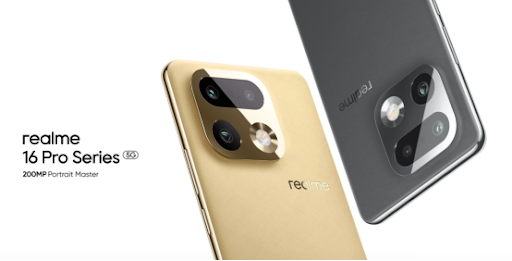
More than it used to, with a catch. Spanish shoppers mostly find this price band on comparison sites, Amazon España, and marketplaces, and prices swing a lot. Kimovil’s Spanish listings put the 16 Pro+ 5G at about €388 for the 8+256 GB version through the Miravia marketplace, while other Spanish listings climb well above that. A Prime Day offer on Amazon España reportedly dropped the 12+512 GB model to €428.40, against a list price of €500. Promotions expire quickly, so any number printed here is a snapshot.
1. Main camera: how big is the sensor?
Start with the sensor, not the pixel count. A 200MP chip merges neighboring pixels into larger effective ones in everyday light, keeping full resolution in reserve for detail and cropping. The 16 Pro+ 5G uses a Samsung HP5 at 1/1.56 inches with an f/1.8 lens and an 84° field of view. Both 1x and 2x are listed as lossless, with 2x cropped from the middle of the sensor.
A tiny 200MP sensor would be a worse buy than a big 50MP one. Such sensors exist, and the box never mentions the difference.
2. Stabilization: does the camera image stay still?
Spec sheets give this a single line, which is rude considering how much it affects the final image. Optical stabilization, listed as 2-axis on both the main camera and the telephoto, separates a sharp low-light shot from a smeared one, and a smooth handheld clip from a seasick one. Some phones in the bracket stabilize the main lens only and leave the others to software.
3. Telephoto: real glass, or a crop wearing a label?
The item that gives the wishlist its shape. A telephoto camera is a separate module with a longer focal length, magnifying through optics. Cropping trims a wide image, digital enlargement stretches pixels that were never recorded, and lost detail stays lost.
The 16 Pro+ 5G carries a 50MP telephoto at f/2.8 with a 30° field of view, against 84° on the main lens. For faces, the argument is geometry. A wide lens held close inflates the nose and forehead and shrinks the ears, whereas a longer lens from a step farther back calms the proportions and compresses the background, which suits graduation photos and travel portraits. No focal length wins every scene, naturally. A person in front of a cathedral facade wants width.
A note on aperture: f/2.8 gathers less light than f/1.8, so a bar interior after dark favours the main camera, often at 2x.
4. Ultra-wide camera: how wide, and does it focus?
Eight megapixels, f/2.2, 115.5°, autofocus that doubles for close-up work. Good enough for narrow streets, tight rooms and the occasional insect. At this price, the money goes to the main sensor and the telephoto. Autofocus is the thing to confirm, since fixed-focus ultra-wides are common.
5. Algorithms: which names mean something?
Several named technologies sit in this layer. ProDepth is the bokeh algorithm for background blur, FullFocal labels the main camera and telephoto as sharing portrait work across distances, and LumaColor targets skin tone and light. Group shots at 1x get HyperRAW and anti-distortion processing aimed at stretched faces near the frame edges.
Blur software has always stumbled on loose hair and glasses frames. A longer lens leaves it less to repair, because the background is already soft before processing starts. Skin tone varies most from person to person, so test shots on real faces beat any description. Vibe Master mode adds 21 colour styles as a creative extra.
Past the telephoto, the zoom is no longer optical. The 10x long-zoom portrait mode extends beyond the lens’s native reach and is not described as optical, so softer detail than at 3.5x is a fair assumption. The 7x step appears in the 4K HDR video focal lengths. The 120x super zoom is there for occasional use.
6. Video: does 4K come from every lens?
Many phones advertise 4K from one camera and drop the rest to 1080p. Rear video on the 16 Pro+ 5G runs at 4K 60fps and 4K 30fps with stabilisation, plus HDR recording and Pro Video mode, which adds 4K 24fps. The FullFocal video spec lists 1x, 2x, 3.5x and 7x at 4K HDR, and the 50MP selfie camera records 4K up to 60fps.
A 7000mAh battery with 80W charging keeps a day of filming from turning into a socket hunt.
7. How does the realme 16 Pro+ 5G cover the checklist?
Most boxes get ticked: large stabilised main sensor, a real telephoto, an autofocus ultra-wide, portrait algorithms, multi-lens 4K HDR.
The realme 16 Pro 5G shows what dropping a tier looks like. The same 200MP main camera, an 8MP ultra-wide at 112°, no telephoto in its listed specs, and rear video capped at 4K 30fps. Kimovil lists it in Spain from about €233, which says plenty about where the telephoto money goes.
Why the realme 16 Pro+ 5G is worth shortlisting around €400

For buyers in Spain who want a 200MP main camera and a dedicated 3.5x telephoto around €400, the realme 16 Pro+ 5G is worth shortlisting. It covers the checklist above with a large 200MP main sensor, 2-axis OIS on both the main camera and the telephoto, a real 50MP 3.5x telephoto, an autofocus ultra-wide, FullFocal portrait processing and 4K HDR video across several focal lengths. Spanish listings for the 8+256 GB version start around €388, and since promotions expire quickly, check the current price before buying. It suits people who photograph friends, family, travel and events.
Read Next
A few related pieces worth your time:
- Turning Unstructured Messages Into Actionable Communication Pipelines
- Velvet Caviar and the Design Behind Fashion-Led Phone Protection
- Why Your Business Text Alerts Stopped Arriving And Nobody Told You
FAQ
What should I check on a phone camera spec sheet around €400?
Check the sensor size, stabilization on more than one lens, whether the telephoto is a separate module, whether the ultra-wide has autofocus, and which focal lengths record 4K HDR. The realme 16 Pro+ 5G lists a 1/1.56-inch 200MP main sensor, 2-axis OIS on the main camera and telephoto, a 50MP 3.5x telephoto, an autofocus ultra-wide and 4K HDR at 1x, 2x, 3.5x and 7x.
Does a 200MP camera matter more than a telephoto lens?
They do different jobs. The 200MP sensor provides detail and room for cropping, while the telephoto changes the distance and perspective of a portrait. The realme 16 Pro+ 5G combines both, which is why it is built around the pairing rather than one number.
Can the realme 16 Pro+ 5G shoot 4K video on more than one lens?
Yes. realme lists 4K HDR at 1x, 2x, 3.5x and 7x, rear video at 4K 60fps, and 4K recording up to 60fps on the selfie camera. A 7000mAh battery with 80W charging supports long shooting days.