You have published the destination guides, the hidden gems posts, the itinerary breakdowns. Titles and meta descriptions are optimised. Traffic has not moved.
Two things are usually happening at once, and they need separating before anything gets fixed. One is structural: scattered posts competing with each other instead of building anything. The other is that travel search changed underneath everyone, and rankings stopped converting into visits.
Key Takeaways
- Travel queries trigger AI Overviews far more often than the average query.
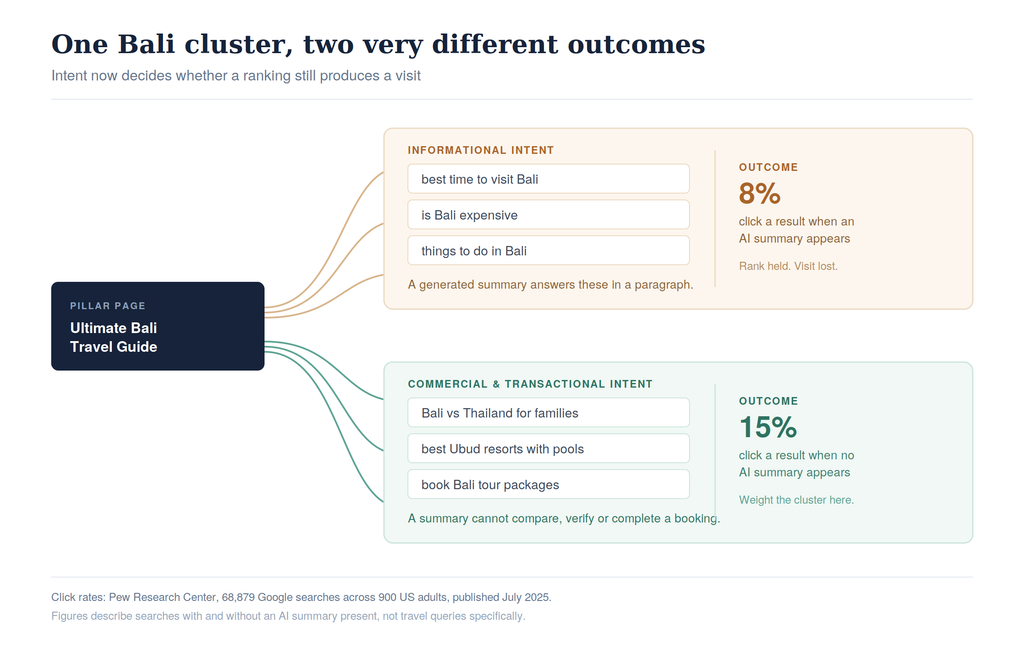
- Pew found users click a result on 8% of visits where an AI summary appears, against 15% without.
- Clustering now serves citation and coverage, not only ranking position.
- Let the SERP decide cluster boundaries rather than your own assumptions.
- Bounce rate is not a Google ranking signal and never was.
Why Travel Got Hit Hardest
Travel content is disproportionately exposed because it is disproportionately the kind of thing an AI summary handles well. Best time to visit, how many days you need, is it expensive, what to pack. These are exactly the questions a generated answer resolves without a click.
Pew Research Center, tracking 68,879 real searches across 900 US adults, found users clicked a traditional result on 8% of visits where an AI summary appeared, against 15% where none did. Links inside the summary itself were clicked around 1% of the time.
Sector-level reporting through 2026 has put AI Overview coverage on travel queries far above the all-query average, with travel and hospitality organic traffic down substantially year over year. Take the direction rather than any single figure, since the measurement methods vary widely and the numbers move.
The consequence for planning is specific. Position one on an informational travel query is worth considerably less than it was, while the pages that still earn visits are the ones answering something a summary cannot resolve in a paragraph.
What Clustering Actually Is
Grouping search terms by shared intent rather than shared wording, then building one page per group instead of one page per phrase.
“Bali itinerary 7 days”, “things to do in Bali for a week” and “1 week Bali travel plan” are the same request in three phrasings. Three posts targeting them compete with each other and split whatever authority the site has. One thorough guide serves all three and concentrates it.
The reason this works has not changed. Google ranks on topic coverage and intent satisfaction rather than exact-match phrases, and a well-built cluster demonstrates depth on a subject rather than presence on a keyword.
The Method
Start with a theme, not a keyword list. “Bali” is a theme. Break it into subtopics that correspond to real decisions: what to do, how long to go, where to stay, when to visit, what it costs.
Pull keywords and sort by intent before volume. Sorting by volume first is how sites end up with ten pages chasing head terms and nothing serving the searches that convert.
The four categories, correctly assigned:
| Intent | Example queries |
|---|---|
| Informational | things to do in Bali, is Bali expensive |
| Navigational | Ngurah Rai airport arrivals, Ubud area map |
| Commercial | Bali vs Thailand, best Bali resorts for families |
| Transactional | book Bali hotels, Bali tour packages |
Informational terms are the ones most exposed to AI Overviews. Commercial and transactional terms hold up better, because a booking is not something a summary completes. Weight the content plan accordingly.
Group by topic and intent together. “Bali itinerary”, “7 day Bali itinerary”, “Bali honeymoon itinerary” and “Bali itinerary for first timers” share both, so they belong on one page with sections rather than four thin posts.
Assign pillar and support roles explicitly. One page owns the broad term. Supporting pages take the narrower variations and link up to the pillar. Writing the roles down is what prevents the same keyword being targeted twice eighteen months later.
Validate against the SERP. Search each keyword in a cluster and compare the results. If the same page types rank across all of them, the cluster is real. If the results diverge, so should your pages. Let the SERP decide, not your instinct about what feels related.
Clustering for Citation, Not Only Ranking
This is the part the standard clustering advice predates, and it changes what a good cluster looks like.
Generated answers assemble from sources, which means the unit of value is no longer only the page that ranks but the passage that gets pulled. Pages built as continuous prose around a broad theme are harder to extract from than pages where each section answers one question completely and in one place.
Three adjustments follow. Write self-contained sections, so a passage makes sense lifted out of context. Put the direct answer first and the elaboration after, rather than building to a conclusion. And include the specifics a summary cannot generate: prices you checked, dates you verified, conditions you observed. First-hand detail is the thing that survives, because a model cannot produce it from other people’s pages.
Weight your clusters toward the queries where a click still happens. Comparison, booking and highly specific planning questions retain clicks that “best time to visit” no longer does. This is the same shift changing how the whole discovery layer works, and travel is simply further along it than most sectors.
Two Claims Worth Dropping
Bounce rate is not a ranking signal. Google has said so repeatedly and consistently. A clustered site genuinely does keep readers moving between related pages, which is worth having for its own sake, but the mechanism is not that Google observes bounce rate and rewards you. Clustering helps rankings through coverage, internal linking and reduced cannibalisation, and those are enough.
“Rankings went up, bounce rate went down” is not evidence. It is the standard proof pattern in SEO case studies and it demonstrates nothing without traffic, conversions and a stated timeframe. Ranking improvements in 2026 frequently arrive alongside flat or falling traffic, which is precisely the problem this article exists to address. Ask for the traffic line.
Tools, Honestly Assessed
Start with Search Console. It shows which queries already bring you impressions and where several of your own pages surface for the same term, which is cannibalisation visible for free before you buy anything.
Beyond that, any mainstream keyword research platform will export the lists you need. Dedicated clustering tools group by SERP overlap, which is genuinely faster than doing it manually at scale and produces roughly what careful manual work produces on a few hundred keywords. Verify tool availability before committing a workflow to it, since this category turns over quickly and several once-standard options no longer exist.
The judgement is not automatable. A tool can tell you which keywords cluster. It cannot tell you which clusters are worth building for a site with limited authority, and that decision determines whether the work pays for itself. Broadly the same evaluation logic applies here as when assessing anyone offering to do it for you.
Conclusion
Clustering still works, and it matters more than it did, because a site with clear topical structure is easier for both ranking systems and answer engines to read.
What has changed is the target. Building clusters to own informational keywords produces rankings on queries that no longer send anyone anywhere. Build them around the questions where someone still needs your page, fill them with detail nobody can generate, and structure each section so it can be quoted. That is the version of this method that survives the next two years.
Read Next
- ChatGPT Is Officially a Search Engine Now. Every 2026 Marketing Forecast Just Aged Badly.
- How to Evaluate an SEO Agency: What to Check Before You Sign
- Google Maps Business Data: What You Can Extract, Store, and Send
FAQs
Keyword clustering groups search terms by shared intent rather than shared wording, then builds one page per group instead of one page per phrase. “Bali itinerary 7 days”, “things to do in Bali for a week” and “1 week Bali travel plan” are the same request phrased three ways, so they belong on one page rather than three that compete with each other.
Yes, but the target has changed. Clustering still helps ranking systems and answer engines read a site\u2019s topical structure. What no longer pays is building clusters around broad informational keywords, since those are the queries AI summaries resolve without a click. Weight clusters toward comparison, booking and specific planning questions where a click still happens.
Search each one and compare the results. If the same types of pages rank across all the keywords, they share intent and belong on one page. If the results diverge, split them. Letting the SERP decide the boundary is more reliable than judging which terms feel related, because Google has already answered the question for you.
No. Bounce rate is not a Google ranking signal, and Google has said so repeatedly. Clustering improves rankings through fuller topic coverage, cleaner internal linking, and the removal of pages competing for the same term. A clustered site does keep readers moving between related pages, which is worth having, but that is a business benefit rather than a ranking mechanism.