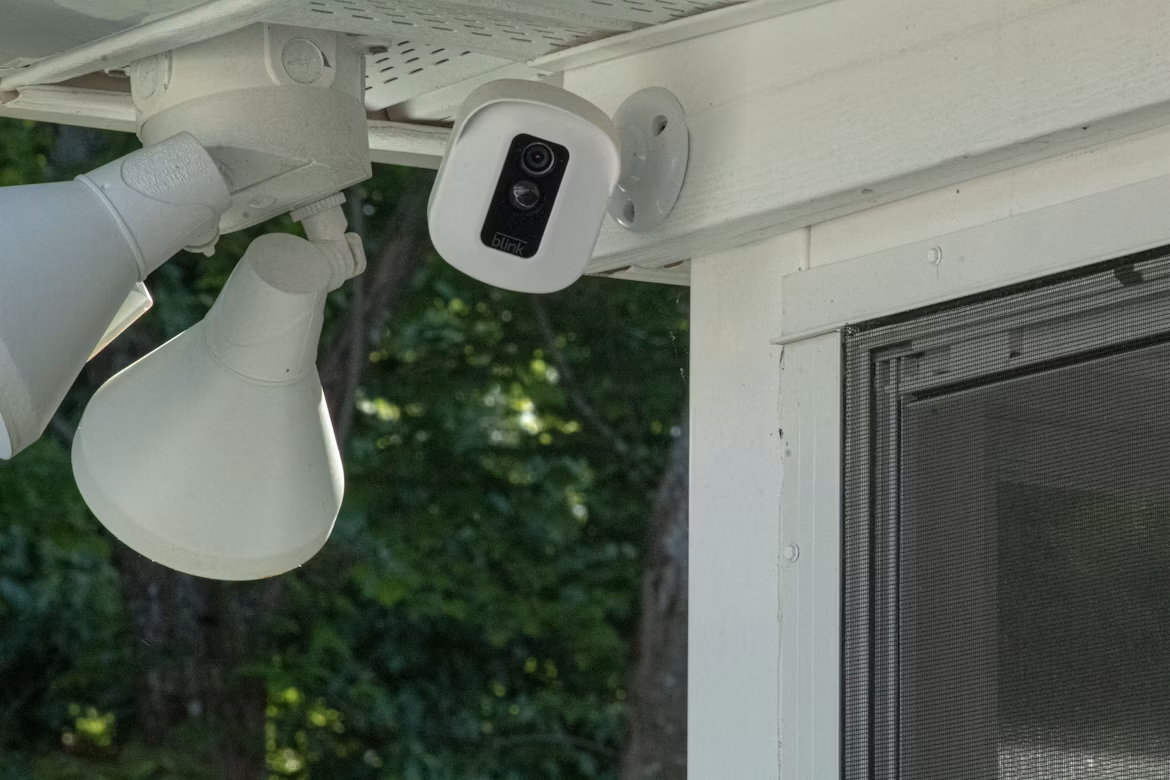
In the security and surveillance field, the model where security teams relied on a single local backend device to store all surveillance footage was once widely adopted. As enterprises expanded across regions, the flaws of local hard drives being prone to failure, vulnerable to theft, and filling up with data in a very short period gradually became prominent. Today, Hikvision’s cameras use remote cloud storage, which allows users to access surveillance footage anytime and anywhere. This paper will next explore how cloud storage reshapes modern surveillance, why it outperforms local recording, and the practical impacts of this transition on key areas, including security and scalability.
Table of contents
- How Cloud Storage Is Transforming Video Surveillance
- What Makes Remote Storage for Hikvision Cameras Different
- Cloud Storage vs. Local Storage: A Practical Comparison
- Scalability Without New Hardware
- Simplifying Multi-Site Monitoring
- Data Security and Cybersecurity Considerations
- Real-World Adoption Trends
- Conclusion
How Cloud Storage Is Transforming Video Surveillance
For years, video surveillance meant local hardware. A DVR captured analog feeds, while an NVR handled IP cameras and stored recordings on attached drives. The footage stayed on-site, which sounded secure until the device itself became the weak point.
Cloud storage flips that arrangement. Recordings travel over the network to remote servers, where they sit safely off-site. This change does more than free up shelf space. It turns surveillance into a flexible, accessible system that fits how modern businesses actually operate, often across many buildings and time zones.
What Makes Remote Storage for Hikvision Cameras Different
Hikvision builds some of the most widely deployed IP cameras and recorders in the world. Many sites already run this equipment, which makes the storage decision practical rather than theoretical.
Moving to the cloud does not require ripping out existing gear. Organizations that already use Hikvision equipment increasingly adopt remote storage for Hikvision cameras to reduce dependence on local recording devices and ensure footage remains accessible from any location.
That accessibility matters. A manager can review an incident from a phone, a laptop, or a central dashboard without ever stepping into the room where the NVR sits.
Cloud Storage vs. Local Storage: A Practical Comparison
Local storage works fine until something goes wrong. A drive fails, a flood hits the equipment room, or a thief walks off with the recorder and the evidence inside it. When that happens, the footage is gone for good.
Cloud storage for surveillance cameras removes that single point of failure. Here is how the two approaches compare:
- Reliability: Local drives wear out and crash. Cloud platforms keep redundant copies across multiple servers.
- Access: On-site storage ties you to one location. Cloud access works from any device with permission.
- Theft protection: Stealing the recorder also steals the evidence. Cloud footage stays safe off-site.
- Maintenance: Hardware needs manual upkeep and replacement. Cloud providers handle infrastructure for you.
None of this means hardware disappears entirely. Many setups keep an NVR for short-term recording and push critical footage to the cloud for long-term retention.
Scalability Without New Hardware
Growth used to mean buying more storage. Add cameras, and you needed bigger drives or another recorder. That cost climbed quickly and capped how far a system could stretch.
Video surveillance cloud storage scales differently. You adjust capacity through a subscription instead of a purchase order. Add ten cameras at a new branch, and the cloud absorbs the extra footage without a hardware project.
This flexibility helps growing companies most. A retailer opening new stores or a logistics firm adding warehouses can expand coverage without rebuilding the entire surveillance backbone each time.
Simplifying Multi-Site Monitoring
Watching one building is simple. Watching twenty is where local storage falls apart. Each site keeps its own recorder, and pulling footage means logging into separate systems or traveling between locations.
Cloud platforms bring every feed into one place. A security team can monitor multi-site surveillance from a single interface, switching between locations in seconds.
That central view delivers real advantages:
- One login for all cameras across every site
- Faster investigations because footage from any location is a click away
- Consistent policies for retention and access applied everywhere at once
For businesses with distributed operations, this is often the strongest reason to switch. IP camera cloud storage turns scattered systems into one coordinated network.
Data Security and Cybersecurity Considerations

Is off-site cloud storage for CCTV surveillance footage secure? The answer to this question first depends on the qualifications
and system configurations of the storage service provider. Legitimate cloud storage platforms support encryption for both data in transit and data at rest, and they also automatically push security updates to patch vulnerabilities. By
contrast, outdated local Network Video Recorders (NVRs) often become targets of cyberattacks because they never receive security patches. Users must still implement three core security measures: strong passwords, multi-factor
authentication, and granular access permissions. Cloud storage only shifts the core operational and maintenance burden, and it does not eliminate users’ security responsibilities.
Real-World Adoption Trends
Adoption is climbing across industries that once defaulted to local recording. Retail chains, schools, healthcare facilities, and property managers are all moving toward Hikvision cloud storage as part of broader infrastructure upgrades.
A few patterns stand out:
- Hybrid setups are common, pairing on-site NVRs with cloud backup for the best of both.
- Remote work has pushed demand, since managers now expect to check feeds from anywhere.
- Compliance needs drive longer retention, which cloud capacity handles more easily than physical drives.
The direction is clear. As surveillance systems grow more distributed and bandwidth keeps improving, cloud storage moves from a nice option to a standard expectation. Organizations that delay often find their old hardware-bound systems harder and costlier to maintain.
Conclusion
Cloud storage can break through the local hardware constraints of traditional video surveillance, delivering five core values: flexible capacity expansion, data security, convenient data access and storage, controllable costs, and low-burden operation and maintenance. We have launched a compatible remote cloud storage solution for existing enterprises that deploy Hikvision IP cameras, NVRs, and DVRs. This solution enables the construction of a highly resilient surveillance system without requiring enterprises to retire their original hardware, making it a sensible choice for growth-oriented organizations.