Artificial intelligence has moved from answering typed questions in a chat window to holding surprisingly natural conversations over the phone. Modern voice AI can recognize intent, answer questions, collect information, schedule appointments, route calls and interact with business software, all without human receptionists picking up the phone.
For businesses, particularly those handling a high volume of incoming calls, the technology presents an obvious opportunity. AI receptionists do not need breaks, can manage multiple conversations simultaneously and can potentially reduce the cost of handling routine inquiries.
But there is another side to the equation.
A phone call is often more than an exchange of information. For many companies, it is the first meaningful interaction between a prospective customer and the business. That raises an increasingly important technology question: Should AI replace the human receptionist, or should it be used to make human customer service more efficient?
The answer depends largely on what businesses expect the technology to accomplish.
Key Takeaways
- AI voice technology has evolved to conduct natural conversations, providing businesses with opportunities to manage calls efficiently.
- AI receptionists excel in handling repetitive tasks, scalability, and availability, whereas human receptionists offer empathy and adaptability.
- The cost-effectiveness of AI goes beyond simple wage comparisons; businesses must consider the potential loss of high-value prospects due to automation mistakes.
- The optimal solution may involve a combination of AI and human receptionists, where each handles the tasks suited to their strengths.
- Businesses should assess the nature of incoming calls to determine whether to implement AI, human receptionists, or a blend of both.
Table of contents
- What Has Changed with AI Voice Technology and Human Receptionists?
- Where AI Receptionists Have the Advantage
- Where Human Receptionists Still Have the Advantage
- The Cost Question Is More Complicated Than It Appears
- Human Receptionists Have Limitations, Too
- The Future May Be AI Plus Human, Not AI Versus Human
- Choosing Based on the Conversation, Not the Technology
What Has Changed with AI Voice Technology and Human Receptionists?
Traditional automated phone systems were relatively simple. Callers listened to menus, pressed numbers and followed predefined paths. Anyone who has repeatedly pressed zero while trying to reach a person knows the limitations of that model.
Generative AI and advances in natural language processing have changed the experience considerably.
Modern AI voice agents can interpret spoken requests instead of relying entirely on menus. Combined with speech recognition, text-to-speech technology, large language models and integrations with CRM or scheduling platforms, an AI receptionist can potentially complete tasks rather than simply redirect calls.
A caller might say, “I need to move my appointment from Tuesday afternoon to sometime Friday morning,” and an appropriately integrated system can understand the request, check available appointments and respond conversationally.
That represents a substantial technological improvement.
Research also suggests consumers recognize that progress. Capgemini Research Institute reported in 2025 that 71% of consumers who had used customer-service chatbots believed their quality had improved during the previous one to two years. At the same time, the research found an important distinction: consumers tended to value virtual agents for speed and convenience, while preferring humans for empathy and creative problem-solving.
That distinction may ultimately determine where AI reception technology succeeds.
Where AI Receptionists Have the Advantage
The clearest advantage is scalability.
A human receptionist can realistically handle one phone conversation at a time. Software does not face the same limitation. An AI system can potentially manage many simultaneous interactions, making it attractive to organizations experiencing sudden spikes in call volume.
Availability is another benefit. AI systems can operate outside conventional office schedules without requiring night shifts or additional staffing.
They are also well suited to repetitive, structured interactions. Questions about business hours, locations, appointment availability, order status or basic policies rarely require emotional intelligence or complex judgment. Automating these conversations can reduce the amount of repetitive work handled by employees.
Consistency may also improve. Once properly configured, AI can follow the same workflow for every call, collect required information and transfer data directly into connected systems.
For high-volume, predictable interactions, those advantages are difficult to ignore.
Where Human Receptionists Still Have the Advantage
The difficulty begins when conversations stop being predictable.
Imagine two callers contacting the same law firm.
The first asks what time the office closes.
The second explains that a family member has just been injured and they do not know what to do next.
Technically, both are incoming calls. From a customer-experience perspective, they are entirely different interactions.
Human receptionists can recognize hesitation, frustration, fear, confusion and urgency. They can change their tone, ask an unexpected follow-up question or simply allow someone additional time to explain a complicated situation.
AI systems can increasingly detect sentiment and imitate empathetic language, but recognizing an emotional pattern is not necessarily equivalent to understanding the circumstances surrounding it.
Consumer research continues to show this gap. ServiceNow’s 2025 Consumer Voice Report found that 70% of surveyed consumers expected humans to perceive their emotions, while only 42% believed AI chatbots could do so.
The difference becomes particularly important for industries such as healthcare, legal services, home services and other businesses where an incoming call may involve distress, uncertainty or significant financial consequences.
There is also the question of improvisation.
Businesses can create extensive AI knowledge bases, but customers have an impressive talent for asking the one question nobody anticipated.
A trained receptionist can interpret an unusual request, determine who should handle it and adapt. AI may instead require an escalation path — meaning the human has not disappeared from the process after all.
The Cost Question Is More Complicated Than It Appears
AI is frequently presented as the less expensive option, and at sufficient scale that can certainly be true.
However, comparing software costs with receptionist wages alone oversimplifies the calculation.
Businesses also need to consider implementation, integrations, monitoring, training data, security, maintenance and what happens when automation fails. There is also a less visible cost: the value of a mishandled prospective customer.
If an automated receptionist saves money on hundreds of routine calls but loses several high-value prospects because it cannot properly understand their circumstances, the efficiency calculation changes.
The relevant metric is therefore not simply cost per call.
It is cost per successfully handled interaction.
That distinction is likely to become increasingly important as businesses evaluate customer-facing AI.
Human Receptionists Have Limitations, Too
A balanced comparison also requires acknowledging that people are not infinitely scalable.
Human receptionists need breaks, training and manageable workloads. During sudden call surges, callers may wait or reach voicemail. Performance can vary between employees, and repetitive administrative work can consume time that could be spent on more valuable interactions.
A professional human-led receptionist service can address some of these limitations by extending a company’s front-desk capabilities without requiring every call to be handled internally. Meanwhile, AI can further reduce repetitive work by assisting with information retrieval, call classification, summaries and workflow automation.
This is where the debate becomes more interesting than simply choosing “AI or human.”
The Future May Be AI Plus Human, Not AI Versus Human
The most effective reception model may ultimately assign each side the work it performs best.
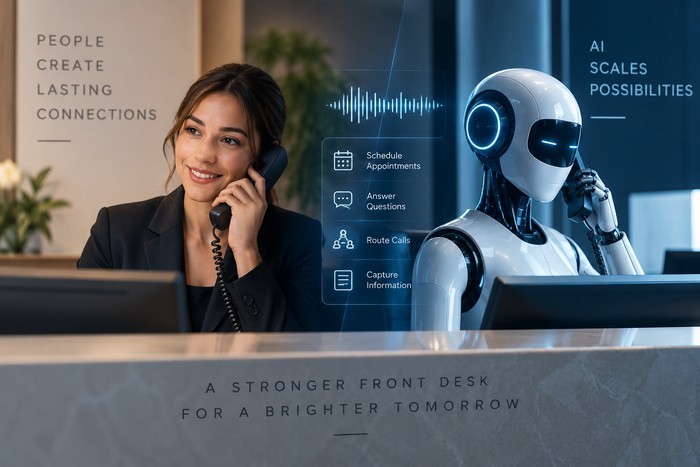
AI can handle repetitive tasks, identify caller intent, retrieve information, summarize conversations, update systems and assist with routing. Humans can take responsibility for conversations requiring judgment, persuasion, reassurance, flexibility or empathy.
Consider an AI system that analyzes incoming calls before routing them. Straightforward requests could be handled automatically, while complicated or sensitive conversations could immediately reach a trained receptionist. AI could then generate notes and update the CRM after the conversation.
In that model, automation does not replace the receptionist.
It removes some of the mechanical work surrounding the receptionist.
This mirrors a broader development occurring across customer-service technology. The most useful AI implementations increasingly appear to be those that determine which tasks should be automated, rather than assuming every task should be.
Choosing Based on the Conversation, Not the Technology
Businesses considering AI reception technology should begin with a simple exercise: examine why customers actually call.
If most conversations involve predictable questions and structured transactions, automation may handle a substantial percentage effectively.
If calls frequently involve complex decisions, emotional circumstances, sales opportunities or customers who need reassurance, maintaining access to a human receptionist becomes considerably more important.
A live receptionist service and an AI voice agent therefore should not necessarily be viewed as competing technologies. They can occupy different parts of the same customer-communication infrastructure.
AI is becoming faster, more conversational and increasingly capable of taking action across connected business systems. Those capabilities will continue to improve.
But the objective of customer service has never been merely to answer a phone.
It is to understand why someone called and help them reach the right outcome.
For some conversations, technology can now do that remarkably well. For others, the most advanced feature a business can offer may still be a person who understands the difference.