An autonomous vehicle can detect an obstacle, calculate a route, and navigate a designated road. But what happens when a container is not ready for collection, a transport lane becomes blocked, or several vehicles need to reach the same loading area at once?
These situations reveal the real value of artificial intelligence in autonomous vehicles. The challenge is not simply to make vehicles move without drivers. It is to help them interpret changing conditions, make appropriate decisions, and operate as part of a coordinated transportation system.
For logistics companies, port operators, and industrial facilities, this distinction matters. Transportation efficiency depends on more than driving performance. Loading schedules, fleet utilization, energy consumption, equipment availability, and communication between systems all influence the outcome.
Artificial intelligence is helping autonomous vehicles become more responsive to these demands. When combined with intelligent fleet management and operational data, it can support a more practical approach to automation—one focused on improving how goods move from one point to another.
Key Takeaways
- Artificial intelligence in autonomous vehicles enhances decision-making, route optimization, and fleet coordination under changing conditions.
- AI helps vehicles interpret sensor data, recognize patterns, and manage operational challenges in logistics environments.
- Businesses should evaluate AI’s impact by measuring specific transportation problems and their operational performance.
- Phased implementation reduces risks and allows businesses to assess the real value of AI-powered autonomous vehicles.
- Westwell offers solutions like Qomolo and Cosmo to integrate AI in logistics, improving efficiency and connectivity across operations.
Table of contents
- What Does Artificial Intelligence Actually Do in Autonomous Vehicles?
- Four Business Problems AI Can Help Solve for Autonomous Vehicles
- Where Artificial Intelligence in Autonomous Vehicles Makes the Most Sense
- Why AI Alone Is Not Enough
- How to Introduce AI-Powered Autonomous Vehicles Without Disrupting Operations
- How Westwell Is Bringing AI into Intelligent Logistics
- How to Measure the Real Value of AI-Enabled Autonomous Transportation
- The Future Is About Intelligent Transportation, Not Just Driverless Vehicles
- Frequently Asked Questions
What Does Artificial Intelligence Actually Do in Autonomous Vehicles?
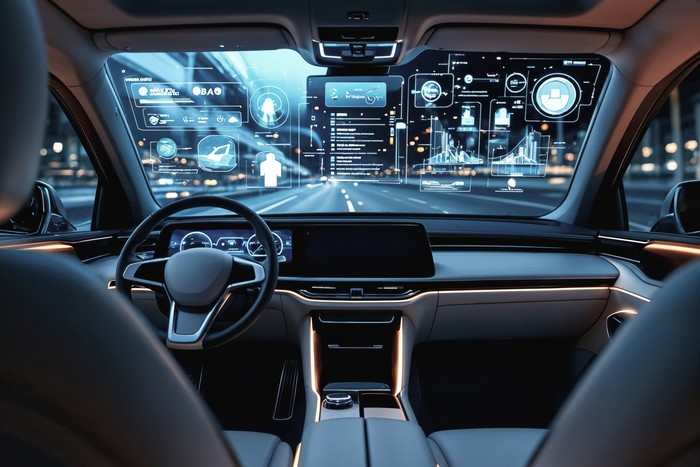
Artificial intelligence is not a single technology responsible for every autonomous driving function. It is a collection of methods that help vehicles interpret information, recognize patterns, predict potential developments, and support decisions.
Understanding these functions helps businesses distinguish between an impressive technical demonstration and a solution that can address everyday operational challenges.
1. Computer Vision and Environmental Perception
An autonomous vehicle must understand what is happening around it before deciding how to move.
Cameras, lidar, radar, and positioning systems provide information about the surrounding environment. AI algorithms process these inputs to identify objects, estimate their positions, and help distinguish moving vehicles from stationary equipment or other obstacles.
Consider a container terminal where trucks, cranes, and other equipment operate in close proximity. A vehicle must recognize relevant objects, understand its position, and respond appropriately when its planned route is obstructed.
Combining multiple sensor inputs can improve environmental awareness, although performance still depends on sensor quality, system design, operating conditions, and the ability to handle unusual situations.
For businesses, the practical question is whether the perception system can perform reliably within the intended operating environment—not simply whether it works under ideal test conditions.
2. Predictive Decision-Making in Autonomous Vehicles
Recognizing an obstacle is only the first step. An autonomous vehicle must also decide what to do next.
AI-supported decision systems can use environmental information and movement patterns to help estimate how situations may develop. The vehicle can then evaluate possible actions, subject to its driving rules, safety constraints, and operating limits.
For example, if another vehicle blocks a transport lane, the system may need to determine whether to wait, select an approved alternative route, or request assistance.
In logistics environments, these decisions can influence more than individual vehicle movement. A delay involving one vehicle may affect subsequent transport assignments, loading schedules, and the availability of other equipment.
The objective is to make decisions that support safe and predictable operations rather than simply choosing the shortest route.
3. Route Optimization and Fleet Coordination
Route planning becomes more complicated when multiple vehicles operate simultaneously.
A route that is optimal for one truck may create congestion when assigned to several others. Likewise, sending every available vehicle toward the same loading area can increase waiting time instead of improving throughput.
AI-enabled planning can help evaluate changing traffic conditions, task priorities, and vehicle availability. When connected to fleet dispatch systems, these capabilities can support more coordinated task assignments.
The result depends on the quality of the operational data and the way scheduling rules are designed. AI cannot compensate for missing cargo information or poorly defined workflows on its own.
This is why intelligent transportation requires both capable vehicles and an effective system for coordinating their work.
Four Business Problems AI Can Help Solve for Autonomous Vehicles
For decision-makers, the most useful way to evaluate artificial intelligence in autonomous vehicles is to connect each capability with a measurable operational problem.
| Business problem | How AI can help | What companies should measure |
| Unnecessary vehicle waiting | Improve task sequencing and coordinate transport with loading readiness | Waiting time and completed tasks per shift |
| Inefficient routes | Evaluate alternative routes and changing traffic conditions | Travel time, empty travel, and route deviations |
| Unplanned maintenance | Analyze vehicle data to identify potential maintenance needs | Unplanned downtime and maintenance frequency |
| Poor fleet visibility | Combine vehicle and operational data to improve dispatch decisions | Vehicle utilization and task completion rates |
These are potential benefits, not automatic outcomes. Their magnitude depends on the application, system integration, operational discipline, and baseline performance.
Companies should establish measurable targets before implementation rather than assuming that adding AI will necessarily improve every metric.
Where Artificial Intelligence in Autonomous Vehicles Makes the Most Sense
Although autonomous driving attracts attention in passenger transportation, industrial and logistics environments offer a different opportunity. Many operations involve recurring transport tasks, defined destinations, and workflows that can be measured.
This makes certain applications particularly suitable for carefully planned automation.
Smart Ports and Container Terminals
Container terminals coordinate vehicles, cranes, storage areas, and cargo movements under demanding time constraints.
When transport schedules and equipment availability are poorly synchronized, vehicles may spend significant time waiting for containers or access to loading areas.
AI-enabled autonomous transport can help improve vehicle movement, while connected dispatch systems can coordinate assignments with broader terminal activities.
However, effective implementation requires more than installing autonomous trucks. Operators must also consider terminal operating systems, traffic rules, equipment interfaces, exception handling, and procedures for interacting with manually operated vehicles.
The goal is to improve the flow of containers through the terminal, not simply to increase the number of driverless trucks.
Airports and Air Cargo Facilities
Air cargo operations involve time-sensitive movements between cargo terminals, warehouses, and other designated areas.
AI-enabled autonomous vehicles can support repetitive transport tasks where routes, access requirements, and operating conditions are suitable. Intelligent scheduling can also help align vehicle assignments with cargo availability and handling priorities.
Before deployment, operators need to verify airside permissions, security requirements, safety procedures, and integration with existing cargo management systems.
Factories and Industrial Parks
Manufacturing operations rely on predictable material flows. When components arrive late at production stations or finished goods cannot be moved promptly, transportation delays can affect the wider production process.
Autonomous vehicles can support internal transportation between warehouses, production lines, and designated transfer points.
When connected with warehouse or manufacturing systems, AI-supported dispatching can help align transport tasks with material demand. This can reduce unnecessary coordination and make internal logistics easier to monitor.
The strongest starting point is often a repetitive, measurable workflow with a clear operational bottleneck.
Why AI Alone Is Not Enough
A common misconception is that a more advanced AI model automatically creates a better autonomous transportation solution.
In practice, performance depends on the entire system.
An autonomous vehicle may navigate accurately but still operate inefficiently if its task assignments are outdated. A fleet management platform may generate an efficient schedule but fail to deliver the expected result if the loading equipment is unavailable.
There are four important considerations.
Data quality: Vehicle location, cargo status, equipment availability, and task information must be sufficiently accurate and timely.
System integration: Autonomous vehicles need appropriate interfaces with the operational platforms that coordinate transportation and cargo handling.
Safety and exception management: The system must define how vehicles respond to uncertain conditions, communication failures, blocked routes, and situations requiring human intervention.
Energy and maintenance planning: Charging, battery availability, inspections, and maintenance can all affect fleet availability.
These considerations become especially important when businesses move from a small pilot to a larger operation.
How to Introduce AI-Powered Autonomous Vehicles Without Disrupting Operations
For businesses considering automation, a phased approach can reduce implementation risk and provide clearer evidence of value.
Step 1: Identify the Bottleneck
Begin by examining existing transportation processes.
Are vehicles spending too much time waiting? Are transport assignments difficult to coordinate? Do recurring internal movements require excessive manual intervention?
Choose a problem that can be measured before and after deployment.
Step 2: Define the Operating Conditions
Map the intended routes, intersections, loading areas, traffic patterns, and interactions with other equipment.
Determine which tasks can be automated under the proposed operating conditions and which situations require a controlled stop or human assistance.
A realistic operating scope is more useful than an ambitious plan that ignores site-specific constraints.
Step 3: Evaluate the Complete Solution
Assess vehicle capabilities alongside fleet scheduling, communication infrastructure, software integration, energy management, and operational support.
Ask how the system handles interrupted tasks, changing priorities, unavailable equipment, and other exceptions.
A solution should fit the existing operation or provide a clear, manageable path toward the necessary changes.
Step 4: Run a Measurable Pilot
Select a defined workflow and establish baseline metrics.
Track completed transport tasks, waiting time, vehicle utilization, energy consumption, interventions, and unplanned downtime. Include realistic operating conditions rather than evaluating the system only during demonstrations.
Step 5: Scale Based on Evidence
Review the results with operations, engineering, safety, and management teams.
If the pilot demonstrates reliable performance and measurable benefits, expand gradually. If the expected improvements do not materialize, investigate whether the underlying problem involves vehicle capability, scheduling, data quality, or workflow design.
This approach helps organizations make expansion decisions based on operational evidence rather than technology expectations alone.
How Westwell Is Bringing AI into Intelligent Logistics
The evolution of autonomous transportation increasingly depends on connecting vehicle intelligence with the systems responsible for moving goods across an entire operation.
Westwell focuses on the intersection of AI, autonomous transport, and new-energy technologies, with solutions designed for logistics environments including ports, factories, and logistics parks.
Its official website presents an integrated portfolio that addresses both transportation and the broader coordination of industrial logistics.
Qomolo: Autonomous Transport Solutions
Westwell’s Qomolo autonomous transport solutions combine AI and new-energy technologies to support autonomous transportation. The platform is designed around autonomous driving, operational adaptability, and energy-related capabilities for different production and logistics scenarios.
This approach is relevant to businesses seeking to automate recurring transport tasks while accounting for the operational requirements of their sites.
Cosmo: Intelligent Logistics Coordination
Vehicle intelligence becomes more useful when it connects with the wider operational environment. Westwell’s Cosmo platform focuses on integrating information across sites, fleets, vessels, cargo, and energy networks to support coordinated dispatch and route optimization.
This broader perspective addresses a central challenge in industrial automation: ensuring that vehicles, equipment, and logistics workflows operate in alignment.
KEWE: Intelligent Heavy-Duty Equipment
Westwell’s KEWE offering extends its technology focus to heavy-duty industrial equipment, including port cranes and other equipment used in demanding logistics environments. AI-based vision, equipment coordination, and energy control can help support more connected operations.
Together, these solutions illustrate a system-level approach to intelligent logistics. Instead of treating autonomous vehicles as isolated machines, Westwell connects transportation with the equipment and operational systems that influence how efficiently goods move.
Businesses exploring these applications can learn more through the Westwell website.
How to Measure the Real Value of AI-Enabled Autonomous Transportation
The success of an autonomous vehicle project should be evaluated through operational performance rather than the number of vehicles deployed.
A useful evaluation framework includes:
• Throughput: How many transport tasks or cargo movements are completed within a defined period?
• Turnaround time: How long does each transport cycle take, including loading and waiting?
• Fleet utilization: How much time do vehicles spend on productive tasks compared with waiting or traveling empty?
• Reliability: How consistently are assigned tasks completed without unplanned interruption?
• Energy efficiency: How much energy is consumed per transport task or unit of cargo?
• Safety performance: How often do incidents, near misses, emergency stops, or human interventions occur?
• Total operating cost: How do maintenance, infrastructure, software, energy, and support requirements affect the overall business case?
These indicators should be reviewed together. For example, higher utilization is not necessarily a success if it increases maintenance pressure or reduces safe operating margins.
A credible business case compares the total cost and performance of the proposed system with the existing operation, using realistic assumptions about workload, availability, and future expansion.
The Future Is About Intelligent Transportation, Not Just Driverless Vehicles
Artificial intelligence in autonomous vehicles is progressing beyond basic object recognition and route following. Its broader opportunity lies in connecting perception, decision-making, fleet scheduling, and operational data to improve how transportation systems respond to changing demands.
Yet the technology is only one part of the equation. Reliable deployment also requires suitable operating environments, robust safety procedures, effective system integration, and clear performance measures.
For logistics businesses, the best starting point is a practical one: identify a recurring transportation problem, select a suitable application, and evaluate whether AI-enabled automation produces measurable improvements.
Westwell’s combination of autonomous transport and intelligent logistics coordination reflects this broader direction. As businesses seek more efficient and sustainable ways to move goods, the competitive advantage will increasingly come from connecting intelligent vehicles with the operations around them.
The real promise of AI is not simply that a vehicle can drive itself. It is that the entire transportation process can become more coordinated, predictable, and responsive to business needs.
Read Next
A few related pieces worth your time:
- Smartyme Refund Policy Explained: What You Need To Know
- What It Takes to Ship a HIPAA-Compliant Mobile Health App in 2026
- Top Data Platform Development Companies: A Technical Evaluation Guide
Frequently Asked Questions
1. What is the role of artificial intelligence in autonomous vehicles?
AI helps autonomous vehicles process sensor data, recognize surrounding objects, support route planning, and respond to changing conditions. In logistics applications, it can also support fleet coordination and energy-aware scheduling when connected with suitable operational systems.
2. What are the biggest challenges of using AI in autonomous vehicles?
Key challenges include handling unusual environmental conditions, maintaining reliable sensor and positioning data, integrating vehicles with existing operational systems, and managing safety-critical exceptions. Businesses must also consider maintenance, cybersecurity, regulatory requirements, and the suitability of the operating environment.
3. How can businesses determine whether AI-powered autonomous vehicles are worth implementing?
Businesses should establish baseline measurements, identify a specific operational bottleneck, and conduct a controlled pilot. Comparing throughput, waiting time, vehicle utilization, energy consumption, maintenance, and total operating costs can help determine whether the solution delivers sufficient operational value to justify expansion.