


Weather conditions always affect daily travel, agricultural production, electricity generation, etc. Weather data incorporation into the machine learning today helps businesses make better decision, plan operations, and even handles changing conditions.
Patterns influencing real-world outcomes can be recognized through historical observation and current forecasts here. Keep reading to learn more about the weather data’s role in machine learning models.
Key Takeaways
- Weather data enhances machine learning models by providing context for predictions in agriculture, energy, transportation, and retail.
- Machine learning benefits from both historical data and weather forecasts to improve accuracy in predicting outcomes.
- Data scientists must collect relevant and accurate weather data, create useful variables, and match it with business data for effective use.
- Challenges include varying data formats, extreme event prediction difficulties, and climate change affecting historical data relevance.
- Success relies on the careful selection of variables, data matching, and thorough testing of model performance.
Table of contents
Importance of Weather Data in Machine Learning
Machine Learning models today understand the relationship between input variables and the outcomes needed for predictions. Temperature, wind, precipitation, etc., are weather conditions influencing these results in different ways.
For example, rainfall may increase traffic delays, and rises in temperature could similarly increase electricity demand. Rainfall forecasts therefore help farmers to plan irrigation. Temperature changes also assist retailers to estimate the demand for seasonal products.
The addition of relevant data variables thus helps the model account for environmental conditions. They might otherwise affect its predictions unexpectedly. The benefit, however, depends on data quality, location, etc.
How Weather Data Improves Model Accuracy
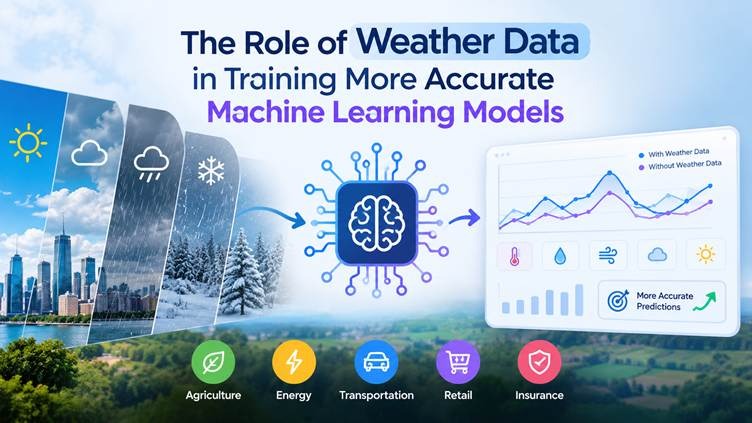
Weather data assist ML in these two main ways:
1. Learning From Historical Patterns
Historical data helps them understand the relationship between environmental conditions and a particular outcome. Suppose a weather dataset helps a model learn the weather’s effect on energy demand in different seasons.
Enough representative data may also used here to improve predictions for new situations. ML systems also know difficult interactions between multiple variables.
2. Making Predictions With Forecast Data
Information available after the prediction happens is also needed in live applications. Although historical data is useful to describe past incidents, ML uses weather forecasts to predict the future.
ML models usually learn the way in which the target outcome was affected by forecast uncertainty through their training on historical data. This is especially useful for making predictions for solar power generation, taxi demand, etc., several hours or days in advance.
Practical Machine Learning Applications Across Industries
Weather-aware machine learning supports these public services:
● Agriculture: Rainfall, temperature, soil conditions, and satellite imagery are combined in this model to estimate crop yields, schedule irrigation, etc,
● Energy: Sunlight, wind, and even temperature forecasts are useful to estimate renewable electricity production & future energy consumption.
● Transport: It is also helpful in estimating delays and adjusting routes or staffing in taxi operators, shipping companies, delivery services, etc.
● Retail: It tests temperature, rainfall, and historical sales to estimate the demand for seasonal goods.
● Insurance: Weather-related risk models also predict potential losses from storms, floods, etc.
They show improvement in prediction beyond weather forecasting through the environmental information here.
Preparing Weather Data for Machine Learning
Data scientists must ensure that the available information is correct and relevant for the prediction task before training their ML models here. This is why they should follow these steps:
● They should collect required variables from reliable sources. Data scientist should also ensures that missing observations, incorrect timestamps, and sensor errors are not there.
● They should then create useful variables like hour of the day, day of the week, rainfall totals, etc. Models can therefore understand seasonal and time-dependent patterns.
● Data scientists must later match business data with the weather pattern with the use of the correct location and timestamp. It is important to avoid incorrect matches and potential errors in prediction.
● They must lastly select the variables most relevant to the outcome. Unnecessary information must also be excluded because it could increase complexity without improving predictive performance.
Challenges of Using Weather Data
Several challenges are also there when working with weather data. Data could come at different time intervals, geographic resolutions, and formats. Errors can also be there due to missing observations, inconsistent timestamps, etc.
Extreme events like floods or hurricanes are also difficult to predict because they happen rarely compared to other regular weather conditions. Climate change may also reduce the historical data’s usefulness at a time of shift in the environmental condition,
The team should therefore evaluate their dataset and test their model on unique data to fix these issues. They should also retrain the system after getting the new information. Although MAE, RMSE, and other evaluation metrics are helpful to measure the prediction errors, feature-importance methods show the exact variables influencing model outputs.
Read Next
A few related pieces worth your time:
- Most Popular Streaming Services on US TV Aren’t What You Expect
- The Benefits of Collaborating with a Website SEO Company
- A Leap into Terabytes: How Energy Trading Platforms Are Ruling the Global Era
Conclusion
Weather data adds more context related to predictions across agriculture, energy, transportation, retail, etc., to the machine learning models. These additions make them more accurate for future prediction.
Success, meanwhile, depends on selecting suitable variables, matching data, and testing performance against t a reliable baseline. Businesses can later use these predictions to plan more effectively and make more informed decisions after getting the right data.