Most creators don’t have a content problem. They have a tool problem. You’re subscribed to one platform for AI video, another for voice cloning, a third for background removal, and a fourth just to generate headshots. Each has its own credit system, its own login, its own learning curve and its own monthly invoice. Before you’ve published a single post, you’ve already lost 45 minutes and $80 to your stack. This is the trap that Magic Hour was built to escape.
Key Takeaways
- Magic Hour is an all-in-one AI creative platform that consolidates multiple tools for video, image, and audio production.
- It offers over 100 tools, including text-to-video, face swap, and voice cloning, all accessible under one subscription.
- The platform eliminates the need for multiple subscriptions, reducing costs and context switching for creators.
- Magic Hour supports professional workflows, enabling parallel rendering and integration with automated content pipelines.
- With a generous free tier, creators can test features before committing, simplifying content creation processes.
Table of contents
What Is Magic Hour?
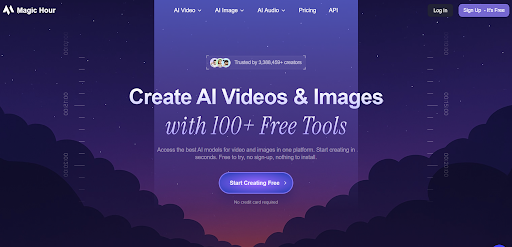
Magic Hour is an all-in-one AI creative platform combining over 100 tools across video, image, and audio production. It’s entirely browser-based no downloads, no installs, no hardware requirements. You sign in, pick a tool, and start creating.
The platform targets content creators, marketers, and social media producers who need professional output fast. Its core pitch is consolidation: instead of a fragmented stack, everything lives in one place, under one subscription, with one credit balance.
That promise sounds simple. The execution is what’s interesting.
The Tool Stack: What You Actually Get
Understanding Magic Hour’s value requires looking at the breadth of what it replaces.
Video Tools
Video is Magic Hour’s centerpiece. The suite covers the entire production lifecycle from raw idea to finished clip.
Text-to-Video lets you describe a scene in natural language and receive a generated clip. You control duration, aspect ratio, and visual style. It’s fast enough for social iteration, where speed often matters more than cinematic perfection.
Image-to-Video animates a static image with AI-driven camera motion. Upload a product photo, a portrait, or a piece of artwork, and the platform generates movement a slow zoom, a parallax drift, or a cinematic pan. For e-commerce brands and social media managers, this alone can replace several dedicated animation tools.
Face Swap is one of Magic Hour’s signature features. The platform’s face swap has been voted the #1 Best AI Face Swapping Software in independent testing, with realistic skin-tone matching, expression tracking, and multi-person support across photos, videos, and GIFs.
Lip Sync matches any video’s mouth movements to a new audio track. Combine this with the voice tools and you have a complete dubbed video pipeline entirely within Magic Hour.
Other video tools include Video-to-Video style transfer, AI Animation, Talking Photo (make any portrait speak), Subtitle Generator, AI Video Upscaler, AI Video Extender, and an AI UGC Ad Generator the last of which is built specifically for performance marketers who need scalable ad creatives.
Image Tools
The image suite is just as comprehensive as the video offering. Magic Hour includes an AI Image Generator, AI Image Editor (edit with natural language no Photoshop required), Background Remover, AI Headshot Generator, AI Image Upscaler, Clothes Changer, Head Swap, Body Swap, Face Editor, GIF Generator, Selfie Generator, Meme Generator, Photo Colorizer, Storyboard Generator, and QR Code Generator.
For marketers, the combination of Background Remover, AI Image Editor, and Image Upscaler already replaces three separate subscriptions. The Headshot Generator adds a fourth. All of it is accessible from the same dashboard, using the same credit balance.
Audio Tools
Audio is the newest and fastest-growing category on the platform. Magic Hour’s audio suite includes a Voice Generator (text-to-speech), Voice Cloner (clone any voice from a short audio sample), Voice Changer, Video-to-Audio, and an AI Music Generator.
The voice tools are designed to stay connected to the rest of the workflow. You clone a voice, pipe it into a Lip Sync video, and have a finished piece without ever leaving the platform. That integration is where Magic Hour diverges most sharply from standalone audio tools like ElevenLabs or Murf, which require you to export audio and re-import it elsewhere.
The Real Cost of a Fragmented Stack
Let’s run the numbers. A typical creator stack in 2026 looks something like this:
- AI video generator (Runway, Kling, or Luma): ~$15–$35/month
- AI voice tool (ElevenLabs Creator): ~$22/month
- AI image generator (Midjourney): ~$10/month
- Background remover (Remove.bg): ~$9/month
- Headshot generator (standalone tool): ~$15/month
- Lip sync tool (D-ID or HeyGen): ~$20–$29/month
That’s $91–$120 per month before you’ve touched editing. And that’s a lean stack. Many creators quietly pay for more.
Magic Hour’s plans run from free to $249/month for business accounts, with most individual creators landing comfortably on the Creator ($10/month) or Pro ($49/month) tier. The Creator plan alone replaces tools that would collectively cost $60–$100/month elsewhere.
The credits-never-expire policy is worth highlighting. Unlike Runway, which recycles credits monthly, and Luma, which doesn’t roll over credits on lower tiers, Magic Hour credits are permanent. Buy them in January; use them in July. That’s a meaningful difference for creators whose output volume fluctuates month to month.
One Platform, Not One Compromise
The standard objection to all-in-one platforms is quality. The assumption is that consolidation means mediocrity you gain convenience but lose the edge that dedicated tools deliver.
Magic Hour challenges that framing.
The face swap quality earned an independent #1 ranking in head-to-head testing. The image editor competes directly with dedicated tools. The voice cloner produces natural intonation and emotional range without the setup complexity of enterprise voice platforms. The text-to-video output is fast and flexible for short-form content the format where most creators actually publish.
Where Magic Hour concedes ground is in niche, high-specialization use cases. Extended narrative video with multi-shot character consistency is better served by Runway’s reference system. Ultra-low-latency real-time voice synthesis for conversational AI is better handled by Cartesia or Resemble AI. Magic Hour is honest about that boundary. The platform isn’t trying to replace post-production pipelines at a Hollywood scale.
For the social creator, the marketing team, the solo founder shooting product ads, and the educator building course content Magic Hour doesn’t ask you to compromise. It just removes the overhead of managing a dozen separate platforms to get there.
Context Switching Is a Hidden Tax
There’s a cost that doesn’t show up on any invoice. It’s the time spent logging into five different dashboards, translating a project across incompatible file formats, re-uploading assets that should already be available, and rebuilding creative context every time you switch tools.
Research consistently shows that context switching can reduce productive output by as much as 40%. For creative work which depends on flow and iteration the damage is even steeper. Every tool boundary is a momentum killer.
Magic Hour’s unified workspace is an answer to that. Your assets live in one place. Your credits work across every tool. Your project history is centralized. The workflow from “idea” to “finished video with voiceover” doesn’t require a handoff it’s a straight line inside a single platform.
One user’s review put it plainly: “Finally, one platform for AI video instead of juggling five different subscriptions.”
Built for Volume and Iteration
Professional content creation isn’t one video per week. It’s testing variations, generating options, comparing outputs, and publishing at pace.
Magic Hour supports queue-based parallel rendering you can run several generations simultaneously without hidden concurrency limits. That’s critical for anyone doing ad creative testing or platform-native content at scale. It also means the platform scales with professional workflows rather than throttling them.
The API and SDK support (Python, Node.js, Go, and Rust) extend that capacity further. Teams building automated content pipelines or agentic workflows can integrate Magic Hour programmatically, making it a backend engine rather than just a browser tool.
Who Magic Hour Is Built For
The platform fits a specific profile well. You’re a creator, marketer, or small team producing regular content for social platforms, ad campaigns, courses, or branded media. You’re currently paying for multiple AI tools and either frustrated by the cost or the coordination overhead. You want professional output without a professional production budget or a steep technical learning curve.
If that describes your situation, the free tier is the right place to start. Magic Hour offers 400 credits and daily replenishment with no credit card required. You can test the face swap, try a lip sync, generate an image, and run a text-to-video prompt before spending a dollar. The free experience is generous enough to validate whether the platform belongs in your workflow.
For most creators who try it, the question quickly shifts from “Is this good enough?” to “Why was I paying for five separate subscriptions?”
The Platform Direction
Magic Hour has surpassed 5 million users and continues to ship aggressively. Recent additions include an AI Music Generator, an AI Image Expander, and expanded developer tooling. The roadmap reflects where AI media creation is heading: toward convergence, integration, and workflows that move from concept to finished asset without friction.
That direction matters. The tools that will define content creation in the next few years aren’t standalone utilities they’re ecosystems. Magic Hour is building toward that ecosystem faster and more accessibly than most.
The case for consolidation has always been sound. Magic Hour makes it practical.