
The Instagram algorithm decides how far anything you post travels, and the stakes climbed again this year: US social media creator revenue will grow 16.2% to $20.6 billion in 2026 (Source: eMarketer). Distribution rules that move that much money changed twice in the past twelve months, and most advice circulating online still describes the version from 2021.
Two things make 2026 different. Instagram published which signals matter, so you no longer have to reverse-engineer them from folklore. And on 30 April, the platform made its largest ranking change in years by extending its originality rule to every content format. Both developments reward the same behavior, and both punish the shortcuts that dominated Instagram growth advice for a decade.
Key Takeaways
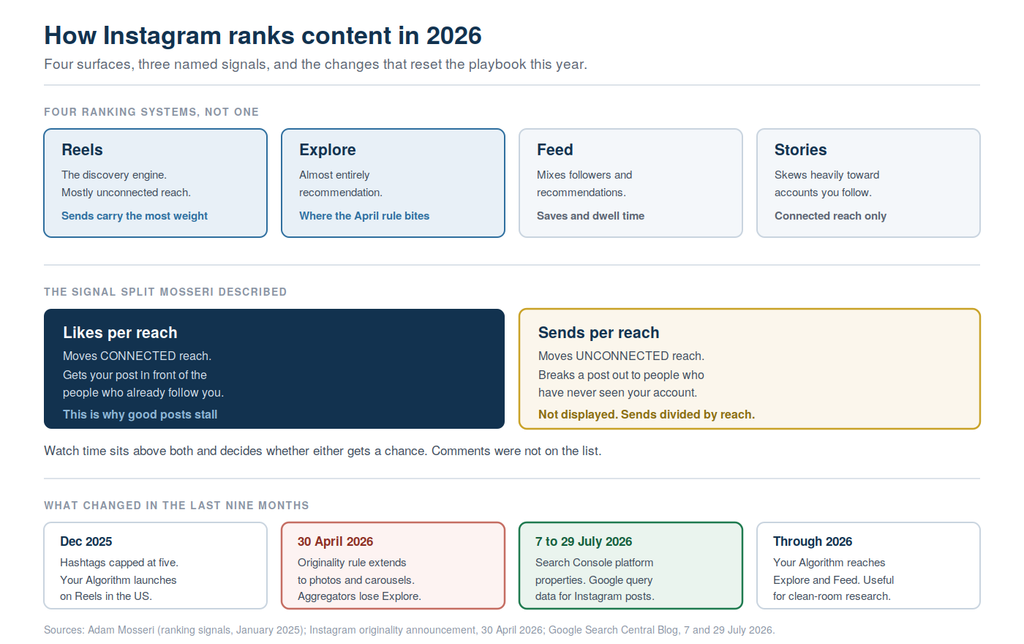
- Instagram runs separate ranking systems for Feed, Reels, Stories, and Explore.
- Watch time, likes per reach, and sends per reach are the named signals.
- Accounts that mainly repost lost recommendation eligibility in April 2026.
- Hashtags are capped at five and do not improve reach.
- Google Search Console now reports on Instagram post performance.
It is four ranking systems, not one
Talking about “the algorithm” as a single thing is the first mistake, because Feed, Reels, Stories, and Explore each run their own model.
The logic behind the split is that people use each surface for something different. Stories skew toward accounts you already follow. Explore is almost entirely recommendation, meaning content from accounts you do not follow. Reels sits in between and functions as the primary discovery engine. Feed mixes connected and unconnected content.
This is the same architecture every recommendation platform has converged on, and the way TikTok predicts what you will watch next describes the underlying pattern well. That split matters practically because the same post can perform completely differently depending on which surface carries it. A Reel with strong follower engagement and weak share behavior will do fine in Feed and go nowhere in Explore. Diagnosing a reach problem starts with asking which surface stopped working, not why “the algorithm” is punishing you.
The three signals Instagram named out loud
In January 2025, Instagram head Adam Mosseri stated which signals matter most for ranking: watch time, likes per reach, and sends per reach. He added the distinction that makes the list usable. Likes carry more weight for connected content, meaning distribution to your followers. Sends carry more weight for unconnected content, meaning recommendation to strangers.
Read that split carefully, because it explains the most common frustration in Instagram growth. A post that earns plenty of follower likes gets respectable reach and then stalls. It never produced the send signal that breaks content out to people who do not follow you. Watch time gets the audition. Sends get the scale.
Comments were not on the list. Neither was follower count, and neither was posting time. Recency still influences ordering within surfaces you already have access to, but it is not the lever that decides whether a post reaches new people.
Two more corrections worth making, since both appear in nearly every older guide. Instagram capped hashtags at five per post in December 2025, and Mosseri has said plainly that hashtags do not improve reach. Their honest job is topical signaling, particularly for search. And sends per reach is not displayed as a labeled metric anywhere, so you have to calculate it: open a post’s insights, divide sends by reach, multiply by 100. Track that number and you are tracking the thing almost nobody watches.
Why buying early engagement backfires
There is a persistent piece of advice that says Instagram watches a post’s first few hours, so purchasing likes early convinces the system your content deserves distribution. The mechanics do not work that way, and following it does measurable damage.
Every named signal is a ratio. Likes per reach. Sends per reach. Watch time relative to length. Purchased engagement from accounts that do not watch, do not share, and do not return produces a spike in one number while the denominators keep growing. The ratios fall. Worse, Instagram evaluates accounts at the account level rather than judging each post in isolation, so a depressed performance history follows you into every subsequent post rather than resetting.
There is a compliance dimension too. Purchased engagement breaches platform terms. Where it shades into fabricated endorsement of a product, US rules on consumer reviews and testimonials treat that as deceptive conduct with civil penalties attached.
The version of this advice that does work is unglamorous: post when your own audience is actually active, reply to comments in the first hour because the conversation keeps people on the post, and send the post to people who genuinely would want it. Real sends are the highest-value signal available. Fake ones are not sends at all.
The originality rule that reset the game in April
On 30 April 2026, Instagram extended a restriction that had applied only to Reels so that it now covers photos and carousels. Accounts that primarily post content they did not create are no longer recommended to people who do not follow them.
The detail most summaries miss is that this is a recommendation eligibility rule, not a ban. Existing followers still see your posts. What disappears is discovery: Explore placement, Reels tab distribution, suggested posts. Mosseri has been consistent that aggregators can keep working provided they meaningfully transform what they repost. Adding a watermark is not transformation. Narration, on-screen commentary, original graphics, and genuine editing are.
The scope is account-level, which is the part that stings. Instagram assesses the balance of your posting, so an account that is mostly original with occasional reposts sits in a very different position from one built on curation.
Two practical consequences follow. First, if you run several accounts posting near-identical cuts of the same asset, that redundancy now reads as a negative signal rather than as efficient distribution. Second, the premium on genuine production went up. The studios that treat AI as seasoning rather than the meal are describing exactly the posture this rule rewards, and it applies to reposted footage as much as to generated footage.
What each format is actually for
Format choice is a distribution decision, not an aesthetic one.
Reels are the discovery engine. If your goal is reaching people who do not follow you, this is the surface, and the first three seconds decide almost everything. Skip rate reporting now shows you exactly how many viewers scrolled past before the clip played meaningfully, which turns a vague hunch about a weak hook into a number you can work against. Video that holds attention is a structural problem more than a creative one, and the way you plan a clip before shooting it tends to matter more than the tools involved.
Carousels earn saves and considered attention. They pull swipe behavior, which extends time on the post, and they suit reference material people want to return to. They are conversion-shaped rather than discovery-shaped.
Captions do real work in search rather than in ranking. Instagram processes caption text for topical understanding, so keywords belong there rather than in a first comment. Long captions can extend dwell time, but only if people actually read them, which is a writing problem.
The mix that works for most accounts is Reels for reach, carousels for depth, and neither one padded out to hit a posting quota. Producing volume stopped being the hard part once tools for generating short video without filming became widely available. Choosing well among the volume is the constraint now, and the originality rule above sets the boundary on how far automation can carry you.
Google now reports on your Instagram posts
This one landed in July 2026 and has barely registered with social teams.
Google introduced platform properties in Search Console on 7 July 2026 and made them globally available on 29 July. They let you verify an Instagram, TikTok, X, or YouTube account as a Search Console property and see how those posts perform in Google Search, Discover, and Google News. No website ownership required, which makes it the first Search Console property type that does not assume you own a domain.
You get clicks, impressions, click-through rate, average position, and, most usefully, the actual queries sending people to your posts. Google also published a guide alongside the global rollout covering cross-platform export and comparison.
For anyone treating Instagram as a closed system, this reframes the job. Your posts have been earning search visibility outside the app this whole time, and until July you had no way to see it. Set up the property, look at the query data, and you may find your Instagram content is answering questions your website never ranked for.
Your Algorithm changes the research job
Instagram launched Your Algorithm in December 2025, initially on Reels in the US, then across surfaces and languages through 2026. It shows users the interest topics Instagram has inferred about them, with controls to add, remove, weight, or reset.
Mosseri has framed the goal as making the algorithm feel like something you talk to rather than something that happens to you, and in June 2026 demonstrated new entry points including pulling down on the feed and tap-to-tune controls under Reels. Not all of those have shipped.
There is a critical reading worth knowing, which is that explicit interest declarations also give Meta cover if recommendation practices draw regulatory scrutiny later. Both things can be true.
For anyone doing competitive research, the reset function is genuinely useful. Wiping your recommendation history and then deliberately consuming a niche for a day gives you a much cleaner view of what actually circulates in that space than your own contaminated feed ever will.
Conclusion
The Instagram algorithm in 2026 rewards a narrow set of things: content people watch to the end, content they send to someone else, and content you actually made. Everything else in the traditional growth playbook has either been capped, deprecated, or turned into a liability.
Start by calculating sends per reach on your last ten posts, because it is the signal that moves unconnected reach and the one nobody tracks. Check whether your originality balance would survive the April rule. Then connect your account to Search Console, since a chunk of your audience may be arriving through Google rather than through the feed you have been optimizing.
Read Next
More on the video stack behind social distribution:
- 9 Best Real-Time Conversational AI Video Platforms
- InfiniteTalk API Pricing Guide: Reduce AI Avatar Video Generation Costs
- AI Is Transforming the Entire E-commerce Marketing Workflow in 2026
Frequently Asked Questions
The Instagram algorithm is four separate ranking systems covering Feed, Reels, Stories, and Explore, each weighting signals differently for its surface. Across all of them, the three signals Instagram has publicly named as most important are watch time, likes per reach, and sends per reach. Likes matter more for reaching existing followers, while sends matter more for reaching people who do not follow you.
No, it works against you. Instagram’s ranking signals are ratios, so purchased engagement inflates the denominator without producing watch time or genuine sends, which lowers every rate the system reads. Because Instagram assesses accounts rather than isolated posts, a weakened performance history carries forward into everything you publish afterwards.
On 30 April 2026, Instagram extended its originality restriction from Reels to photos and carousels. Accounts that primarily post content they did not create are no longer eligible for recommendation to non-followers, which removes Explore placement and suggested-post distribution. Existing followers are unaffected, and meaningfully transformed content still qualifies.
Not as a reach lever. Instagram capped hashtags at five per post in December 2025, and Adam Mosseri has stated directly that hashtags do not improve reach. They remain useful for signaling what a post is about, particularly for in-app search, so put relevant keywords in the caption rather than in a first comment.
Yes, as of July 2026. Google introduced platform properties on 7 July and made them globally available on 29 July, letting you verify an Instagram account and see how its posts perform in Google Search, Discover, and Google News. Reporting includes clicks, impressions, and the queries driving them, and no website ownership is required.