
Have you ever started reading an article online and, despite the grammar being flawless, the structure being logical, and the information being entirely accurate, you found your mind completely wandering after just three paragraphs? You are certainly not alone. This human reading widespread phenomenon isn’t merely a symptom of internet fatigue or shortened modern attention spans; it is a highly documented, neurobiological response to synthetic text.
Our brains are not just passive receivers of information; they are highly sophisticated, predictive pattern-recognition machines. When we read, we don’t just process individual letters or static definitions. We subconsciously anticipate the rhythm, the emotional undercurrents, and the structural surprises of the author. Human reading relies on a delicate neurochemical balance between expectation and novelty. When a writer uses an unexpected verb or shifts the pacing of a narrative, it triggers a micro-dose of dopamine in the reader’s brain, rewarding them for processing novel information. But what happens to our cognitive engagement when the author is a machine explicitly designed to be as predictable and statistically “safe” as possible?
Key Takeaways
- Human reading often feels exhausting due to the predictability of AI-generated text, which lacks cognitive surprises.
- Large Language Models (LLMs) create text with low perplexity, making it mathematically perfect but psychologically monotonous.
- Cognitive friction and burstiness are essential for keeping human readers engaged and processing information actively.
- Digital content can become less engaging when purely relying on AI, resulting in high bounce rates and disengagement.
- To connect with readers, content creators should introduce structural variance and utilize advanced tools that mimic natural, unpredictable human thought.
Table of contents
The Predictability Trap and the Math of Monotony with Human Reading
To understand why AI text feels so exhausting to read, we must look at how Large Language Models (LLMs) are engineered. These systems function by calculating the statistical probability of the next token (or word) in a sequence. They are fundamentally trained to aim for the center of the bell curve, choosing the most logical, common, and mathematically “correct” sequence of words based on their vast training data.
In the realms of cognitive psychology and natural language processing, this creates text with extremely low “perplexity.” Perplexity is a measurement of how surprised a model is by a sequence of words. Human reading and writing is naturally high in perplexity because human thought is erratic, emotionally driven, and heavily influenced by lived experience. AI text, by contrast, is mathematically perfect, but psychologically monotonous. It provides zero cognitive surprises.
Interestingly, this distinct lack of cognitive friction is exactly what the best AI detector relies on to operate. These sophisticated detection algorithms do not scan for factual errors, poor syntax, or bad grammar—in fact, AI rarely makes those mistakes. Instead, they look specifically for the absolute absence of human unpredictability. If a text flows too predictably and its perplexity score drops below a certain threshold, the algorithm flags it as synthetic. It is, quite literally, a machine recognizing another machine’s inherent lack of imagination.

The Necessity of “Cognitive Friction” and “Burstiness”
Human communication is inherently messy, and our brains have evolved to prefer it that way. We use fragmented, incomplete sentences for sudden dramatic emphasis. We might follow a complex, thirty-word, winding explanation with a blunt, three-word punchline. This structural variance is known in linguistic analysis as “burstiness.”
Burstiness provides something essential for human reading attention: cognitive friction. While “friction” might sound like a negative trait in user experience design, in cognitive science, a slight amount of friction is what forces the brain to stay awake, actively process information, and transfer it from short-term working memory into long-term retention.
When digital creators rely solely on raw AI outputs to save time or cut production costs, they inadvertently strip their content of all this necessary friction. The text becomes a frictionless surface. The result is a skyrocketing bounce rate on websites and a total lack of reader engagement. The reader’s brain quickly recognizes the mathematical monotony, shifts into a low-energy “autopilot” mode, and simply tunes out, subconsciously discarding the content as low-value, synthetic noise.
Rewiring the Machine for the Human Reading Mind
So, how can modern writers, marketers, and digital publishers utilize the undeniable speed and efficiency of AI generation without actively putting their readers to sleep? The answer lies in the deliberate re-injection of cognitive entropy into the text.
For creators who are curious about how structural variance directly impacts readability and audience retention, experimenting with a free AI humanizer serves as an excellent, low-risk starting point. Running a synthetic draft through such a tool provides a fascinating real-time demonstration of how breaking the robotic predictability of a sentence—perhaps by altering the syntax or shifting the rhythmic weight—can instantly make a paragraph feel more engaging, trustworthy, and authentic to the human eye.
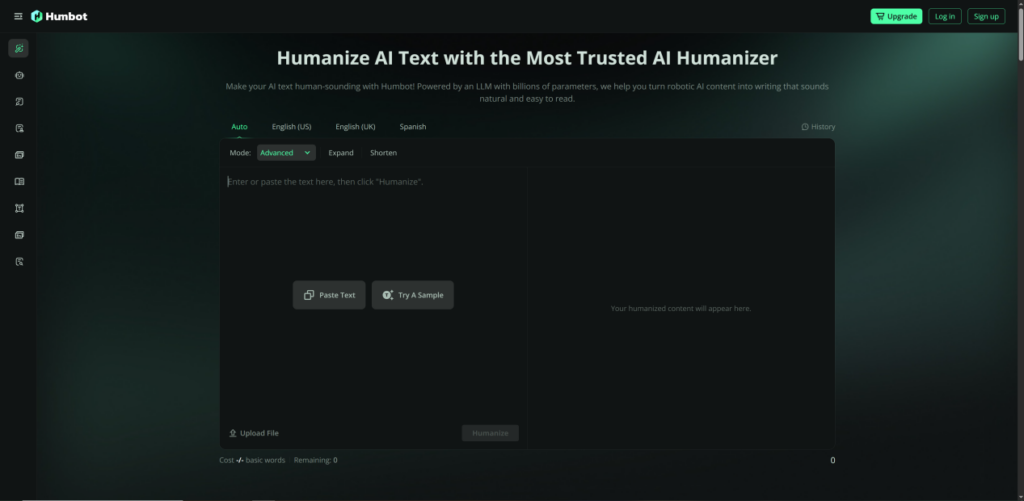
However, for a sustainable, long-term content strategy, this refinement process needs to go far beyond simple synonym swapping or basic paraphrasing. It requires a fundamental, algorithmic restructuring of the text’s underlying rhythm. Platforms like Humbot are currently navigating this exact intersection of advanced machine learning and cognitive psychology. By actively analyzing and strategically disrupting the overly uniform, low-perplexity patterns of standard LLM drafts, these systems rebuild the text from the ground up. They are engineered to mimic the natural, unpredictable cadence and burstiness of a genuine human reading thought process, restoring the acoustic grit that our brains crave.
Writing for the Brain, Not the Bot
Ultimately, as we navigate an increasingly automated digital landscape, the goal of digital publishing must evolve. It is no longer merely about generating enough volume to satisfy search engine crawlers, nor is it simply about bypassing algorithmic scrutiny. The true objective is to genuinely connect with the human reading mind on the other side of the screen. By deeply understanding the cognitive psychology behind how we read, and by utilizing advanced tools specifically designed to preserve our natural linguistic chaos, we can ensure that our digital content remains not just highly informative, but fundamentally and delightfully readable.