Generative engine optimization (GEO) is the practice of structuring your content and brand presence so that AI systems like ChatGPT, Perplexity, and Google’s AI Overviews cite you in their answers, and the stakes just jumped: after ChatGPT began placing clickable brand links inside its answers on May 7, 2026, referral traffic from the platform surged 157.7% week over week across tracked websites (Source: Similarweb).
The question used to be whether AI search would ever send meaningful traffic. Now the question is whether it sends that traffic to you or to a competitor.
If you built your visibility playbook around ten blue links, the ground has moved underneath it. Users increasingly get answers instead of links, and the brands named inside those answers win consideration without a single click being tracked. This guide explains how generative engines choose their sources, what actually moves citations, and how to build a GEO program without abandoning the SEO foundation you already have.
Key Takeaways
- GEO earns citations inside AI-generated answers rather than rankings in a list of links.
- Ranking well on Google no longer guarantees AI visibility; the overlap between the two has collapsed.
- Statistics, quotations, and cited sources measurably increase how often AI engines reference a page.
- AI referral traffic is small in volume but converts far better than traditional organic visitors.
- Citation share, not sessions, is the metric that captures most of GEO’s real impact.
What Generative Engine Optimization Means
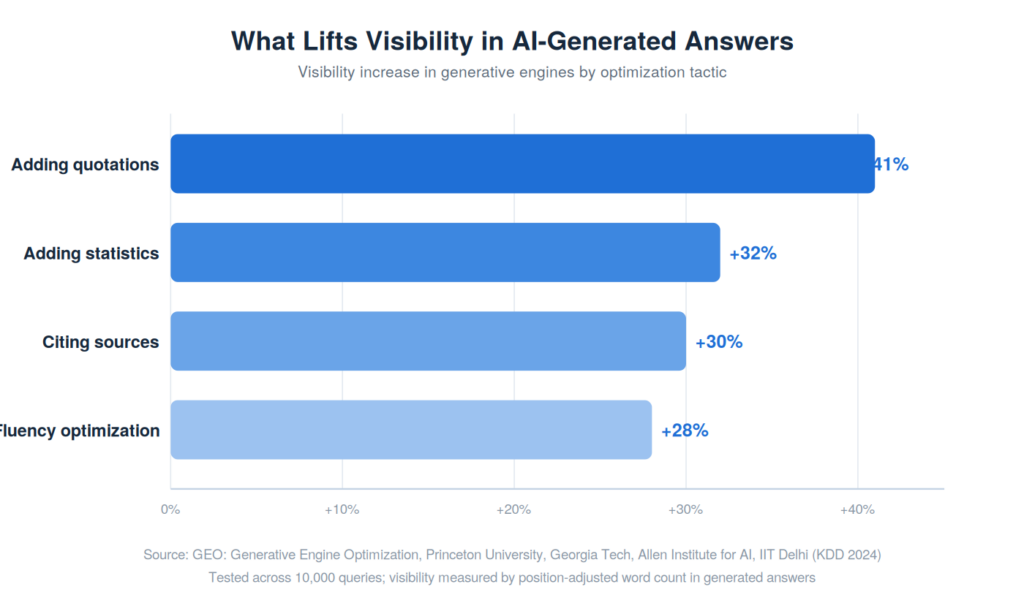
The term comes from a peer-reviewed 2024 study by researchers at Princeton, Georgia Tech, the Allen Institute for AI, and IIT Delhi, who tested how content changes affect visibility inside AI-generated answers across 10,000 queries. Their headline finding: targeted optimizations can lift a source’s visibility in generative engines by up to 40%, with the strongest gains coming from adding quotations, statistics, and source citations.
That finding defined a new discipline. Traditional SEO optimizes for a ranked position and a click. GEO optimizes for selection: when an AI engine synthesizes an answer from dozens of possible sources, your job is to be one of the sources it pulls in and names.
The distinction matters because the two games now reward different things.
| Dimension | Traditional SEO | Generative Engine Optimization |
|---|---|---|
| Goal | Rank in a list, earn the click | Get cited or recommended inside the answer |
| Key signals | Backlinks, keywords, technical health | Entity clarity, statistics, quotable claims, structure |
| Where results appear | Search results pages | ChatGPT, AI Overviews, Perplexity, Gemini, Claude |
| Success metric | Position and organic sessions | Citation share and brand mentions |
| Relationship to top-10 rankings | Direct | Weak: most AI citations come from outside the organic top 10 |
That last row deserves emphasis. BrightEdge found that only 17% of AI Overview citations come from pages ranking in Google’s organic top ten. Winning traditional search and winning AI search have become separate accomplishments, which is exactly why GEO emerged as its own practice rather than an SEO subheading. Coruzant’s explainer on AI search engine optimization maps the wider family: SEO makes you crawlable, answer engine optimization makes you extractable, and GEO makes you citable.
Why GEO Went Mainstream This Year
Three shifts pushed GEO from conference talk to budget line.
First, the interfaces changed. Google rebuilt its search experience around AI answers, with AI Overviews now appearing on roughly half of US queries. ChatGPT crossed 900 million weekly active users and, as of May, links brands directly inside responses. When the default surface for a question is a synthesized answer, presence inside that answer is the whole game.
Second, the clicks went away. Zero-click behavior has become structural: most informational queries now end without a visit to any website. Publishers relying on informational traffic have reported steep declines as AI summaries sit above the links that used to earn the click.
Third, the traffic that does arrive is unusually valuable. AI referrals still account for only around 1% of total website traffic, and ChatGPT drives the overwhelming majority of it (Source: Conductor). But visitors arriving from AI answers convert at multiples of standard organic rates, because they show up pre-informed and recommendation-primed. A user who clicks through from an AI answer has already been told your brand fits their need. Small volume, outsized intent.
How Generative Engines Choose Their Sources
You cannot optimize for a system you do not understand, so start with how the engines actually retrieve. When a user asks a question, most AI search systems run retrieval behind the scenes: they query an index, pull candidate pages, and synthesize an answer from the passages that best fit. Your content gets cited when it wins that passage-level competition.
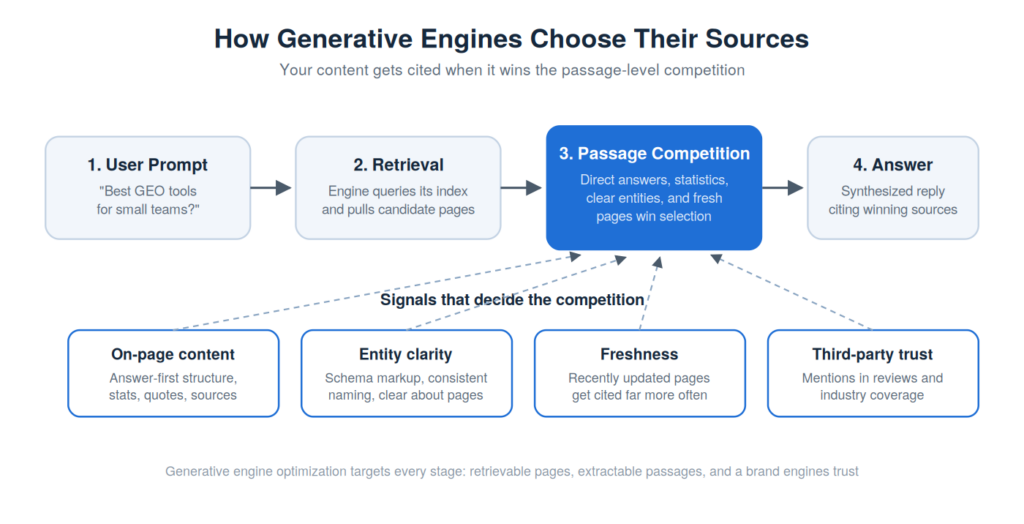
Several patterns hold across platforms. Engines favor content that answers the question directly and early, ideally within the first sentences of a section. They lean toward pages with verifiable specifics: numbers, dates, named sources. They reward clear entity signals, meaning it is unambiguous who you are, what you do, and how you relate to the topic. And they show a strong freshness bias, citing recently updated content far more often than stale pages.
Third-party presence matters as much as your own site. AI systems weigh what the wider web says about a brand, so mentions in industry publications, comparison articles, and review platforms feed citation probability. This is why GEO programs increasingly look like digital PR programs: earned media has become a retrieval signal.
The Tactics That Move Citations
The research and the field data converge on a fairly short list.
Lead with the answer. Structure every section so the first sentence or two could stand alone as a complete response to the heading’s question. Engines lift self-contained blocks; they skip pages that make readers wade through preamble.
Add statistics, quotes, and sources. The original GEO study quantified this: quotations lifted visibility by around 41%, statistics by 32%, and source citations by 30%. Specific, attributable claims give an engine something concrete to extract and a reason to trust it.
Phrase headings as real questions. “What is generative engine optimization?” beats a clever abstract heading, because it matches the prompts users actually type.
Strengthen entity signals. Consistent naming, an unambiguous about page, schema markup for articles, FAQs, and authorship, and coherent profiles across the web all help engines resolve who you are. Confused entities do not get cited.
Keep content fresh. AI engines disproportionately cite recently updated pages, so high-value articles need a refresh cadence, not a publish-and-forget workflow.
Earn third-party mentions. Being named in listicles, reviews, and industry coverage on other domains raises the odds that engines encounter and trust your brand. Structured comparison content performs especially well as a citation source.
None of this replaces SEO fundamentals. Crawlability, site speed, and clean architecture remain the price of admission, since engines cannot cite what they cannot retrieve.
Measuring a Discipline That Hides Its Wins
GEO measurement is genuinely harder than SEO reporting, and pretending otherwise leads to bad decisions. The core problem: the most valuable GEO outcome, being named in an answer that shapes a buying decision, often produces no trackable click. A user reads a recommendation in ChatGPT, closes the tab, and later types your URL directly. Your analytics logs it as direct traffic. Practitioners call this the dark funnel.
Mature programs track three layers instead of chasing sessions. Citation share: for a defined set of high-intent prompts, how often does your brand appear in the answer compared with competitors? Sentiment and accuracy: when engines mention you, do they describe you correctly? Downstream behavior: what do AI-referred visitors do after arrival, given their unusually high conversion rates?
A tooling ecosystem has grown around exactly this, from enterprise visibility platforms to affordable trackers. Coruzant has reviewed several, including the Ayzeo GEO platform for agencies and a roundup of AEO tools for small businesses that monitor prompt-level visibility for under $30 a month.
Expect volatility. Citations churn month to month as engines re-retrieve, and a lost citation typically takes weeks to recover, usually because a competitor displaced it. Monitoring is not optional; it is how you notice you are losing before the pipeline tells you.
The Honest Caveats
GEO rewards early movers, but keep three caveats in view. The absolute traffic numbers remain small, so GEO is a visibility and consideration play more than a volume play, and it should extend your search strategy rather than replace it. Measurement standards are immature, and vendors quoting precise ROI figures deserve skepticism. And the platforms keep changing the rules: a single product decision, like ChatGPT’s link rollout in May or its introduction of ads, can reshape the channel’s economics in a week. Build the capability, but keep the program adaptive.
How to Get Started
Begin with a visibility audit. Write down the twenty questions a serious buyer in your category would ask an AI assistant, then ask them across ChatGPT, Perplexity, and Google’s AI experience. Record who gets cited and whether you appear at all. That baseline usually motivates the rest of the program on its own.
Next, retrofit your highest-value pages: answer-first openings, question-phrased headings, current statistics with named sources, and schema markup. Refresh anything important that has not been touched in a year. Then work the off-site layer by pursuing mentions in the comparison and review content engines already cite in your category.
Finally, put monitoring in place before you scale production, so you can connect content changes to citation movement. Track your prompt set monthly, watch competitor citation share, and treat sudden drops as incidents worth investigating rather than noise.
Conclusion
Generative engine optimization is what visibility looks like when answers replace links. The fundamentals are learnable and mostly content-shaped: direct answers, verifiable specifics, clear entities, fresh pages, and a brand footprint beyond your own domain. The overlap between ranking and being cited keeps shrinking, which means the brands that treat GEO as a distinct, measured discipline are quietly accumulating an advantage that is expensive to claw back later.
Start with the audit this week. Twenty prompts, three platforms, one spreadsheet. You will know within an hour whether AI engines consider you part of the conversation in your category, and that answer should set your priorities for the rest of the year.
Read Next
More on winning visibility in the AI search era:
- How the Best AEO Agencies Prove ROI
- AEO Tools for Small Businesses: Affordable Ways to Win in AI Search
- 7 Secret On-Page SEO Hacks Your Competitors Won’t Tell You About
Frequently Asked Questions
Generative engine optimization (GEO) is the practice of structuring content and brand signals so AI systems such as ChatGPT, Perplexity, Gemini, and Google AI Overviews cite or recommend your brand inside their generated answers. The discipline was formalized in a 2024 peer-reviewed study showing targeted optimizations can lift AI visibility by up to 40%.
GEO differs from SEO in what it optimizes for: SEO targets ranked positions and clicks, while GEO targets citations inside synthesized answers. The signals differ too, with GEO weighting statistics, quotations, entity clarity, and freshness over backlinks and keywords. Most AI citations now come from pages outside Google’s organic top ten, so the two disciplines produce different winners.
GEO and answer engine optimization overlap heavily and many practitioners use the terms interchangeably. Where a distinction is drawn, AEO focuses on being extracted as the direct answer in snippets and AI answer boxes, while GEO covers earning citations when a generative engine synthesizes an answer from multiple sources. In practice the tactics are largely shared.
GEO drives modest but unusually valuable traffic. AI referrals account for around 1% of total website visits, with ChatGPT supplying most of them, yet those visitors convert at several times typical organic rates because they arrive pre-qualified by a recommendation. Much of GEO’s impact is also invisible in analytics, since users often see a brand in an answer and visit directly later.
Generative engine optimization typically shows early citation movement within about eight to twelve weeks of implementing answer-first structure, fresh statistics, and schema markup, as engines re-crawl and re-retrieve updated content. Off-site signals such as earned mentions compound more slowly, and citation share continues shifting month to month, so GEO requires ongoing monitoring rather than a one-time push.