AI-powered devices look magical in demos. In real life they’re more like grumpy machines that need to be fed clean data, kept within thermal limits, and prevented from bricking themselves during an update at 2 a.m. The AI model gets the spotlight, sure. But embedded software is the thing that keeps the spotlight from falling off the truss.
If you’re building AI that actually touches the physical world (robots, medical gear, cameras, smart industrial sensors), you quickly end up in the weeds of timing, drivers, memory, and failure modes. That’s why I often point teams toward practical engineering insights on Physical AI requirements. Not as marketing fluff, but because it’s a reminder that “edge AI” is a full system problem, not a model checkout.
Let’s talk about what that system problem really is, and why embedded software is the foundation for reliable AI in embedded systems.
Key Takeaways
- AI-powered embedded systems require reliable embedded software to function effectively in the real world.
- These systems face harsh constraints, such as limited resources and the need for real-time decision-making.
- Key factors for success include deterministic timing, data quality, resource management, and robust security measures.
- Testing under real-world conditions is crucial to ensure reliability and uptime for AI devices.
- Developers should consider practical strategies for deployment, updates, and model management to create shippable products.
Table of contents
How AI in Embedded Systems Enables Real-Time Intelligence
AI in embedded systems is basically a trade: you get fast local decisions, but you accept harsh constraints. Cloud AI can throw GPUs at the problem. Embedded AI systems often have a small CPU, limited RAM, a power budget, and a physical environment that does not care about your sprint deadline.
When it works, it’s great:
- A camera flags defects on a line without sending every frame to the cloud.
- A wearable detects abnormal motion in real time.
- A robot avoids obstacles with low latency.
- A smart meter spots tampering patterns locally and reports only the important bits.
But “real-time intelligence” is not just model inference. It’s the whole path from sensor to decision to actuation.
Here’s the unglamorous flow that makes ai-powered embedded systems feel instant:
- Sensor sampling (with correct timing and calibration)
- Signal conditioning and preprocessing (filtering, scaling, windowing)
- Feature extraction or tensor preparation
- Inference (often quantized, sometimes accelerated)
- Post-processing (thresholds, smoothing, tracking)
- Control logic (what do we do with this output?)
- Actuation (motors, valves, alerts)
- Logging and telemetry (without killing performance)
Miss a beat anywhere in that chain and your “AI” becomes a random-number generator with a product label.
A note people hate hearing: a model that’s 2 percent more accurate on a benchmark can be a downgrade in the field if it pushes latency over the edge, blows your memory budget, or increases false positives in weird lighting. Embedded software is where those trade-offs get negotiated.
What AI-Powered Embedded Software Systems Require to Work Reliably
Reliability is where most AI prototypes go to die. You don’t need a dramatic “hack” or a catastrophic bug. A couple of dropped frames, a watchdog reset loop, or a flaky Wi-Fi stack is plenty.
Here are the requirements that matter when you’re shipping ai-powered devices, not just showing them.
Deterministic timing in embedded software (or at least bounded timing)
If your system has deadlines, it needs a plan for jitter. That might mean RTOS scheduling, CPU isolation, prioritizing ISR work, or moving parts of the pipeline off the main thread. If you’re doing embedded Linux, you still need to think about real-time behavior. Preempt-RT, proper priority tuning, and avoiding “death by background services” are not optional.
Practical questions to ask early:
- What’s the max acceptable sensor-to-action latency?
- What’s the worst-case compute time for inference?
- What happens when inference can’t keep up?
- Do we degrade gracefully or just… stall?
Data is a product feature
AI accuracy depends on data quality. Embedded software is responsible for the boring stuff that makes data trustworthy:
- sensor drivers
- calibration routines
- timestamping
- synchronization across sensors
- outlier handling (noise, spikes, dead pixels, dropouts)
If your data pipeline is shaky, you’ll waste months “tuning the model” when the real issue is that one sensor drifts with temperature.
Resource management (memory, power, thermals)
Many embedded ai systems run close to the edge, literally. One extra buffer copy can push RAM over the limit. One sustained inference loop can thermal-throttle a small SoC and tank performance.
Stuff that tends to bite teams:
- memory fragmentation over long uptimes
- leaking file descriptors or sockets
- swapping (yes, even on devices where you swear it won’t happen)
- aggressive power saving that breaks sensor sampling timing
- thermal throttling changing inference latency
A reliable device treats these as first-class requirements, not “later optimizations.”
Security and updates to embedded software that don’t sabotage uptime
AI-capable devices often ship into environments where attackers have incentives: IP theft, surveillance, ransom, disruption. Security is not separate from reliability. A device that can’t update safely becomes unreliable the moment a CVE drops.
Minimum bar, in my opinion:
- signed firmware and secure boot
- authenticated update channels
- rollback protection
- staged rollout with health checks
- telemetry for update success and failure reasons
Testing conditions in embedded software you can’t fake with unit tests
You need more than “the model runs on my dev board.”
Strong teams use:
- hardware-in-the-loop (HIL)
- fault injection (bad packets, corrupt frames, sensor disconnects)
- long-run soak tests
- power cycle tests during updates
- simulated edge cases (lighting, motion blur, vibration)
And yes, it’s annoying. It also saves you from a support queue that never ends.
The Role of Embedded Software Development Services in Building AI-Powered Devices
When companies look for embedded software development services, it’s rarely because they can’t write code. It’s because stitching AI into a physical product forces you to coordinate too many disciplines at once: firmware, drivers, RTOS/Linux, connectivity, security, build systems, production provisioning, and the ML pipeline.
A good team, whether in-house or an embedded software development company you trust, tends to bring a few habits that make embedded AI less chaotic.
They treat the AI model as one component in a larger system
Meaning: the model doesn’t get to dictate everything. It has to fit the device.
Typical engineering work that surrounds the model:
- model compression and quantization strategy (INT8 vs FP16, accuracy trade-offs)
- choosing the runtime (TFLite, ONNX Runtime, vendor SDKs)
- hardware acceleration integration (NPU, DSP, GPU)
- zero-copy pipelines (camera to inference without expensive copies)
- versioning models like software artifacts (because they are)
They build a pipeline for deployment, not just development
If you can’t reproduce a build, you can’t secure it, and you can’t support it. Period.
Look for maturity in:
- deterministic builds and artifact signing
- CI that runs on real hardware (or at least emulator plus board farm)
- device provisioning flow (unique keys, certs, identity)
- OTA strategy from day one, not day 300
They plan for the “field reality” parts
This is where senior embedded folks earn their keep.
Field reality includes:
- intermittent connectivity
- captive portals and broken DNS
- users who never update
- unexpected peripherals
- regional compliance requirements
- brownouts and noisy power
If your system can’t handle a bad network or a sloppy power supply, it’s not production-ready. It’s a lab toy.
They know when to simplify embedded software
The best embedded people I’ve worked with are not maximalists. They’ll ask the painful question: do we really need this?
Some simplifications that often improve reliability:
- reduce sensor fusion complexity if it creates fragile dependencies
- keep a non-AI fallback mode for safety-critical actions
- avoid “AI everywhere” in the stack. Put it where it pays off
- prefer proven protocols and libraries over shiny custom ones
Building Reliable Embedded AI Systems for Real-World Use
If you’re building ai embedded systems right now, here’s a practical checklist. Not a “framework.” Just the stuff that tends to separate shippable devices from perpetual prototypes.
1) Define your latency and uptime targets early
Write them down. Make them part of acceptance criteria.
Example targets:
- p95 inference latency under X ms at Y temperature
- max boot-to-operational time under Z seconds
- recover from network loss within N minutes
- survive 10,000 power cycles without corruption
Then test those targets continuously. Not once at the end.
2) Budget your compute like money
Treat CPU, RAM, and power as budgets with owners.
A simple approach:
- allocate RAM for each pipeline stage (capture, preprocess, inference, post-process)
- profile CPU per thread
- measure thermals over time, not just at startup
If you “hope” it fits, it won’t.
3) Design for degraded modes
Real world inputs are messy. Sometimes the camera is blocked. Sometimes the sensor lies. Sometimes inference is slow.
A degraded-mode plan might include:
- run inference less frequently when hot
- switch to lower-resolution frames
- fall back to rules when confidence is low
- require multi-sensor confirmation before an action
- fail safe on actuator commands
This is also where you keep physical safety in mind. “Do nothing” is often safer than “do the wrong thing quickly.”
4) Make updates boring
OTA updates should be predictable and recoverable.
Basic best practices:
- dual-bank firmware (A/B) so you can rollback
- health checks before marking an update successful
- power-loss tolerance during flashing
- clear separation between app, OS, bootloader, and model artifacts
If updates scare the product team, you’ll stop updating. If you stop updating, your security posture decays fast.
5) Instrument the device, but don’t drown in data
You want enough telemetry to answer:
- is the device alive?
- what version is it running?
- is inference meeting latency targets?
- how often are we hitting fallback modes?
- are sensors drifting?
You do not want to stream raw everything unless you have a strong reason, and a privacy story you can defend.
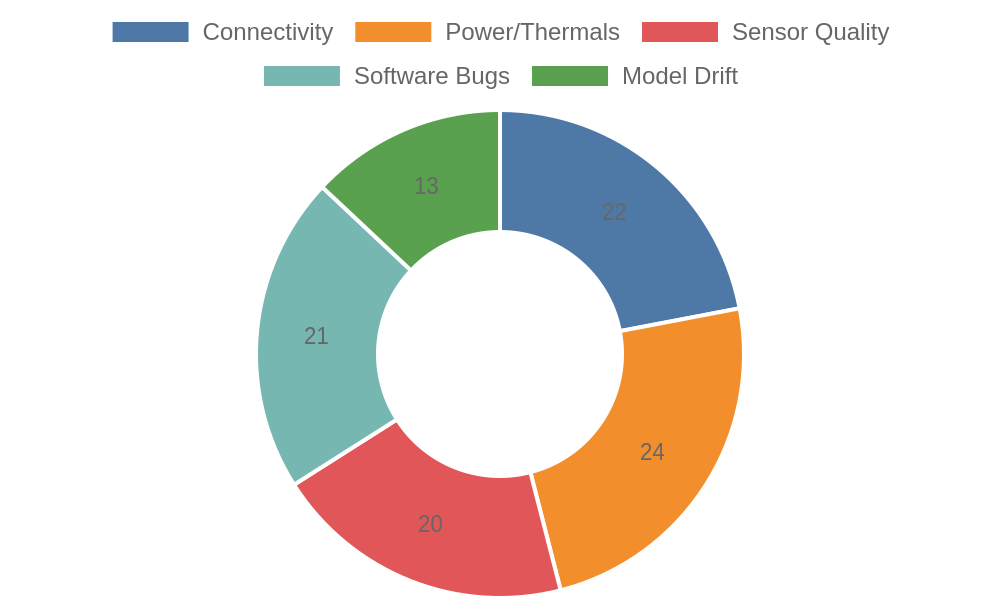
6) Plan for model drift like an adult
Models degrade. Environments change. Users behave differently than your dataset.
Practical drift countermeasures:
- periodic evaluation on curated field samples
- confidence monitoring and alerting
- safe model rollback
- canary releases for new model versions
- clear policies for when the device should refuse to act
This is where “AI” becomes a lifecycle, not a one-time feature.
7) Keep the boundary between AI and embedded software control logic clean
One mistake I see: teams let the model output directly drive critical actions. That’s tempting, but risky.
A better pattern:
- model produces a score, label, or estimate
- control logic applies rules, hysteresis, and safety checks
- actuators move only after validation
It’s not less “AI.” It’s more shippable.
Read Next
A few related pieces worth your time:
- B2B Buyers Are Starting Research on AI Chatbots Instead of Google
- Credit Decisions Take Too Long: How AI is Transforming Underwriting
- Best AI Tools to Restore Facial Details in Old Photos
Closing thought
AI-powered embedded systems are getting more capable, and also more unforgiving. The closer your device gets to the physical world, the less patience reality has for crashes, latency spikes, flaky updates, or “we’ll fix it in the next sprint.”
The model matters, yes. But embedded software is what turns that model into a product that survives heat, noise, bad networks, weird user behavior, and months of uptime. If you’re serious about shipping ai-powered devices, start there. Everything else builds on top.