
For CRE investors, the edge comes from seeing opportunities others don’t and evaluating them faster than the next bidder. Mostly, a CRE platform help with one side of the equation and charge heavily for the other.
Realmo takes a different route. It’s an AI-native CRE ecosystem that pairs a large, no-paywall inventory with intelligence tools built to move investors from discovery to evaluation quickly. Its value is not just that it shows more properties but also that it compresses the work between finding a property, understanding the opportunity, and deciding if it deserves a closer look.
This review looks at Realmo in five parts:
- Inventory
- Investment tools
- Access and pricing
- How it compares with incumbents
- Which investors get the most value from it
Key Takeaways
- Realmo is an AI-native CRE ecosystem that combines a no-paywall inventory with intelligent tools for faster evaluation.
- The platform offers over 1 million active listings, including both on-market and off-market assets, across all 50 states.
- Realmo provides key investment features like natural-language search, Auto Valuation Modeling, and off-market lead generation.
- Many independent investors and smaller funds benefit from Realmo’s free access and optional upgrade without high costs.
- Overall, Realmo enhances deal flow and speeds up evaluation for opportunistic and value-add investors.
Table of contents
- Realmo CRE Platform at a Glance
- Inventory: What An Investor Can Find
- Beyond Tier-1: Where The Alpha Hides
- Asset-Class Depth That Matters To CRE Platform Investors
- Off-Market Inventory: The Pipeline Edge
- Business-For-Sale + Real Estate: Cash-Flow Plays
- Investment Tools: What An Investor Can Do
- Auto Valuation Modeling: Faster First-Pass Underwriting
- Off-Market Outreach Via AI Workflow on Realmo’s CRE Platform
- Analytics & Market View with your CRE Platform
- Access & Pricing on Realmo’s CRE Platform: The No-Paywall Argument
- How Realmo Stacks Up Against Incumbents
- Verdict: Which Investors Get The Most From Realmo
Realmo CRE Platform at a Glance
Before the deep dive, here’s the platform in brief.
| Brand name | Realmo |
|---|---|
| Web site | https://realmo.com/ |
| Founded | November 2023 |
| Platform type | AI-native CRE marketplace + intelligence ecosystem |
| Inventory | 1M+ active listings inside a 9M+ property database |
| Geographic coverage | All 50 states, including secondary and rural markets |
| Listing types | On-market + off-market assets |
| Taxonomy | 60+ business categories |
| Key investor tools | Rey (AI search & analysis), Auto Valuation Modeling, Analytics Center |
| Off-market sourcing | Yes (surfaced leads + AI owner outreach) |
| Data freshness | Listings refreshed daily |
| Pricing | Free (no credit card) + optional upgrade |
| User ratings | 4.6★ (SmartCustomer, 5 reviews); Trustpilot ~17 reviewers |
| Best for | Value-add / opportunistic investors, owner-operators, business buyers |
Inventory: What An Investor Can Find
Scale & reach with your CRE Platform: The supply advantage
Realmo’s first advantage is supply. The platform offers 1M+ active listings across all 50 U.S. states, sitting inside a 9M+ property database that includes both on-market and off-market assets.
Deal sourcing is still a numbers game, so investors will find this breadth very handy. More foundation means more chances to find:
- A mispriced asset
- A neglected submarket
- A seller with poor visibility
- A property that simply has not been seen by the same buyer pool yet
A broader inventory base doesn’t guarantee alpha by itself, but it does widen the surface area where alpha can appear.
That also makes Realmo more useful than a basic listing search. Investors can use the database to build a market view:
- Which owners are active
- Where inventory is clustering
- Which property types are showing up in a region
- Where pricing may look disconnected from fundamentals
The daily-refresh point is also a plus here since CRE data goes stale quickly. If availability, pricing, or listing status is outdated, investors waste time underwriting opportunities that are no longer real. Realmo’s daily-refreshed pages give users a cleaner view of current availability and pricing.
Beyond Tier-1: Where The Alpha Hides
Realmo’s solid inventory story goes beyond national coverage and lies in the depth past the obvious gateway markets.
Most CRE platforms are strongest where the market is already crowded like New York, Los Angeles, Dallas, Miami, Chicago, Atlanta, and other high-visibility metros. These markets are heavily watched, with more bidders, more brokers, more institutional attention, and more data access usually mean less room for obvious mispricing.
Realmo’s reach into secondary, rural, and historically thinner-data markets is more interesting for investors. States like Montana, the Dakotas, Missouri, and other overlooked regions can be harder to scan efficiently because inventory is fragmented across brokers, local platforms, business-for-sale sites, and quiet owner networks.
That’s where a broad, searchable CRE database becomes a sourcing advantage.
For value-add and opportunistic investors, less efficient markets can mean:
- Less competition
- Wider pricing dispersion
- More overlooked assets
Realmo gives investors a way to search these markets without building a separate local-data workflow for every state or metro.
On the test date, Realmo’s indexed state and metro pages backed up the secondary-market point with concrete inventory depth:
- Montana showed 5,082 commercial properties for sale
- North Dakota showed 817 commercial properties for sale
- Missouri showed 10K+ commercial properties for sale
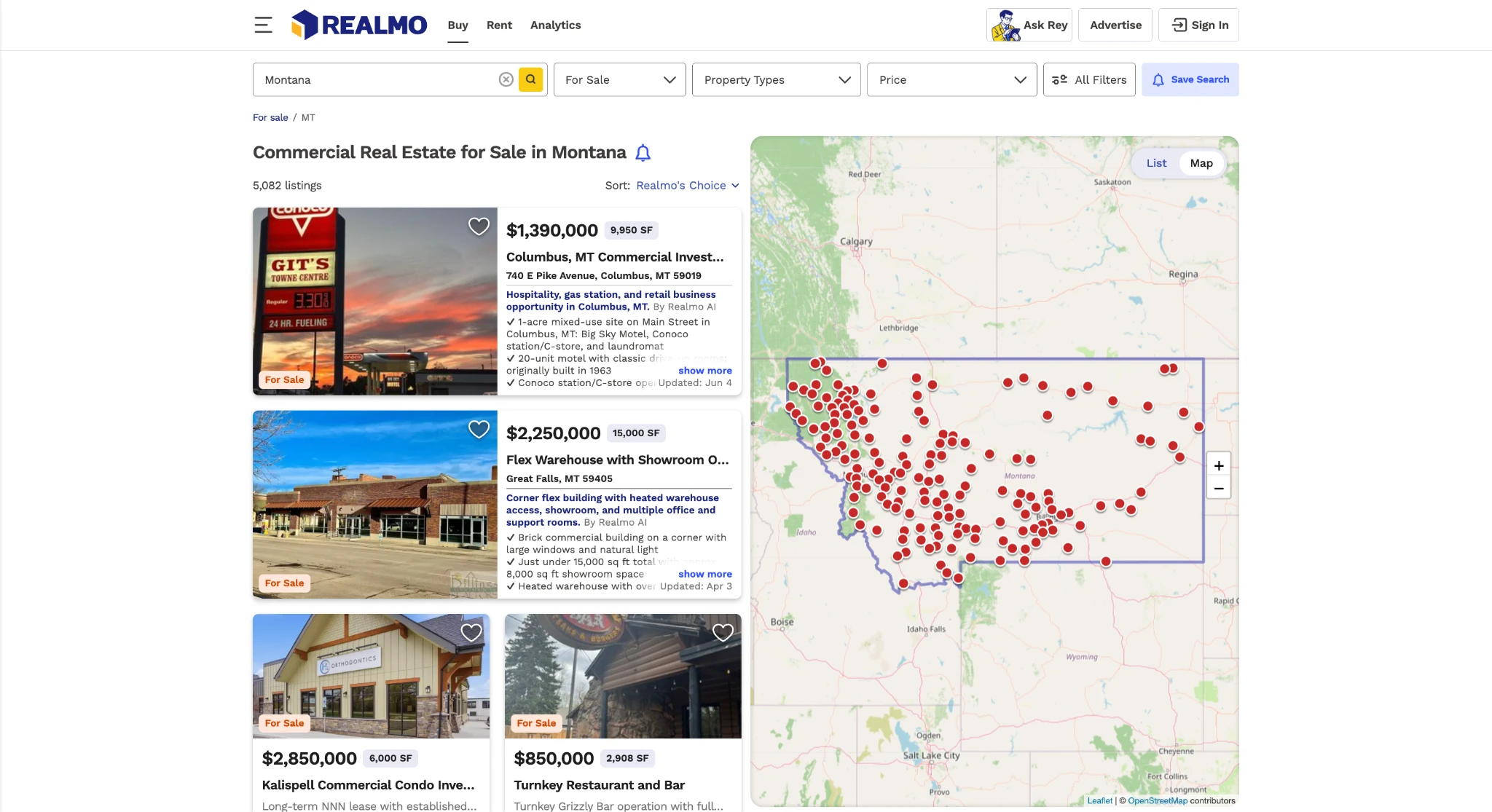
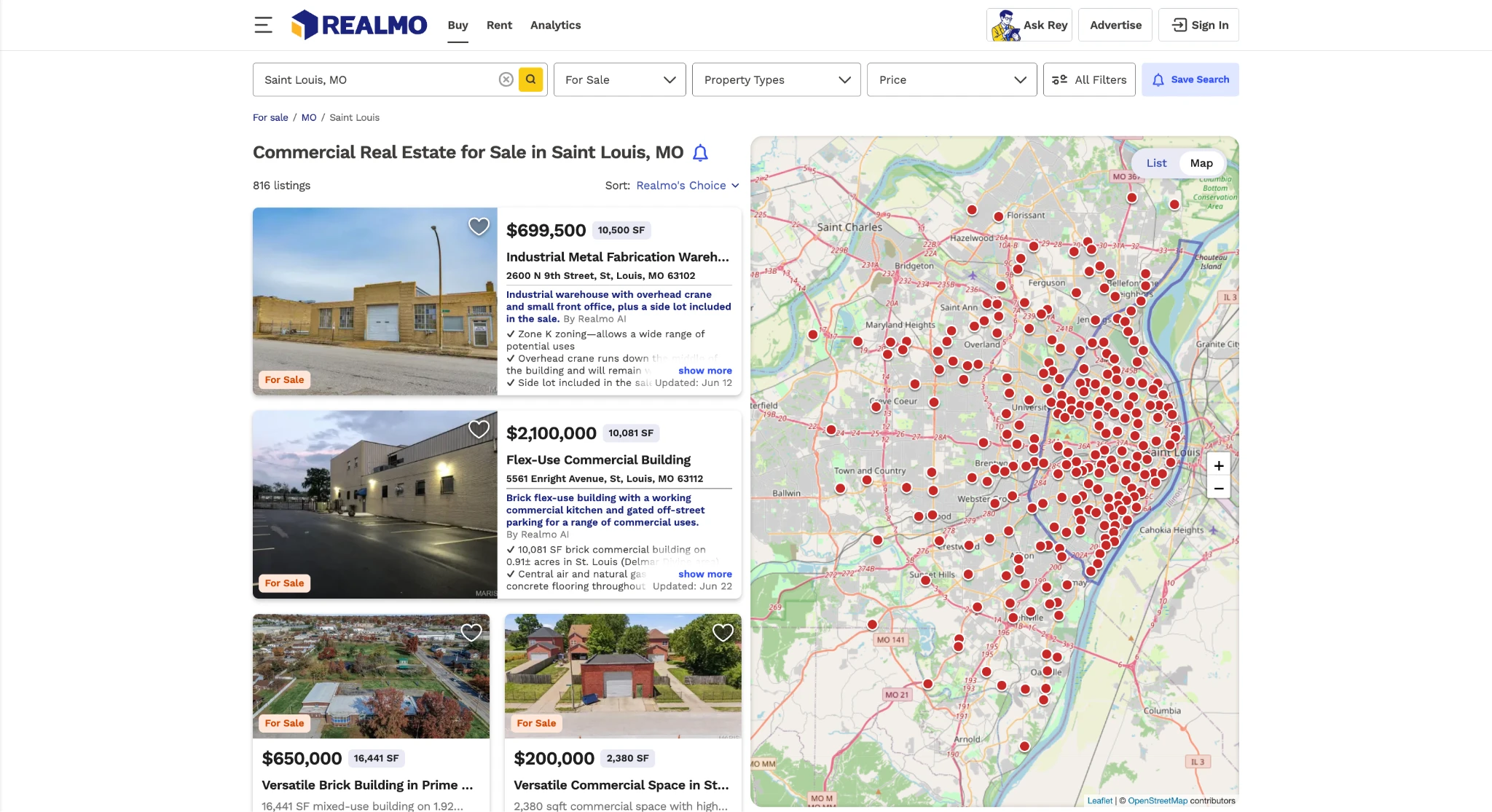
The coverage also extended into smaller local markets, including Great Falls, MT with 69 properties, Stanley, ND with 8 active listings inside 247 tracked investment opportunities, and Saint Louis, MO with 816 active listings.
Asset-Class Depth That Matters To CRE Platform Investors
Realmo’s taxonomy breaks commercial property into clean-cut categories instead of forcing investors to work through vague asset-class buckets.
For example, industrial inventory in New York showed 1,200+ listings and about $1.99B in estimated value in the source set. This kind of scale gives industrial buyers enough insights to compare pricing, location, building type, and availability across a serious opportunity set.
Office is another useful example because the asset class is not one neat category anymore. General office, flex office, and medical office attract different tenants, require different buildouts, and are valued through different assumptions.
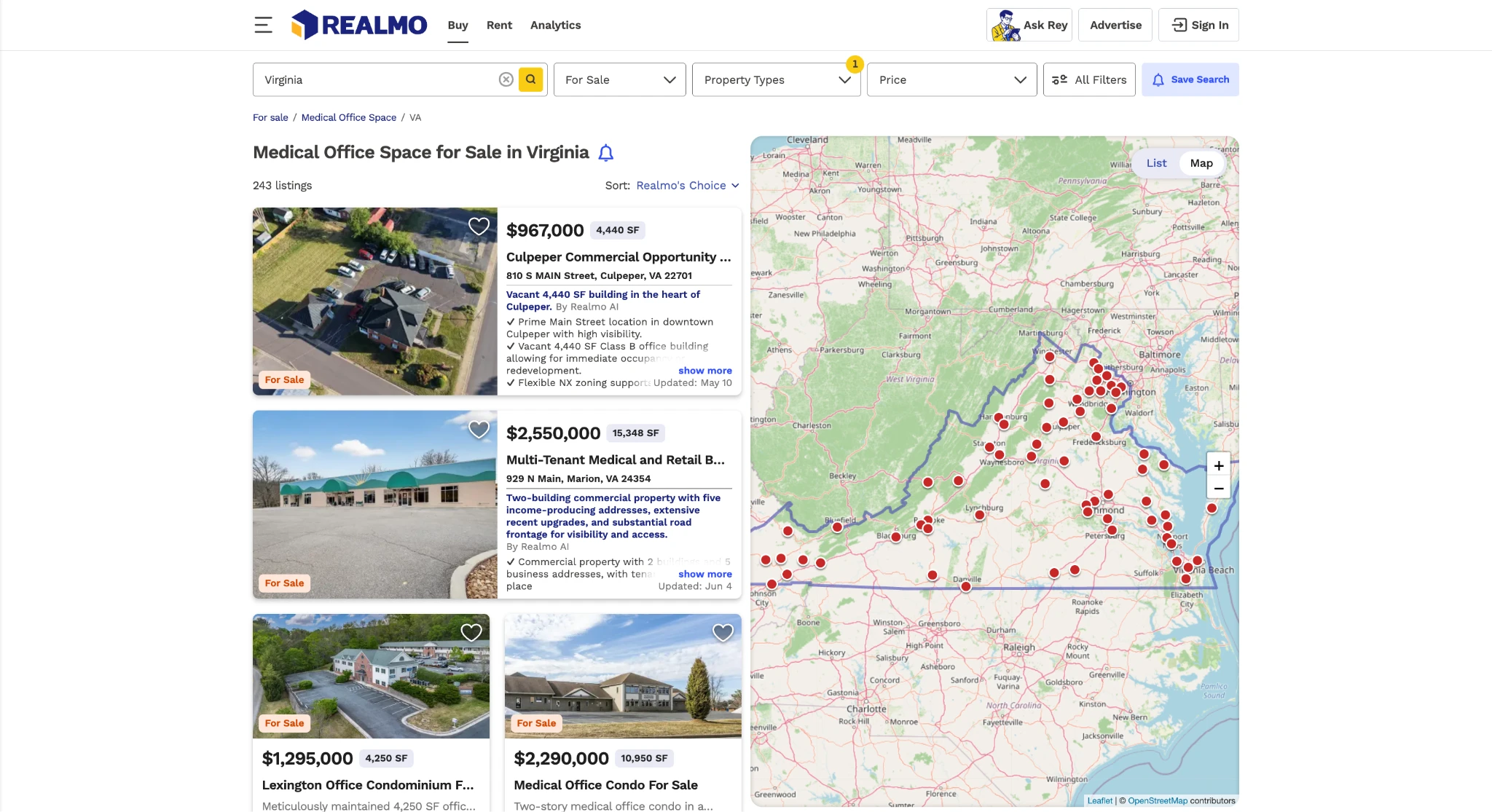
Realmo keeps these distinctions visible. In Virginia, for example, medical office showed 243 listings in the source set, giving healthcare-focused investors a more focused way to screen opportunities.
The same logic applies to retail, bars and hospitality, schools and education assets, and other specialty categories. A buyer looking for a restaurant with real estate attached is not running the same search as a buyer looking for a vacant retail box. A school investor is not underwriting the same tenant demand as an office buyer.
Clean segmentation helps investors avoid false comparisons. It lets them search by actual investment logic:
- Tenant profile
- Operating model
- Buildout
- Lease structure
- Owner type
- Exit strategy
Off-Market Inventory: The Pipeline Edge
A standout feature for investors is that Realmo surfaces off-market opportunities alongside active inventory.
That’s a great feature since some of the best CRE deals are not sitting in the obvious public listing pool. They are relationship-driven, quietly marketed, owner-held, or sitting in markets where formal listing coverage is thin. In a Realmo test example, North Dakota showed about 50 off-market options on top of active inventory in the bars vertical.
The investor value is straightforward: a wider surfaced pipeline means more chances to reach an owner before the market does.
Business-For-Sale + Real Estate: Cash-Flow Plays
Realmo is also a solid choice for investors who are open to operating assets, not just passive real estate. The platform surfaces businesses for sale alongside underlying real estate opportunities. One example from the source set was a Downtown Orlando bar/lounge listed at $290,000, with FF&E and a lease in place.
Again, the insights are great, because some investors are not only looking for a building but may want:
- A cash-flowing business
- A property-plus-business acquisition
- An operating asset with real estate upside
Realmo listings make this kind of distinction clear by showing whether real estate is included. This gives buyers a more flexible sourcing path: business only, property only, or a combined operating-real-estate play.
Investment Tools: What An Investor Can Do
Rey, the AI analyst: Plain-english search and insights
Rey is Realmo’s natural-language search and analysis assistant. Investors can brief Rey the way they would brief an analyst instead of building a search through filters alone.
For example:
- “Show me medical office under $3M in secondary Texas markets.”
- Or: “Find owner-operated industrial properties in smaller Midwest cities.”
- Or: “Compare bars for sale in Florida where real estate is included.”
The workflow is simple and intuitive. There’s no need to manually toggle geography, asset class, price, ownership, and category filters. You can just start with intent. Rey helps translate this intent into a narrower opportunity set.
The biggest benefit here is speed. Rey basically collapses search, lookup, and early comparison into a conversation, which makes it easier to move from a broad market idea to a usable shortlist.
On top of that, Rey can generate property reports, summarize key deal signals, support first-pass analysis, and automate routine research steps that would normally eat up an investor’s time.
Auto Valuation Modeling: Faster First-Pass Underwriting
The most investor-relevant tool in Realmo is Auto Valuation Modeling.
Investors don’t need a full underwriting model for every property they see. They want a fast way to decide whether a deal is even worth deeper work. Realmo’s AI-assisted value estimation helps create that first directional view on price before you commit analyst time, broker calls, lender conversations, or a full pro forma.
This comes in especially handy when screening a large market. If an investor is reviewing 100 potential assets, the goal is to triage quickly, reject weak fits, and spend real time only on the few that clear the first cut.
The off-market use case is particularly strong. If Realmo surfaces an off-market asset, a directional value estimate helps the used decide whether owner outreach is worth making in the first place.
Off-Market Outreach Via AI Workflow on Realmo’s CRE Platform
Realmo doesn’t stop at showing off-market opportunities. The platform can also support owner outreach through its AI workflow.
Traditionally, off-market sourcing breaks down between discovery and action. An investor finds a promising asset, then has to identify the owner, understand whether outreach makes sense, draft the message, manage the contact step, and track what happens next. Each handoff adds to the effort and time.
Realmo shortens this path. A surfaced off-market lead can become a contact step inside the platform, helping investors move from an interest to a specific conversation. For lean investment teams and owner-operators, that is a powerful shortcut. The less time spent stitching together sourcing admin, the more time goes into actual deal judgment.
Analytics & Market View with your CRE Platform
Realmo’s broader database also helps investors build context, not just find single properties.
A good sourcing workflow needs two components:
- Deal-level analysis.
- Market-level understanding.
Investors need to know whether a specific asset looks attractive, but also whether the surrounding market supports the assumption:
- Is inventory clustering in a certain asset type?
- Are certain states showing more hospitality or industrial supply?
- Are owner patterns revealing potential consolidation plays?
- Are secondary markets showing enough depth to justify a closer look?
Realmo’s database and analytics help answer these questions earlier in the process.
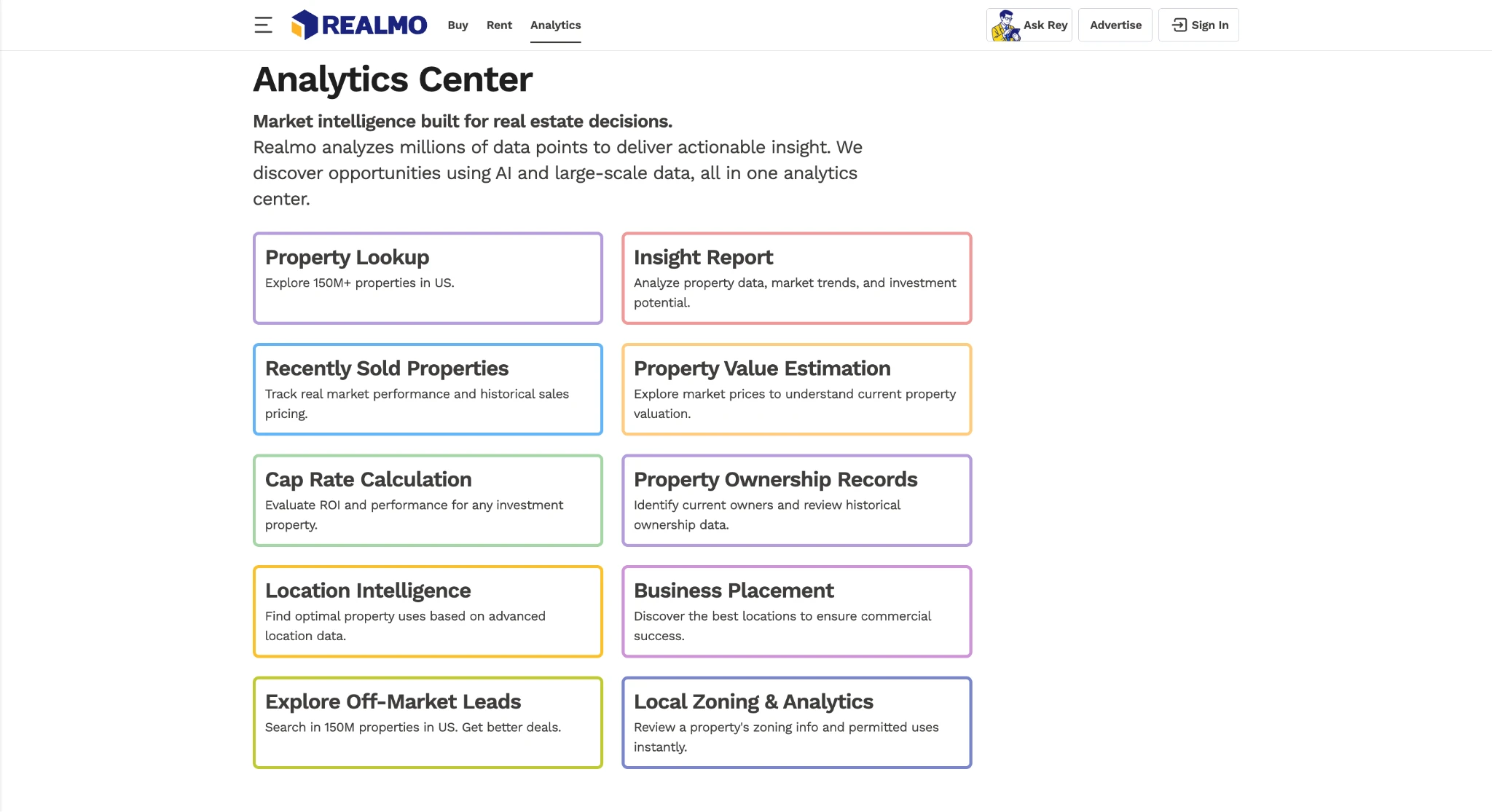
Thanks to this, the platform feels less like a static marketplace and more like an investment research tool. You can use it to identify market patterns, test theses, compare asset types, and understand where opportunity volume is actually appearing.
Access & Pricing on Realmo’s CRE Platform: The No-Paywall Argument
Realmo’s access model is yet another advantage worth looking into.
Many incumbent CRE platforms are expensive, subscription-heavy, or built around gated access. This may be manageable for institutional teams, but it creates a barrier for:
- Independent investors
- Smaller funds
- Owner-operators
- Business buyers
- Anyone who wants to test a platform before adding another paid tool to the stack
Realmo is free to start and doesn’t require a credit card. The optional upgrade path adds depth, but the free tier is still useful for sourcing and screening.
That’s a big plus: investors don’t need to replace their existing tools immediately. They can run Realmo alongside broker relationships, local market sources, CoStar, LoopNet, Crexi, or internal databases. The low cost-to-evaluate makes adoption easy.
Basically, Realmo lowers the barrier to adding another sourcing tool without saying yes to another four-figure monthly commitment.
How Realmo Stacks Up Against Incumbents
Realmo doesn’t try to be a traditional CRE database with AI added on later. Its positioning is different: broad searchable inventory, off-market visibility, natural-language discovery, valuation support, and simple access in one platform.
- Against listing marketplaces, Realmo’s advantage is intelligence. It’s helping users screen, compare, and decide what deserves attention on top of merely browsing listings.
- When it comes to subscription-heavy data platforms, Realmo’s edge is found in accessibility. Institutional systems can be powerful, but they often come with steep cost, locked workflows, and a learning curve. Realmo’s no-paywall model makes it easier for investors to use the platform as an extra sourcing tool.
- As for local broker networks, Realmo’s offers a stronger scale. A solid broker relationship will always matter in CRE, especially for negotiated deals. But no single local network gives investors a searchable view across all 50 states, multiple asset classes, and off-market leads.
Realmo is not a full replacement for every incumbent, but it’s a good sourcing and first-pass evaluation tool that can sit on top of an investor’s existing workflow.
Verdict: Which Investors Get The Most From Realmo
| Category | Rating |
| Inventory breadth | ★★★★ |
| Off-market reach | ★★★★ |
| AI investment tools | ★★★★ |
| Data freshness | ★★★★ |
| Data accuracy | ★★★★★ |
| Access/value | ★★★★★ |
Realmo is the best match for:
- Value-add investors
- Opportunistic investors
- Owner-operators
- Business buyers who want a wide, AI-searchable sourcing layer without a paywall
Its strongest use cases are broad market discovery, secondary-market sourcing, off-market lead generation, business-plus-real-estate opportunities, and fast first-pass valuation.
It may be less essential for pure institutional underwriting teams already standardized on CoStar or internal data infrastructure. Even then, the CRE platform Realmo can still add value as a top-of-funnel sourcing tool, especially in overlooked markets and off-market categories.
Bottom line: Realmo gives investors more deal flow and faster evaluation in one accessible platform. For teams trying to find more opportunities before everyone else sees them, that’s a real sourcing and screening advantage.