Most companies no longer struggle to get data. They struggle to decide on it. Dashboards multiply, reports arrive on schedule, and meetings still end with someone saying the team needs another week to look into it.
AI is bridging that gap, though not in the way most vendor decks suggest. It is not replacing the executive judgment call. It is compressing the distance between a question and the evidence needed to answer it, and it is moving that evidence into places leaders did not previously monitor at all.
This piece looks at where AI has entered the decision loop, what new inputs it has made measurable, and what your team should log before trusting a machine-assisted decision.
Table of contents
- The bottleneck moved from data to judgment
- Where AI already sits in the decision loop
- Decisions about the market: what the answer engines say about you
- Decisions about people: measuring confidence, not satisfaction
- Decisions about the AI itself: build, buy, or route
- What to log before you trust the output
- Where AI decision support falls short
- The bottom line
- Common questions about AI in decision-making
The bottleneck moved from data to judgment
For two decades, the operating assumption was that better decisions came from more data. Companies bought warehouses, lakes, and then platforms to sit on top of both. The information arrived. The decision speed did not improve much.
The reason is structural. Coruzant’s coverage of spatial computing in the enterprise makes the point plainly: modern organizations are not short on technology; it is fracturing under the weight of too much of it arriving too fast. Every new system adds a view of a business that nobody has time to reconcile with the others.
AI changes the economics of that reconciliation. A model can read 14 systems, summarize the disagreement between them, and hand a manager a one-page picture in the time it used to take to schedule the meeting.
The judgment stays human. The preparation for the judgment stops taking three days.
That is the real redefinition. Decisions that were previously made on a quarterly cadence, because assembling the inputs took a quarter, can now be made monthly or weekly without losing rigor.
Where AI already sits in the decision loop
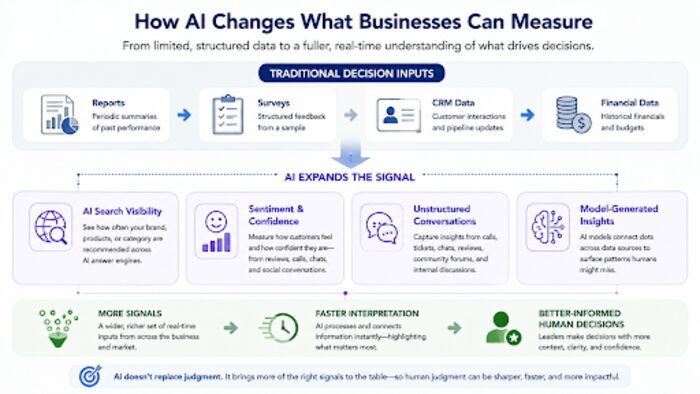
It helps to separate the hype from what is deployed. Across most mid-market and enterprise operations, AI has entered decision-making at three distinct points, each with a different risk profile.
| Decision layer | What AI does | Human role | Risk if unmonitored |
| Sensing | Reads and summarizes unstructured inputs: calls, tickets, reviews, AI search answers | Sets what counts as a signal | Confident summaries of thin data |
| Framing | Builds options, models scenarios, surfaces the trade-off | Chooses the option and owns it | Anchoring on the first framing offered |
| Executing | Routes, prices, schedules, and escalates inside defined limits | Sets the limits and reviews exceptions | Silent drift outside intended behavior |
Most failed AI programs try to start at the third layer. The teams that get value tend to start at the first, because sensing is where the payback is fastest, and the blast radius is smallest.
Decisions about the market: what the answer engines say about you
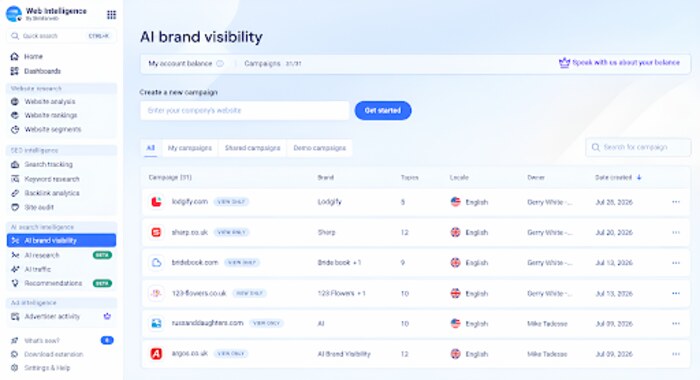
The most underrated change is what buyers now see before they ever reach a website. Businesses investing in search engine optimization services can use AI-driven search insights to improve their visibility, understand buyer behavior, and strengthen their overall organic search strategy.
That turns a marketing metric into a strategic input. If a category’s three most-cited sources never mention your product, your pipeline shrinks for reasons no CRM report will explain.
The problem is that nobody owns this number yet. Rankings have a dashboard, paid has a dashboard, and the question of whether an answer engine names you at all sits with whoever happened to notice it first.
Measuring it means tracking three separate things: how often you are named in AI answers for the topics you care about, which prompts trigger the mention, and which pages the engine reads before answering.
Similarweb’s AI search optimization platform covers all three. It reports visibility share by domain across tracked topics, surfaces the underlying prompts so a team can see what buyers are asking rather than guessing, benchmarks the top 30 brands in a topic, so a rising competitor is visible before it shows up in lost deals, and traces citations down to the exact URL the engines used as sources.
Sentiment is broken out separately, because being mentioned and being mentioned well are different results, and only one of them help
The strategic value is in the citation data. It tells a leadership team where its authority lives, which is often not where the budget goes. Coruzant’s roundup of AI visibility tools draws a useful line between platforms that watch and platforms that act, and the category is sorting itself along that split.
One caution applies to all of them. AI answers move day to day, so a single snapshot will flatter or frighten you. Insist on multi-day sampling before any of it reaches a board report.
Decisions about people: measuring confidence, not satisfaction
Hiring, retention, and product decisions have always leaned on feedback that everybody privately distrusts. Survey scores cluster at the extremes, reviewers moderate themselves when they can be identified, and the resulting number is treated as fact because nothing better is available.
This is where scoring systems built on psychological methods have started to change the input quality.
A confident management tool such as Confiscore takes a different route to the same question: respondents express how they feel across multiple attributes rather than assigning a direct score; the responses stay anonymous, and an algorithm converts the pattern into a confidence score for a candidate, a team, a product, or a service.
For decision-makers, the useful part is the shape of the output. A multi-attribute score tells you which specific attribute is dragging, so the follow-up action is assignable to a person rather than a department.
Applied to recruitment, it produces a view built from interviewers and prior references. Applied internally, it produces a 360-degree read across superiors, peers, and reports.
But the limitation is worth stating. Confidence data describes perception, not performance, and it should sit next to operating numbers rather than replacing them.
Decisions about the AI itself: build, buy, or route
Leadership teams now spend real time on a decision that did not exist five years ago: which AI, from whom, wired in where.
The answer is that the gap between options is narrowing. Coruzant’s comparison of Salesforce Agentforce and Claude for enterprise AI reaches the conclusion that the practical difference between native suite AI and a leading external model is small.
If capability is converging, the deciding factors move elsewhere. Where does the data already sit? Which option gives you the flexibility to change models later without costly redevelopment? Which one can your team operate on a Tuesday afternoon?
Those questions are more predictive of outcome than benchmark scores.
What to log before you trust the output
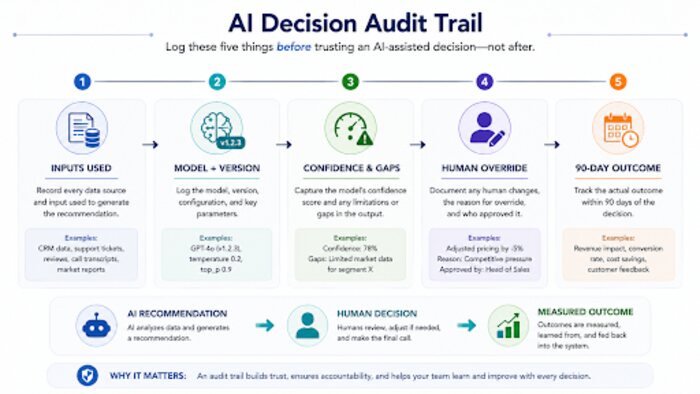
A decision produced with AI assistance needs the same treatment as any other system that runs in production. Visibility separates a program that improves from one that degrades.
The framework Coruzant applies to real-time AI systems in production transfers directly. Teams do not need perfect scores on every dimension before they run a pilot, but they do need enough telemetry to diagnose what went wrong.
Log these five things from the first decision:
- Inputs used
Which systems and date ranges the summary drew on, so a stale feed is visible immediately.
- Model and version
The exact model behind the output, because behavior changes when a vendor updates.
- Confidence and gaps
What the system flagged as uncertain, kept separate from what it stated plainly.
- Human override
Who changed the recommendation, and the reason given at the time.
- Outcome at review
The result 90 days later, matched back to the original recommendation.
That last one is the step almost everyone skips, and it is the only one that turns a pile of assisted decisions into evidence about whether the assistance works.
Where AI decision support falls short
These systems are confident by design, which is a problem when the underlying data is thin. A summary of four support tickets reads like a summary of four thousand. Nothing in the output tells a reader which one they are looking at.
Bias in the source data survives summarization intact. If a CRM only records deals that reached stage three, no model will surface the pattern in the ones that never did.
Analysis of why data and AI initiatives fail keeps landing on the same causes, and most of them are organizational rather than technical.
There is also a quieter failure mode. When a system produces a clean recommendation quickly, teams stop arguing. Disagreement is expensive, but it is also the mechanism by which bad assumptions get caught, and a plausible machine answer can end that argument before it starts.
The bottom line
AI has not taken decision rights away from anyone. It has removed the delay between a question and the evidence, made a set of previously invisible inputs measurable, and raised the standard for what counts as a defensible reason.
The organizations getting value are the ones that decided what to measure, wrote down what the machine contributed, and checked the outcome afterward.
Try this today:
- Pick one recurring decision and write down which inputs currently take the longest to assemble
- Run a two-week visibility check on how answer engines describe your category
- Add a confidence measure to one hiring or product decision already in progress
- Start logging model version and human overrides on every assisted recommendation
Common questions about AI in decision-making
1. Does AI improve decision quality or just speed?
Mostly speed, and speed compounds. Faster evidence assembly means more decisions get revisited on real data instead of being locked in for a year.
2. Which decisions should stay fully human?
Anything irreversible, anything involving a small number of high-stakes cases, and anything where the training data is unlikely to resemble the situation.
3. How do we know the recommendation is not just AI hallucinations?
Ask what the output rests on. A system that cannot name its sources and its uncertainty is not ready to inform a decision that matters