

When six AI proposals compete for the same two data engineers, the question is not which one is best. It is which ones you can actually staff.
Updated on: 2026-11-24
Too many AI pilots is now a portfolio problem, not a pilot problem: 44% of respondents in a 2026 global survey say AI is scaling across their enterprise, yet just 37% report any positive AI-related EBIT impact (Source: McKinsey). A pattern we keep seeing in executive reviews: every proposal looks approvable on its own. Each has a plausible business case, a willing sponsor, and a demo that worked. Then someone asks who builds them, and the room goes quiet, because the same senior data engineer and the same security reviewer are named on four of them.
That is the portfolio problem, and it is a different executive task from evaluating a single pilot. A readiness review asks whether one proposal is prepared for the next stage. Portfolio triage asks which of several competing proposals your organization can support at the same time, in what order, and what has to pause or merge so the survivors actually get finished. This piece is about that second question, aimed at CEOs and CIOs who have more approved-looking ideas than delivery capacity.
Key Takeaways
- Budget is rarely the constraint; named people, data, and reviewers are.
- Describe every proposal on the same eight dimensions before ranking value.
- Scan capacity and dependency columns first to expose staffing conflicts.
- Use five decisions: proceed, sequence, merge, pause, or stop.
- Write a baseline and stop condition into every approved pilot.
Why having many pilots is not the same as making progress
McKinsey’s state of AI in 2026 survey reports that 44% of respondents say AI is scaling across their enterprise, up from 38% a year earlier, while 37% report some positive AI-related EBIT impact, essentially unchanged from the prior year. About 20% experienced AI operating costs as a constraint. Those are self-reported figures from 1,719 participants across 97 countries, fielded May 4 to June 8, 2026, weighted by each nation’s share of global GDP. They describe respondents, not every firm, and they do not prove any particular portfolio method works.
What they do suggest is the tension most leadership teams are living with. More activity, flat returns, and cost showing up as a real constraint. Running more pilots does not close that gap. Finishing the right ones, with the capacity and ownership to operate them, is what moves EBIT.
There is no proven correct number of concurrent pilots. Anyone who tells you the right figure is three or seven is guessing. The useful discipline is not a quota. It is forcing every proposal to compete for the same scarce resources in the open, instead of getting approved in separate meetings where no one sees the overlap.
The resource that actually runs out is not money
Budget is the easiest thing to approve and the least likely thing to be your real constraint. You can fund five AI projects. You cannot clone the one platform engineer who understands your data permissions, or the one legal reviewer who signs off on model risk, or the business owner who is supposed to drive adoption while also running their day job.
This is an analytical framing, not a measured finding, but it holds up in practice: money does not resolve scarcity in data access, platform engineering, risk review, business ownership, or user adoption. A worksheet that tallies project budgets will miss this entirely. A worksheet that shows named people and their committed time by month will surface it immediately.
The trap is the low-effort score. Five proposals each marked “small, two weeks of specialist time” look harmless until you notice they all want the same two weeks from the same person. Count capacity and dependencies by time period and by named owner, not by project headcount.
The triage worksheet
For each proposal, record the same eight pieces of evidence. The point is comparability. When every proposal is described in the same terms, the conflicts between them become visible.
| Dimension | What to record |
|---|---|
| Business outcome | The process or decision that changes, who it affects, the measurable result that matters, and the current baseline. No baseline means you cannot prove improvement later. |
| Accountable owner | The person who owns the business result and adoption, not just the technical build. Can they make decisions and commit staff? If the owner cannot free up their own team, the pilot stalls after handoff. |
| Capacity | Named people and specialist teams required, how much of their time, and during which weeks or months. What active work gets displaced if this proceeds. |
| Dependencies | Data, permissions, platform, vendor, integration, and infrastructure prerequisites. Mark which are shared with other proposals on this list. |
| Risk and oversight | Potential impacts and risk treatments that need specialist review or ongoing monitoring. Confirm those reviewers are available, not just that the risk is named. |
| Evidence and uncertainty | What is demonstrated versus estimated versus still an assumption. What new evidence would change this proposal’s priority. |
| Timing and sequencing | Is this blocked by another initiative, or does it build shared capability others need? |
| Decision and checkpoint | Proceed, sequence, merge, pause, or stop. Name the decision-maker, the next evidence checkpoint, and the conditions under which a paused proposal gets reconsidered. |
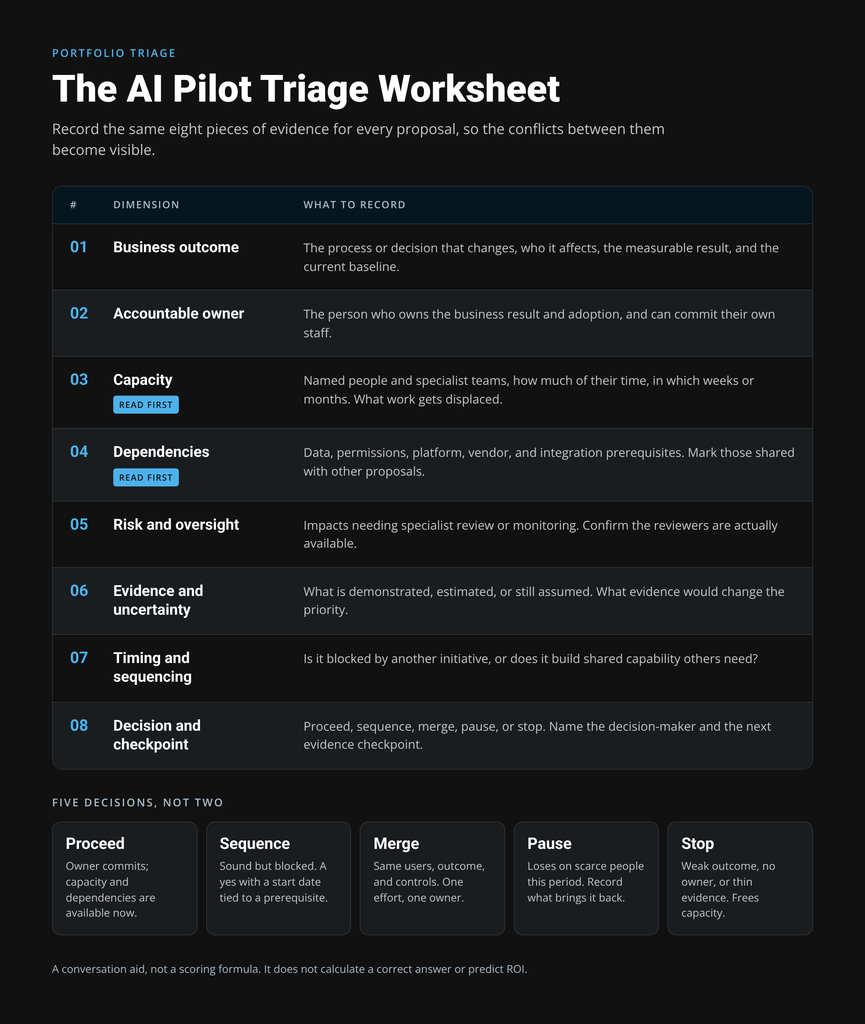
Treat this as a conversation aid, not a scoring formula. It does not calculate a correct answer or predict ROI. Its job is to put competing proposals in the same frame so a leadership team can argue about tradeoffs with the same facts in front of them.
Do not let a tidy rubric imply precision it does not have.
Read the capacity and dependency columns together first
Before anyone debates which outcome is most valuable, scan those two columns across all proposals. Two signals matter most.
First, the same named owner or specialist appearing on multiple rows. That is a staffing conflict regardless of how each project rates on its own. Second, the same data contract, platform component, or security review listed as a dependency in several places. That is either a sequencing opportunity or a bottleneck, depending on whether that prerequisite exists yet.
NIST’s AI Risk Management Framework supports making this explicit. Its Manage function calls for prioritizing risks based on impact, likelihood, and available resources, and for accounting for the resources needed to manage risk alongside viable non-AI alternatives, then deciding whether a system should proceed. NIST does not prescribe a universal weighting or ranking threshold, so do not read a scoring formula into it. It does give you cover to put oversight capacity on the table as a real constraint, because an approved pilot that no one is available to monitor is not actually ready to run.
Five decisions, not two
Most review meetings behave as if the only options are approve or reject. Triage has five.
Proceed. The outcome matters, the owner can commit, and the capacity and dependencies are clear and available now.
Sequence. The proposal is sound but blocked, usually because it needs a data contract, platform capability, or reviewer that another initiative will deliver first. Sequencing is not a soft no. It is a yes with a start date tied to a named prerequisite.
Merge. Two proposals target a shared capability or the same process. Before you combine them, test whether they genuinely overlap. Initiatives can touch the same process but still have distinct users, outcomes, or controls. Overlap is a reason to examine, not an automatic duplicate label. If they do serve the same users and outcome with the same controls, one effort with one owner beats two half-staffed ones.
Pause. The idea has merit but loses the competition for scarce people this period. Record what evidence or capacity change would bring it back. A pause without reconsideration conditions is just a slow rejection that wastes the sponsor’s goodwill.
Stop. The outcome is weak, the owner cannot be named, or the evidence does not support the investment. Stopping clearly frees capacity for the proposals you are keeping. The hardest stops are the ones with an enthusiastic sponsor and a nice demo, which is exactly why the worksheet asks for a baseline and a business owner who can commit staff.
Pilot success is not the same as a running service
A frequent error in triage is treating “the pilot worked” as “we can roll this out.” They are different states with different resource needs.
A contained pilot can run on curated data, a narrow set of users, and close human oversight. Operating it as a service adds workflow integration, named business and technical owners, monitoring, incident response, and stop or rollback conditions. Coruzant’s coverage of what CIOs must sign before a pilot goes live walks through that gap in detail. For triage, the practical consequence is this: when a proposal says “proceed to production,” its capacity and dependency columns have to reflect the operating cost, not just the pilot cost. Those are much larger, and they are the costs that show up in McKinsey’s constraint figure.
Pilot usage also tends to understate production demand. Coruzant’s capacity planning guidance notes that pilot traffic may not represent real adoption, wider usage, or retries. If two proposals both assume they will have the same shared capacity available at production scale, at least one of those assumptions is probably wrong. Flag it in the worksheet rather than discovering it after both ship.
What makes a baseline and a stop condition non-negotiable
A proposal without a baseline cannot prove it worked, and a proposal without a predefined stop condition tends to keep consuming capacity on momentum alone. Coruzant’s guidance on measuring AI ROI recommends taking a baseline before launch, tying each project to a specific outcome, counting the costs, and defining in advance when to continue or stop. Treat that as editorial guidance on good practice, not a validated universal threshold.
For portfolio triage, these two fields do double duty. The baseline tells you whether a running project is still earning its capacity. The stop condition gives you a pre-agreed way to free that capacity for a paused proposal without relitigating the whole decision. A portfolio you can rebalance is far more valuable than one locked in place the day it was approved.
What I would do first
Put every active and proposed AI initiative on one sheet before the next review, and fill in only two columns: named capacity by month and shared dependencies. Not the business cases yet, just those two.
The overlaps you find there will tell you more than any individual proposal’s ROI estimate. Once you can see which people and prerequisites are overcommitted, the proceed, sequence, merge, pause, and stop decisions get much easier, because you are no longer pretending the organization can do everything at once.
For the surrounding decisions, from single-pilot approval to operating AI as an accountable service, Coruzant’s broader Enterprise AI Decisions coverage and its Digital Executive podcast carry the adjacent conversations on strategy, ROI, and readiness.
FAQ
There is no evidence-based correct number, and anyone citing one is guessing. The useful limit is set by your scarcest committed resources, usually specific people, data access, and risk reviewers, not by a target count. Run as many as you can staff and operate with named owners through their next checkpoint.
Value ranking is part of it, but value alone will approve more work than you can deliver. Two high-value proposals that both depend on your only platform engineer still cannot run in parallel. Triage weighs value against committed capacity, shared dependencies, and accountable ownership together, which is why the worksheet keeps those in separate columns.
Tie it to evidence checkpoints rather than the calendar. When a project hits a defined checkpoint, when a stop condition triggers, or when a major dependency is delivered, rebalance. Paused proposals get reconsidered when their recorded conditions are met. A fixed quarterly review is fine as a backstop, but the real triggers are the checkpoints and stop conditions you wrote into the worksheet.
No. Test for genuine overlap first. Projects can share a process or capability but serve different users, pursue different outcomes, or need different controls. Merge when they truly share users, outcome, and controls. Otherwise, sequencing them so one builds shared capability for the other is often the better move.
When you have too many AI pilots, map named capacity and shared dependencies across all of them before comparing business cases. That view shows which proposals compete for the same people and prerequisites. From there, assign each one a clear decision: proceed, sequence, merge, pause, or stop.
Read Next
Go deeper on enterprise AI decisions with these Coruzant sections: