
The rapid adoption of generative AI tools has reshaped digital publishing, SEO workflows, and content operations across industries. While these systems enable unprecedented content velocity, they also introduce a parallel challenge: maintaining authenticity, originality, and search engine trust signals at scale. As a result, two categories of tools have emerged as essential infrastructure in modern content ecosystems—AI detection systems and AI humanization platforms. Within this evolving landscape, Lynote.ai positions itself at the intersection of detection accuracy and content refinement.
This article provides a structured SEO and industry-level analysis of how AI detection and humanization technologies are influencing content quality signals, ranking stability, and editorial integrity.
Key Takeaways
- Generative AI tools reshape digital publishing but challenge authenticity, leading to the rise of AI detection systems and humanization platforms.
- AI detection tools assess content quality for SEO, helping identify risks and ensure alignment with search intent before publication.
- Humanization tools transform AI-generated text, improving readability and engagement, which are crucial for SEO success.
- Lynote.ai operates within a dual-system framework, integrating detection and humanization to streamline content quality processes for publishers.
- The future of SEO will focus on governance, ensuring that all content meets quality thresholds while maintaining fast production.
Table of contents
- The SEO Impact of AI-Generated Content: A Shifting Baseline
- Why AI Detection Has Become a Core SEO Workflow Layer
- The Rise of AI Humanization in Content Optimization
- Detection vs. Humanization: A Dual-System Content Strategy
- Lynote.ai in the Content Quality Ecosystem
- SEO Implications: Why This Matters for Rankings
- The Future: From AI Content Creation to AI Content Governance
- Conclusion
The SEO Impact of AI-Generated Content: A Shifting Baseline
Search engines have become increasingly sophisticated in evaluating content quality beyond keyword density. Modern ranking systems incorporate behavioral signals, semantic coherence, and perceived authenticity. While AI-generated content is not inherently penalized, mass-produced low-value outputs can dilute topical authority and reduce trust signals across domains.
This has created a measurable demand for verification and refinement tools. Publishers now routinely evaluate whether content reads as human-written, whether it aligns with search intent, and whether it demonstrates informational depth rather than surface-level summarization.
In this environment, AI detection tools are no longer niche utilities—they function as quality assurance layers in SEO pipelines.
Why AI Detection Has Become a Core SEO Workflow Layer
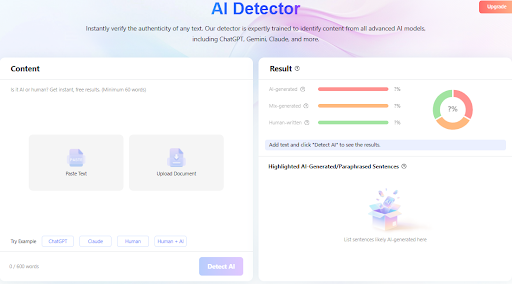
AI detection tools assess probability-based linguistic patterns, syntactic predictability, and token distribution anomalies to estimate whether content is machine-generated. While not perfect, they are widely used in editorial workflows for risk mitigation.
For SEO teams, the value is not binary classification but directional insight. Detection scores help identify sections of content that may require restructuring, enrichment, or stylistic adjustment before publication.
Among emerging tools in this category, platforms like Lynote.ai contribute to a broader ecosystem where content verification is integrated into production workflows rather than applied post-publication.
A key benchmark keyword in this space is best free ai detector, reflecting the demand for accessible tools that balance accuracy with usability. Free-tier detection systems are particularly important for smaller publishers and affiliate sites that operate under tight content budgets but still require compliance-level quality assurance.
From an SEO standpoint, AI detection is increasingly used for:
- Pre-publication content audits
- Editorial consistency checks
- Affiliate content risk scoring
- Brand safety validation
- Content refresh evaluation for existing URLs
These applications highlight a broader shift: detection tools are becoming part of technical SEO infrastructure, not just editorial add-ons.
The Rise of AI Humanization in Content Optimization
While detection focuses on identifying machine-generated text, humanization tools aim to transform it. This includes adjusting sentence rhythm, reducing predictability, introducing semantic variation, and improving narrative flow.
Humanization is particularly relevant for SEO because search engines indirectly reward readability and engagement. Content that feels overly structured or repetitive often underperforms in dwell time and scroll depth metrics—both of which correlate with ranking stability in competitive SERPs.
This is where AI humanization tools play a strategic role. Instead of simply rewriting content, they reshape linguistic patterns to align more closely with human writing behavior.
A commonly targeted search term in this category is best free ai humanizer, reflecting growing demand for tools that improve content authenticity without requiring manual rewriting at scale.
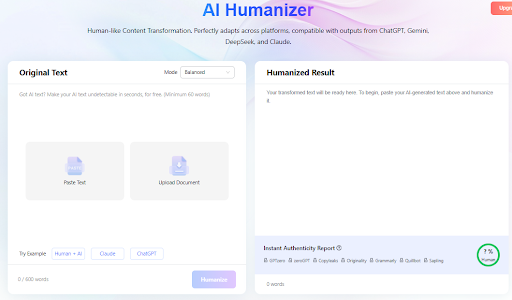
From an operational perspective, AI humanizers are used for:
- Converting AI drafts into publish-ready editorial copy
- Improving tonal consistency across multi-author blogs
- Reducing detection risk in high-scrutiny niches (finance, health, tech)
- Enhancing readability for non-native audiences
- Refining SEO content generated in bulk workflows
In essence, humanization tools act as a bridge between machine efficiency and editorial standards.
Detection vs. Humanization: A Dual-System Content Strategy
Rather than viewing AI detection and humanization as opposing forces, modern SEO teams increasingly treat them as complementary systems.
Detection identifies risk.
Humanization resolves it.
This dual-layer workflow allows publishers to maintain production speed while controlling quality variance. A typical pipeline might look like this:
- AI-generated draft creation
- Initial SEO optimization (keywords, headings, internal structure)
- AI detection scoring
- Humanization pass for flagged sections
- Final editorial review
- Publishing and performance monitoring
This structured approach reduces the likelihood of algorithmic suppression due to low-quality signals while preserving the scalability advantages of AI-assisted writing.
Lynote.ai in the Content Quality Ecosystem
Lynote.ai operates within this dual-system framework by focusing on both detection and transformation. Rather than treating AI content as inherently problematic, the platform emphasizes controllability—helping teams measure, adjust, and refine outputs based on contextual needs.
In SEO terms, this is significant because content quality is no longer static. A single article may go through multiple optimization cycles depending on performance metrics, keyword updates, and SERP volatility.
Platforms that integrate both detection and humanization functions reduce operational friction. Instead of switching between multiple tools, content teams using Lynote.ai can apply iterative improvements within a unified workflow.
SEO Implications: Why This Matters for Rankings
From a search engine optimization perspective, AI detection and humanization tools influence three key ranking dimensions:
1. Content Quality Consistency
Consistent tone and structure across pages improve topical authority signals, especially for domain-wide SEO strategies.
2. Engagement Metrics Optimization
Humanized content tends to improve readability, which can positively impact time-on-page and bounce rates.
3. Algorithmic Risk Reduction
While search engines do not explicitly penalize AI content, low-quality patterns associated with unedited AI output can reduce visibility in competitive SERPs.
As algorithms evolve toward more sophisticated content evaluation models, these indirect signals become increasingly important.
The Future: From AI Content Creation to AI Content Governance
The next phase of SEO will likely move beyond content generation toward content governance. Instead of asking “How do we produce more content?”, organizations will focus on “How do we ensure every piece of content meets quality thresholds at scale?”
In this context, AI detection and humanization tools function as governance mechanisms. They introduce structure into what would otherwise be an unregulated production environment.
This shift also changes the role of SEO professionals. Rather than purely optimizing keywords and metadata, they increasingly act as content system designers—building workflows that ensure quality, compliance, and performance consistency across AI-assisted pipelines.
Conclusion
The integration of AI into content creation has not eliminated the need for editorial oversight; it has amplified it. Tools that evaluate and refine machine-generated text are becoming essential components of modern SEO infrastructure.
By combining detection capabilities with humanization processes, platforms like Lynote.ai reflect a broader industry movement toward balanced content ecosystems—where speed and quality are not competing priorities but interconnected outcomes.
As search engines continue refining their understanding of content authenticity, the ability to measure and adjust AI-generated text will become less of an advantage and more of a baseline requirement for competitive visibility.