At 400,000 SKUs, you don’t test AI SEO tools. You test whether one survives contact with the catalog. Vendor demos run against a tidy fifty-page site with no seasonal noise; ours is eleven templates and category pages holding position through a six-week peak. About 30% of US search keywords now trigger an AI Overview, per SE Ranking’s tracking, so whatever we run must show whether pages still surface with no blue link to rank.
The short answer: SE Ranking is the strongest all-round pick at catalog scale, the only platform here pairing a single audit spanning the whole catalog, up to 2,000,000 pages, with AI-answer tracking across five engines and an API feeding a revenue-weighted scoring sheet directly. For the deepest enterprise content grading alone, a specialist goes further.
What I weighted, in the units that matter at scale: crawl ceiling without sampling away the truth, template-level grouping instead of a 60,000-row page list, an API that feeds a scoring sheet, and AI-answer visibility for category and product terms, not just blue links.
| Rank | Tool | Best for (at scale) | AI capability | Bulk / API behavior | Entry price |
| 1 | SE Ranking | In-house teams auditing six-figure catalogs and tracking AI answers in one platform | AI Results Tracker across 5 engines: ChatGPT, Perplexity, Gemini, AI Overviews, AI Mode | Website Audit up to 2,000,000 pages/mo; API and MCP included on every plan | $129/mo ($103.20/mo billed annually) |
| 2 | seoClarity | Enterprise catalogs needing unlimited seats and custom-scale data | Sia AI assistant plus Clarity ArcAI add-on for AI-search visibility | Unlimited users on all tiers; sales-managed onboarding for large data volumes | Custom, from roughly $2,500/mo |
| 3 | Surfer SEO | Template-scale category and product copy | Surfy AI assistant plus AI visibility tracking across ChatGPT, Perplexity, Gemini, AI Mode | Content Editor scores drafts against the live SERP; credit-based document caps | Around $99/mo |
| 4 | Ahrefs | Backlink and competitive research across a large domain footprint | Brand Radar tracks brand visibility across 271M+ AI prompts | Deep crawl and backlink index at scale; one seat included on entry plans | Lite $129/mo |
| 5 | Semrush | One broad platform spanning SEO, PPC, content, and AI search | AI Visibility / AI SEO Toolkit across Google, ChatGPT, Perplexity, Gemini | Enterprise AIO tier built for large-scale prompt tracking | $139/mo |
| 6 | Nightwatch | Hyper-granular rank tracking extended to AI answers | AI Overview and AI Mode tracking plus AI-prompt monitoring | Rank tracking across 107,000+ locations; unlimited seats on all plans | €79/mo |
| 7 | Alli AI | Code-free bulk on-site edits pushed across templates | AI Search Visibility Engine pre-renders optimized content for 50+ AI crawlers | Snippet or WordPress edits applied site-wide without a dev queue | $249/mo |
Key Takeaways
- SE Ranking excels for large catalogs, auditing up to 2,000,000 pages while tracking AI answers across five engines.
- The audit approach focuses on template-level grouping, ensuring efficient insights without overwhelming data noise.
- Other tools like seoClarity and Surfer SEO offer specialized capabilities, but SE Ranking is the top choice for revenue-weighted scoring.
- Pricing varies significantly among tools, with SE Ranking starting at $129/month, making it accessible for in-house teams.
- AI SEO tools enhance visibility into AI Overviews and chatbot citations, crucial for optimizing product pages in a competitive landscape.
Table of contents
The catalog audit: reading 400,000 pages by auditing 8,000
You audit a slice, not every page: grouped by template, not URL, so the 2% you read stands in for the rest. SE Ranking’s Website Audit crawls up to 2,000,000 pages this way; Ahrefs and seoClarity hold up at this size too. 68% of US Google searches ended without a click in early 2026.
Category and product copy at template scale
You don’t optimize one product description, you optimize the template generating 60,000 of them. SE Ranking pairs Content Editor with AI Writer; Surfer SEO scores drafts against the live SERP; Alli AI pushes bulk edits across templates when the fix is structural, not copy. The template wins. It always wins.
Tracking positions and AI visibility across the whole catalog
Rankings alone don’t answer the question anymore: you track positions and AI-answer presence across thousands of queries at once. SE Ranking’s AI Results Tracker covers five engines with cited and cached sources; Nightwatch adds 107,000+ locations; Semrush folds AI visibility into a broader suite. Users click a result in only 8% of searches showing an AI summary, versus 15% without.
The 7 AI SEO tools, ranked
1. SE Ranking
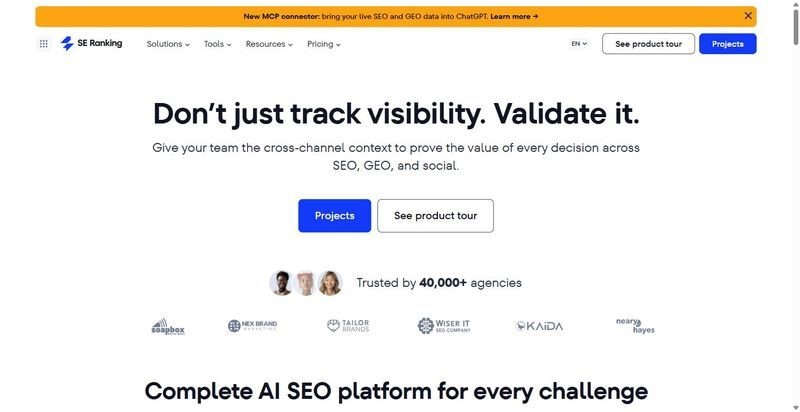
SE Ranking is an AI-powered SEO platform that covers traditional SEO and AI-search visibility in one workspace.
Best for: in-house e-commerce teams auditing six-figure catalogs and tracking AI answers for product and category terms in one place.
Standout: the proof at scale is a Website Audit spanning up to 2,000,000 pages, issues grouped by URL pattern so a leak traces to one of eleven templates, not a spreadsheet. The audit tool also runs AI Insights daily against top keywords, catching cannibalization before it costs a category its rankings.
Pros:
- Audits up to 2,000,000 pages with template-level grouping and JS rendering, so a 400K-SKU crawl doesn’t get sampled to noise.
- Tracks AI answers across 5 engines (ChatGPT, Perplexity, Gemini, AI Overviews, AI Mode), with cited and cached sources.
- Includes API and MCP access on every plan, so audit deltas feed into a revenue-weighted backlog sheet.
- Flags cannibalization and thin content daily through AI Insights.
Cons:
- AI-drafted content still needs a human pass before shipping.
- Some Insights need Google Search Console connected, a procurement step, not a toggle.
- No automated cross-channel correlation inside the UI; that happens via the MCP server.
Pricing: Core runs $129/mo ($103.20/mo annually); Growth runs $279/mo ($223.20/mo annually). API and MCP access are included on every plan, with a 14-day trial.
Where it lands: this is the one platform I’d feed into the revenue-weighted backlog without translating it first. The audit-to-template trace paid for its own sprint in month one.
2. seoClarity
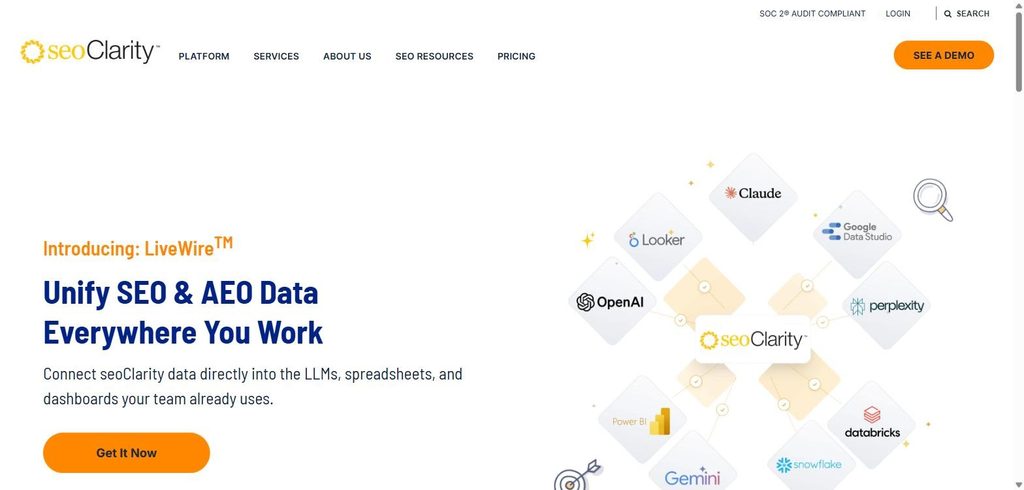
seoClarity is an enterprise SEO platform built for custom-scale data and unlimited seats.
Best for: enterprise in-house catalogs and large agencies needing unlimited seats at custom scale.
Standout: Sia, its AI assistant, surfaces prioritized actions from account data, useful when eleven templates compete for two sprints. Every tier includes unlimited users, and Clarity ArcAI adds AI-search visibility.
Pros:
- Surfaces prioritized, data-driven actions through Sia instead of generic checklists.
- Includes unlimited users on every tier, once several teams need logins.
- Extends into AI-search visibility through Clarity ArcAI.
Cons:
- Prices custom, assuming full catalog commitment up front.
- Carries a heavier onboarding load than a self-serve tool.
- Sells sales-only, no signup to test first.
Pricing: Custom; Research & Content plans start near $2,500/mo, with a roughly 2,000-keyword minimum.
Where it lands: earns a slot once unlimited seats beat a per-user tax and procurement has the quote in hand; below that, it’s a budget question.
3. Surfer SEO
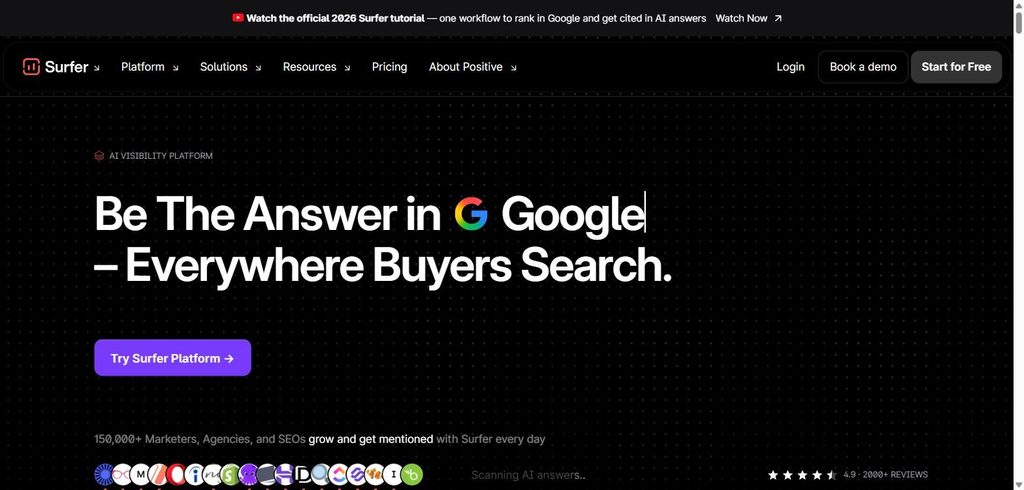
Surfer SEO is a content optimization platform that scores drafts against live SERP data.
Best for: content teams optimizing category and product copy at template scale.
Standout: the Content Editor scores a draft against the live SERP as you type; Surfy drafts and humanizes copy in that view, and an AI Visibility layer tracks four engines.
Pros:
- Scores content against live SERP signals, not a fixed checklist.
- Drafts and rewrites copy inside the same editor it scores.
- Maps topical clusters before a template gets written.
Cons:
- Content-credit and document caps bite fast once a template covers 60,000 pages.
- Scoring guidance can push writers toward over-optimization if followed literally.
- AI-prompt allowances at entry are too thin for catalog scale.
Pricing: around $99/mo Standard; entry tiers start near $49/mo annually.
Where it lands: Surfer earns its seat on the template, not the page. Score it once, let the editor catch drift as SKUs get added.
4. Ahrefs
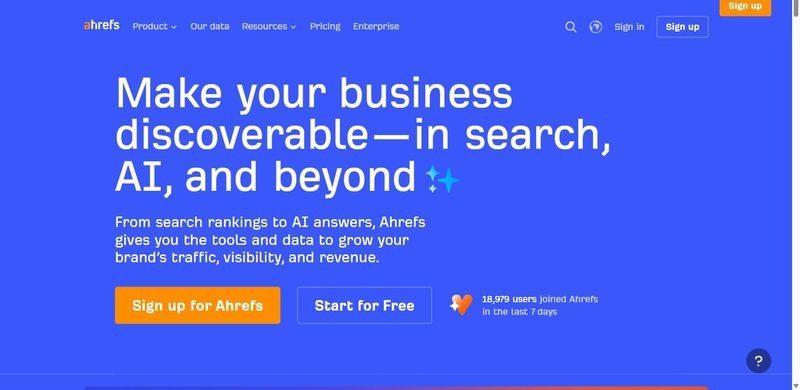
Ahrefs built its name on backlink data, and that index is still why large sites keep a seat.
Best for: teams that live in backlink and competitive research at scale, with AI visibility bolted on.
Standout: Brand Radar tracks brand visibility and citations across a large index of AI prompts; the backlink index underneath stays industry-leading.
Pros:
- Runs competitor and backlink research across a link index few rivals match.
- Surfaces brand citations across AI answers through Brand Radar.
- Handles competitive teardowns at 400K-SKU scale.
Cons:
- Ships with one seat, so a six-person team pays extra immediately.
- AI-prompt allowances stay stingy next to AI-visibility-first tools.
- Report and credit limits cap how often you re-pull data.
Pricing: Lite runs $129/mo, Standard $249/mo, both billed annually.
Where it lands: the backlog treats Ahrefs as the link and competitor system of record, not the AI-visibility tool.
5. Semrush SEO Tools
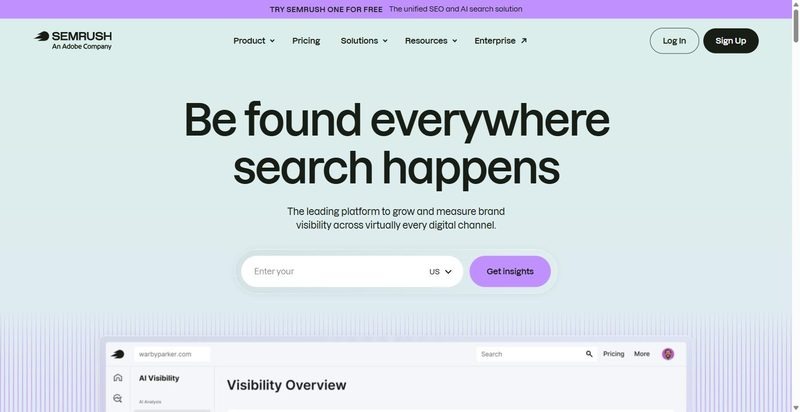
Semrush is the broadest suite here, one login spanning SEO, PPC, content, and AI search.
Best for: teams wanting one broad suite across SEO, PPC, content, and AI search visibility, not a point solution.
Standout: the AI Visibility / AI SEO Toolkit tracks brand presence and sentiment across Google, ChatGPT, Perplexity, and Gemini; Enterprise AIO scales further.
Pros:
- Covers SEO, PPC, content, and AI search visibility in one toolset.
- Tracks AI presence and sentiment across four major engines.
- Enterprise AIO scales prompt tracking past most dedicated tools.
Cons:
- Cost climbs fast once seats and AI add-ons stack up.
- Standardizing workflows across a team this size takes real onboarding.
- Entry-tier limits throttle before reaching catalog volume.
Pricing: SEO plan starts at $139/mo ($117.33/mo annually); higher tiers run to $549/mo.
Where it lands: the case here is one login instead of three for SEO, PPC, and AI monitoring.
6. Nightwatch
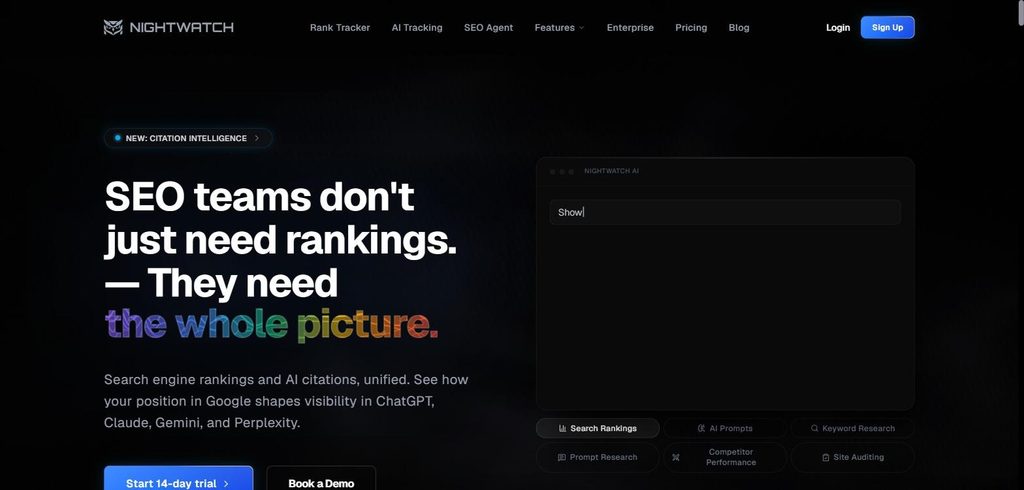
Nightwatch is a rank tracker built for granularity, now extended into AI answers.
Best for: teams needing hyper-granular rank tracking across many locations, extended to AI Overviews and AI Mode.
Standout: Nightwatch tracks rankings across 107,000+ locations with multi-year SERP history, useful for categories with different local intent, and now adds AI Overview and AI Mode monitoring.
Pros:
- Tracks positions across more locations than most competitors offer at any tier.
- Multi-year SERP history helps trace when a template’s visibility shifted.
- Adds AI Overview and AI Mode tracking at no extra cost.
Cons:
- Reporting is plainer than the bigger suites’.
- No content optimization or backlink suite, so it won’t replace your audit tool.
- Entry AI-prompt allowance is modest, and pricing runs in EUR.
Pricing: Starter is EUR 79/mo; Professional is EUR 159/mo.
Where it lands: location-level tracking is the actual sell here, not the AI layer on top; it won’t replace a platform that audits the templates causing the drift.
7. Alli AI SEO Tools
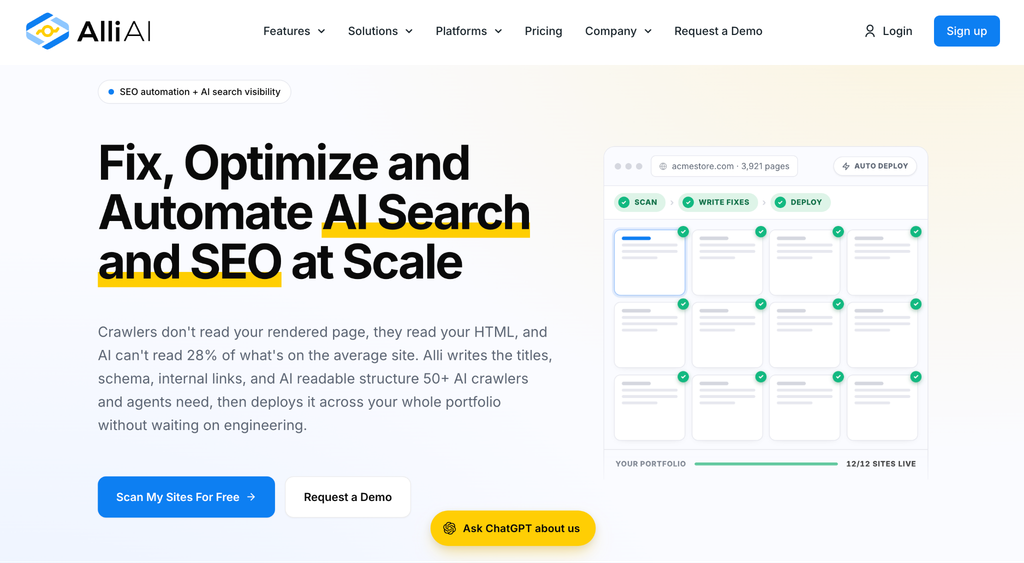
Alli AI automates on-site SEO changes and AI-crawler optimization across a site without a rebuild.
Best for: agencies and dev-capable teams wanting code-free bulk on-site SEO automation across large sites.
Standout: an AI Search Visibility Engine pre-renders optimized content for 50+ AI crawlers with no rebuild, paired with a live AI-bot traffic monitor: template-wide changes ship from one snippet, not one ticket per page.
Pros:
- Deploys on-site fixes across templates from a single snippet, not a per-page dev ticket.
- Pre-renders content for 50+ AI crawlers without touching the codebase.
- Monitors AI-bot traffic live, so crawl allocation is measured, not assumed.
Cons:
- Nothing under $249/mo.
- Built for dev and agency workflows, not a lean team.
- Automated changes need a review gate before they touch live pages.
Pricing: Business $249/mo, Agency $499/mo.
Where it lands: worth a sprint to install and gate the snippet; it then runs without competing for engineering time again.
The pick, in backlog terms
If you run a large catalog and have to pick one, it’s SE Ranking: not because it does more, but because it feeds the revenue-weighted scoring sheet directly, and every finding traces to a template, not a URL. Track your own AI-Overview exposure at seranking.com’s AI visibility tracker before committing a sprint.
Skip if: Alli AI, if nobody owns a snippet deployment; seoClarity, if you can’t clear its enterprise minimum.
It was never “which tool is best,” but “which tool survives a backlog and a sprint that also funds checkout work.” Price the tools in revenue per sprint, and the list sorts itself.
FAQ
Which AI SEO tool handles the largest catalogs?
Crawl ceiling and template-level reporting decide this, not feature count. SE Ranking’s Website Audit runs up to 2,000,000 pages a month with JS rendering included, covering a 400,000-SKU site with room to spare. seoClarity also clears enterprise scale, but custom pricing and sales-only onboarding cost a sprint first.
Do AI SEO tools replace a dedicated technical crawler at scale?
No: treating them as a replacement is how a template-level fix gets missed. AI SEO tools add visibility into AI Overviews and chatbot citations on top of a crawl; they don’t replace it. The audit groups issues by template first; the AI layer then shows whether it appears in AI search.
How do AI SEO tools help product pages show up in AI Overviews?
They surface which templates are cited, cached, or invisible to AI engines, so the fix targets a template, not a single product page. Roughly 30% of US SERP keywords trigger an AI Overview, so tens of thousands of our pages had no visibility into whether they were read.
Are AI SEO tools worth a sprint for an in-house e-commerce team?
Worth a sprint if the output feeds a decision, not a dashboard. Connect AI-visibility data to the same revenue-weighted sheet, or it’s a report nobody reads. Usually half a sprint to wire in, and it pays for itself the first time it catches a losing template.