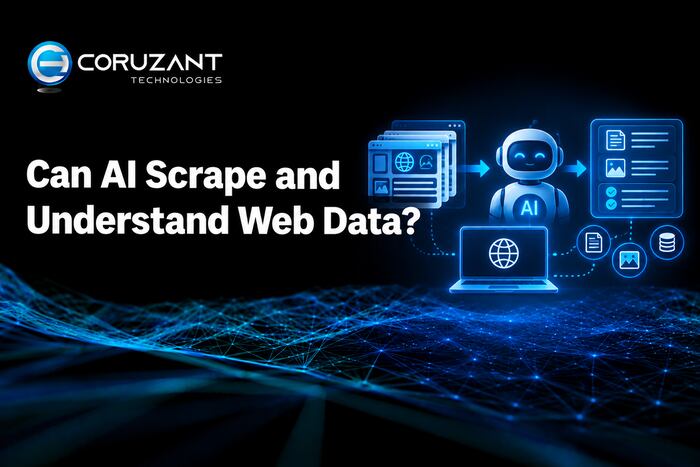
The web has an amount of information. You can find product listings, company details, news stories, public data, guides, and customer feedback. For a time, gathering all this data at scale meant using web scraping tools. These tools go to websites, pull the content, and turn it into formats like spreadsheets or databases.
Now artificial intelligence is starting to change how this works. AI can help not only with pulling data but also with understanding it. It can spot patterns and group similar information. Pull out key insights. This means the process is getting smarter and faster.
So the big question is: can AI actually scrape and understand web data? The answer is yes, more and more. There’s an important difference to keep in mind. AI can boost steps in the process like interpreting what the data means, organizing it, or extracting useful facts.. The actual task of visiting websites, sending requests, and getting the raw content is still handled by traditional scraping systems. These systems are reliable and work behind the scenes to make sure data is retrieved properly.
Key Takeaways
- AI enhances web scraping by interpreting and organizing data, but traditional scraping still retrieves raw content.
- AI adds flexibility, allowing it to analyze HTML and identify relevant information unlike fixed scrapers.
- Developers can still benefit from Python libraries for web data collection, ensuring effective retrieval and processing.
- AI can handle unstructured content, improving data accuracy and extraction from varied web formats.
- Future workflows will blend scraping and AI to create more adaptive information collection systems.
Table of contents
How AI Changes Web Scraping
Traditional web scraping generally follows a predictable process. A scraper sends a request to a webpage, receives its HTML, identifies relevant elements, and extracts information according to predefined rules. For example, a script might collect product names from a particular HTML element or extract prices from a known page structure.
The limitation is that websites do not always follow consistent structures. A small change to a page’s HTML can cause a rule-based scraper to stop working correctly. Dynamic websites can create another challenge because important information may only appear after JavaScript executes.
AI introduces a more flexible layer. Instead of relying entirely on fixed selectors, AI systems can analyze page content and determine what information is relevant to a particular task. A user might ask a system to identify the product name, price, availability, and key specifications from a collection of pages. The AI can then interpret the retrieved content and map information into those requested fields.
This makes AI particularly useful for the understanding stage of web data workflows. The underlying scraper still needs to retrieve the information, but AI can help determine what the information means.
Scraping and Understanding Are Different Tasks
It is useful to separate web scraping from data understanding.
Scraping focuses on retrieval and extraction. It answers questions such as:
- Which pages should be accessed?
- How should requests be handled?
- What content should be collected?
- How should HTML or rendered page content be converted into usable data?
Understanding focuses on interpretation. It involves questions such as:
- What does this text describe?
- Which information is relevant?
- Are two differently worded descriptions referring to the same concept?
- How can unstructured content be categorized?
- What conclusions can reasonably be drawn from the collected information?
AI is particularly valuable in the second area.
For example, a conventional scraper could collect descriptions from hundreds of software product pages. An AI model could then classify those descriptions according to features such as automation, analytics, integrations, security capabilities, or pricing models. Instead of simply producing a large collection of raw text, the workflow can turn that text into a more organized dataset.
Where Python Libraries Still Matter
AI does not eliminate the need for conventional scraping technologies. Python remains widely used for web data collection because developers have access to a broad ecosystem of tools for making HTTP requests, parsing HTML, interacting with browser environments, and processing structured data.
Developers can explore different Python web scraping libraries depending on whether a project requires HTML parsing, browser automation, request handling, or another scraping function.
These libraries provide the foundation for retrieving web content. AI can then operate on the resulting information.
A practical architecture might therefore look like this:
Website → Scraping layer → Cleaned content → AI processing → Structured data
This separation can make systems easier to maintain. The scraping layer handles access and retrieval, while the AI layer handles more flexible interpretation and classification.
AI Can Handle Unstructured Web Content
One of the biggest advantages of AI-assisted scraping is its ability to work with unstructured information.
Consider a collection of technology company websites. Each company might describe its products differently. One page could use a detailed technical specification table, another could present information in paragraphs, and a third could use marketing-oriented descriptions.
A traditional scraper may require separate extraction rules for each website. An AI model can potentially interpret the different formats and identify comparable information based on meaning rather than exact wording.
Natural language processing allows AI systems to recognize relationships between words and concepts. For example, “automated customer support,” “AI-powered support agents,” and “intelligent customer service automation” may describe related capabilities even though the wording differs.
This capability can be useful for research, market analysis, content monitoring, competitive intelligence, and internal data projects. However, AI interpretation should not automatically be treated as fact. Models can misunderstand ambiguous language or infer information that a source does not explicitly provide.
AI Web APIs and Agentic Workflows
The emergence of AI web scraping systems is also moving scraping toward more task-oriented workflows. Instead of configuring every extraction rule manually, a user can describe the information they need in natural language.
An AI Web Scraper, for example, reflects this broader direction: using AI to extract information from websites according to a defined objective.
More advanced workflows can combine scraping with AI agents. An agent may be designed to navigate a sequence of pages, collect relevant information, process the content, and return structured results. In theory, this reduces some of the manual configuration traditionally required for complex data collection.
However, agentic scraping also introduces additional engineering considerations. Systems need clear boundaries, validation mechanisms, error handling, and appropriate controls over which websites and data they access.
The Role of Data Quality
The ability to understand web content does not guarantee that the resulting dataset is accurate.
Web pages can contain outdated information, duplicate content, missing fields, inconsistent terminology, or dynamically generated elements. AI can help organize such information, but it cannot automatically make an unreliable source reliable.
For this reason, AI-powered scraping systems benefit from validation steps. Extracted information can be checked against the original page, required fields can be verified, and unusual results can be flagged for human review.
This is particularly important when scraped information is used for business decisions, research, reporting, or other applications where inaccurate data can have meaningful consequences.
Legal, Ethical, and Technical Considerations
AI does not change the responsibilities associated with collecting web data. Website terms, copyright restrictions, privacy requirements, access controls, and applicable laws can affect whether and how information should be collected.
Scraping publicly accessible information does not necessarily mean that every form of automated collection is appropriate. Personal information requires particular care, and organizations should consider data minimization and retention practices when designing scraping systems.
Technical restrictions also remain relevant. Websites may use rate limits, authentication, robots directives, CAPTCHAs, or other mechanisms that affect automated access. Responsible systems should respect applicable restrictions rather than treating AI as a way to bypass them.
What the Future May Look Like
AI is unlikely to completely replace traditional web scraping. Instead, the two technologies are increasingly complementary.
Scraping tools are well suited to retrieving web content efficiently and repeatedly. AI is well suited to interpreting language, identifying patterns, classifying information, and transforming unstructured content into more useful representations.
This combination could make web data workflows more accessible. A developer may still need to build reliable infrastructure for crawling, request management, browser rendering, storage, and validation, but AI can reduce the amount of manual work involved in defining and processing the information.
The most useful systems will likely combine deterministic extraction with AI-based interpretation rather than relying entirely on either approach. Structured fields can be collected through conventional methods where possible, while AI can handle ambiguous or highly variable content.
Conclusion
AI can scrape and understand web data, but those are two separate capabilities. Conventional scraping technologies remain important for accessing and retrieving information, while AI adds value by interpreting content and transforming unstructured material into more meaningful data.
The result is a more flexible approach to web data collection. Instead of viewing scraping as simply copying information from webpages, organizations can treat it as a broader pipeline involving retrieval, cleaning, interpretation, validation, and analysis.
As AI systems become better at understanding context, web scraping is likely to become less dependent on rigid extraction rules. Yet reliable data collection will still require sound engineering, responsible access practices, and human oversight where accuracy matters. The future of web data is therefore not necessarily AI replacing scraping, but AI making scraping workflows more intelligent and adaptable.