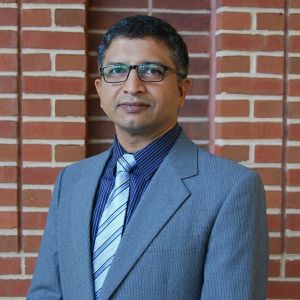
Ali Ashraf Podcast Transcript
Ali Ashraf joins host Brian Thomas on The Digital Executive Podcast.
Brian Thomas: Welcome to The Digital Executive. Today’s guest is Dr. Ali Ashraf. Dr. Ali Ashraf is the Dean of the Hassan School of Business at Colorado State University, Pueblo. Dr. Ali Ashraf previously served as Associate Dean in the College of Business, Engineering, Computational, and Mathematical Sciences at Frostburg State University, part of the University System of Maryland.
At Frostburg State University, a regional comprehensive university similar to Colorado State University, Pueblo, Dr. Ashraf has been instrumental in expanding access to higher education for diverse student populations, including first-generation college students, minorities, and women. He joined Frostburg State University as a tenure-track Assistant Professor of Finance in 2013, and steadily advanced through the ranks, earning tenure in 2018, and holding several key leadership positions, including MBA coordinator, department chair, and associate dean, and now dean at the Hassan School of Business at CSU Pueblo.
Well, good afternoon, Ali. Welcome to the show.
Dr. Ali Ashraf: Hi, Brian. Thank you for having me.
Brian Thomas: Absolutely, my friend. I appreciate it. You, it’s early morning for you. It’s afternoon here, late in Kansas City, and you are in Dhaka, Bangladesh in travels. I know you work in the State of Colorado at University of Colorado there.
So, really appreciate you making the time and traversing these several, several time zones to get here, so thank you. And Ali, I’m gonna jump into your first question. Let’s start with your journey. You were born and raised in Bangladesh, a country that places tremendous value in education, and you’ve spent 13 years in higher education, most of it at Frostburg State.
How did that path lead you to becoming Dean of the Hassan School of Business?
Dr. Ali Ashraf: Thank you, Brian, for having me, and such a wonderful question. I would like to take a little bit of time and go back to my background a bit and then come to my journey here in US. So I come from Bangladesh. It’s a small country, a highly populated country, and it’s a poor country.
So here, education is highly valued, and it’s kind of an opportunity for students and young people here in this country. So this is highly valued and highly competitive, and people here, they know that they have to break through the higher ed system and to make a good earning and good living.
And that’s the only way of like, evolving out of the poverty. So I had that struggle when I was in Bangladesh and I started my undergrad in a engineering school. I did my architectural degree over there, but guess what? I was really lost after my graduation. Then a good friend of mine, he talked about going to a business school, and I went to a business school.
And both my undergrad engineering school and business school they at some point, they were started by US universities. So the curriculum there were pretty much similar to what we have in US. So I had the blessing and also the opportunity to follow through similar curriculum, but in Bangladesh, so that helped me.
And going through the process I was still confused when I was in my MBA program. And then I figured, like, a little bit of soul-searching. I did construction management, I did architectural site gigs. Then I figured finance is my area. So, I opted for some finance job, proper finance job, like, banking and finance job.
And I figured I… research attracts me most, and then I pivoted to the central bank job. So, there I stayed for close to five years, and I did like, you know, different types of roles from, like, research through IT automation in the central bank. Pretty interdisciplinary background and the experience that you would see in my experience in Bangladesh.
Then in two thousand nine, I came to the US to pursue my PhD, and aft- in my final year of my doctoral degree from University of New Orleans, Louisiana. I call Louisiana hometown home state, because for immigrants, the first state that they come to US, that’s the home state. So, In 2013, I did my graduation.
2013, I started in Frostburg, and then I had my second phase of journey of my life. So, in Frostburg, I started as assistant professor of finance on the tenure track in 2013. In five years, I got tenured and promoted 2018 to associate professor. I also served in different, like, leadership role.
A part of it is, like, you know, the department and the college needed and also my senior faculty mentors; they encouraged me to step up. I served in the MBA director’s role for a while, department chair, and then 2022nd I stepped up. So, there was an open search for associate dean’s role. I applied.
My dean and the search committee recruited me. I feel so blessed, so thankful that I tried, and that kind of changed my journey from higher ed- higher e- higher educator to higher ed leader. So, I’m still learning. So, I had three years of associate dean’s experience, three and a half years of associate dean’s experience, altogether five years of leadership experience before coming to HSB here at Colorado State University Pueblo, Haslam School of Business.
And last year, I started mid-July with HSB. Actually, in February, I visited the campus, and I was so touched, so touched with the mission and the vision of the school. It’s a small school. It’s a AACSB accredited school. This is the gold standard in the business school in across the world.
Only five percent of schools are accredited by this AACSB program. In the US, close to twenty-five percent of the business schools, they are accredited. So highly selective, and HSB is very mission-driven small school focused towards students driven to student success, engaging the students. I love that.
And also, in a small school, we are very interdisciplinary, so that attracted me. So that brings me to HSB. I know it’s a little bit longer answer for that first question, but hopefully that gives you good preview of my background, my interest area, my journey in Bangladesh, transition to US, and then coming to leadership role.
Brian Thomas: Thank you. Really appreciate that. And that’s awesome. I appreciate the backstory. It helps our audience understand you know, where you started and, your humble roots, and you’ve come so far. But I, I liked how you talked about in Bangladesh, they treat education as a priority, which you certainly pursued, and then you decided, I, I wanna do something a little different.”
You went and got your MBA. Your career interest was in finance, and from there you applied to g- go into your PhD program, and things just kind of cascaded. And over time, you received many accolades in your career and which really led to some amazing promotions, and now including the dean of the State of Colorado at Pueblo in the Hassan School of Business, which is no small feat.
As you mentioned the accreditation there is one of the few very few of the many here in the US, so thank you. And Ali, if I could, jumping into your next question. Mm-hmm. You said Colorado State University Pueblo’s professors are doing amazing things in and beyond the classroom, and you wanna raise the school’s public presence.
How do you plan to strengthen the connection between the Hassan School and the Southern Colorado business community?
Dr. Ali Ashraf: Thank you, Brian, again. This is one of the very important factors that attracted me to HSB Weblo so as I talked to the search committee and talked to the faculty, and I found that, like, beyond the classroom, they engage with the students, they mentor the students, they handhold them in different projects.
They’re bringing in connection with the local industry. And we have two centers, one Healey Entrepreneurship and Business Research Center that’s directed to community engagement. Our professors they get invitation or request from community and local business for consulting and they do different kind of student-driven projects.
Faculty mentor the consulting projects and engage the students. For example, a marketing professor could be doing marketing strategy or marketing plan engaging the students and doing it for real-time local business. Our faculty do that. Another example after I started. So we are talking about, like, our MBA program, how to revamp it, and we had a marketing faculty.
She engaged her grad students on these projects, and they came up with very competitive, very innovative ideas how to enhance the MBA enrollment, how to better place our MBA program within our audience and beyond. So these are a few examples. And we also have another center called Cybersecurity Center that engages our CIS students with industry-driven projects as well.
At Healey also we do we engage K-twelve students in the district sixty and district seventy in a business development program like the Shark Tank for young students and also adults. We do that. So we do a lot. And also we have a faculty he’s a he’s he takes very sincere interest in economic de- development and also economic impact.
So, he would do lots of econ- impact study for new business or existing business, and he will engage the students. So, they are getting hands-on experience with the business consulting. So now with these two units, we are going to be more strategic, more mission-driven, and some of the initiatives that we had were state funding driven, but now we are looking at how to engage more with the community and have those initiatives be community-driven, industry-driven.
So that will help us do the student high student engaged activity but in a different way. So that’s what we are looking at. And me as a new dean, it’s a new place, and I am so much helpful and so much appreciative of the support In the last one year I got from the local community and we are trying to rebuild the connection and take it from there.
Brian Thomas: That’s awesome. Love the story there. You looked really at where you’re at now, how your professors, your, some of your peers really connect with the students in the local community, and you’ve provided several examples. But at the end of the day, they’re looking to strive to be innovative, creative, and improve the program.
And you mentioned much of the faculty is really connecting with that community and matching some of that community and some of that experience to, with the students which makes, real world examples as they say, boots on the ground makes it something where students can really walk into new employment after graduation and really thrive having that exposure.
So, thank you. And Ali, as a financial economist, your research spans monetary policy, bank regulation, microfinance, and corporate governance, along with higher education leadership itself. How does staying active as a scholar inform the way you lead?
Dr. Ali Ashraf: Thank you, Brian. Thank you for this amazing question.
I’ll try to address it from two perspective, from practitioner’s perspective and also from my connection as a scholar academician as well. So because my background is in financial economics and my research area is monetary policy, bank regulation, I think it makes sense very intuitively for me to connect with the big-picture idea of what’s going on the economy itself.
What are the factors these are driving our higher ed decision-making? I put myself in the shoes of the students. What are the competing forces? So perhaps students and the families they look at after I finish my degree, what’s my employment opportunity? These factors like, cost, opportunity cost inflation high employment rate these days.
So, people have to find multiple works. So if you think it that way, like, with rising tuition fees high inflation, and there’s push on the burden on our students. Most of our students are first-gen college goers. A significant proportion of our students are non-traditional students.
They like, they had to drop out after their high school. They’re now some of them, they are coming back. They have good industry experience, but they have a breakout in their career path. Now they are coming back, so they are doing multiple jobs. So, their struggles are different, but their vision is same.
They want to finish their degree. So, I put myself in the shoes of my students, and they are competing priorities. They have competing priorities. Talk about opportunity cost, inflation after the graduation employment opportunity. Everything is driven by the economic forces. So having big-picture idea where the economy is going, how the employment sector is behaving, labor market is behaving what are the interest rate how that is affecting my financing capacity, me as a student or the family of the students, how they are deciding on sending the students or supporting the students to college.
So, all these factors like it makes much more sense. Now, on the other pieces now that I’m in the higher ed leadership role, I’m also pivoting my research interest and doing some interest research in this area. So I’m ta– I’m digging into topics of higher ed finance, how colleges work, how small colleges are different from the bigger colleges what are the sources of funding, how to diversify the revenue basket from and the leadership perspective.
So, even if during financial crunch, like, we are better off because we have multiple pots to dip into that. So, m- now my research is different to that and I try to connect my research. Me as … When I was in a classroom, I tried to connect my research with my classroom so I could talk stories to my students.
Now I’m that on the leadership side, so, I work with my provost and the deans, and also I connect with other other deans across the community and the academic sphere as I go to different conferences. So I feel like, there’s opportunities for us to do research on the higher ed finance, how we manage finance, and given the myriad of like, complexities these days, how the state funding is going on, what’s the opportunity in the industry funding.
So I think this is an interesting space, and for us to reflect on higher ed finance. So I try to connect long and short. I’m pivoting to my research area. I will still do traditional finance and econ monetary policy research, mo- monetary economics research, but I’m also having a new branch out to higher ed finance.
Brian Thomas: Thank you so much. Really appreciate that. Just to break this down, you talked about your practitioner perspective, with obviously with your education and your work experience, you really have a good pulse on how the economy is doing. You talk about inflation and employment, the really the overall big picture.
And putting yourself in the student’s shoes, you can really help them how they can better adapt, maybe find a new career have success in that career. And then you flipped over to your scholar perspective, where you talked about your research, sharing knowledge with your peers, and your leadership strategy and your role as dean there.
I think that’s a lot that you have there that you can bring to the table as far as helping the school, helping the students, and overall really helping the economy, so thank you. And Ali, the last question of the day, as we look ahead, business education is changing fast. With AI shifting employer expectations and questions about the value of a degree, how do you see the future of business education evolving, and how are you preparing Hassan’s school students for that rapidly changing global environment?
Dr. Ali Ashraf: Thank you, Brian, for asking this question about AI. How timely. And you talk about AI I go and meet all the deans in the conference. I talk with the provost and all the higher ed leaders. We are all on the same page. Like, we don’t know what AI will be in next two years, three years.
Because if you look back at hindsight, right now we didn’t know or we don’t know what, like, three or five years ago AI would have been that much impactful as of today So I think with AI for the business schools we have to be very creative, we have to be open, and we have to be adaptive as well.
Recent changes in AI have forced the business educators and also the higher ed leaders at large to reflect on how to adapt. So the good strategy with AI in higher ed should be– I know there are two concerns that we have to address. First of all academic integrity and honesty. That’s a no-brainer.
There’s no way to think about, two way to think about that. We have to think very openly and and also strategically a-about academic honesty, because academic honesty in one kind of discipline area may not be appropriate to another area. So, we have to be very respectful of academic freedom of the faculty, how faculty are dealing with that.
And also the other piece of AI is the ethical impact, ethical perspective of AI. So these two we have to be very mindful, yet we have to be very open to adapt AI as a tool. So this is– I think this is where the business schools, they have to be very creative and adaptive. And me as a, like, a new dean as I look around other business school compared to other business school, HSB is blessed in a different way, I would say, because it’s it’s a small business school, but we provide a good value of interdisciplinary mix.
And we are one of the few business schools in the undergrad program. We have traditional business programs like accounting, finance, econ marketing and management, but also we have a BS in CIS program. Under that CIS program, we have cybersecurity software development data science. So we do a lot given the small s- size of the school.
And we also have an MBA program as well and three concentration. But long and short, like in our program portfolio allows us for our students at the undergrad level to test or to have access or exposure to some tech-focused courses as well. So, So our business students, they could take few CIS courses.
On the other side, our CIS students, they could take some business courses. They could be equally prepared in the job market. I think this is a beauty if you think about we talk about business job and as I talk with other deans in the business schools, they, and also the industry, like, you know, folks in the business sector, they say that business jobs are becoming tech job.
You– I talk with the tech folks, tech friends in different company, they say that tech jobs are becoming business job. So we need to have a good blend, and AI is coming into that now. It’s not only like, business or tech, it’s becoming business, tech and AI. So we need to adopt AI as a tool that could blend into, like in a…
as a tool, how it could enhance students’ core knowledge in the discipline area. How could use that core knowledge and, like, enhance their skill set and use AI to analyze and how just as an assistant, as, as a helping hand they could use AI. So that’s the next level. It’s not AI is going to be a disruptor, but I think long and short, we need to think AI as a strategic tool and employ and prepare our students for that.
Again, for HSB students, I think as an undergrad spectrum, so AI, they have, we have a very good opportunity to blend through, and we are working intentionally towards that. I’m highlighting this blend in the undergrad level because I’m thinking, like, when I went to my grad school The paths were very, like, you know, selective.
Like, you know, unless someone is coming from a tech background to a business school or MBA program they don’t have a very interdisciplinary background. Or other way around, if someone is pursuing a business degree, that person has to do a master’s in, like, like, in a computer science to get a blend of it.
So, and it’s not always, like, you know, easy path. Having no preparation in technology background now pursuing a, a master’s in computer science is a difficult route. But we are providing that interdisciplinary blend and preparing our students at the undergrad level because our students business students, they could take few CIS courses.
And if I’m a CIS students, I could take two business courses, so I’ll be ready for the business job or the tech job in the market. So, I think that’s the sweet spot. AI provides us the sweet spot, and that’s what we are working. We have an MBA program a, a course where our CIS professor, one of our senior pro- CIS professor, he is embedding AI already, and he’s talking about agentic AI, how to like, do the AI prompting and do the connect them with the real life.
So that’s long and short. I think we need to address AI and also consider AI as a as a friendly tool. Be aware of, be cognizant of the issues with AI, but adapt it as a tool and enhance our students’ learning so they’re prepared. Because there is no two way. AI already happened. In two or three years, more things will happen with AI, and we have to take it up and move ahead.
Brian Thomas: Thank you. Really appreciate that, Ali. There’s a real– And I’ll just highlight some things that you talked about. There’s a lot of uncertainty with AI, obviously, in the next few years. We’ve seen explosive growth and advancement in the technology. Certainly, there’s a lot of promise, but potentially there could be some negative consequences here.
What I liked what you said is you network with your peers in the higher education space to discuss the value of AI strategy, AI ethics, guardrails, and your commitment to learning about AI and to be able to strategize and offer AI guidance for your school and students, I thought was really impressive.
And you shared many examples about this and how you’re educating your students and how they can really be a leader in the pack as far as this goes because you are committed to learning and teaching and engaging in this particular technology nowadays. So thank you. And Ali, it was such a pleasure having you on today, and I look forward to speaking with you real soon.
Dr. Ali Ashraf: Thank you, Brian. Appreciate all your time, and I appreciate the opportunity. You have a good day as well.
Brian Thomas: Bye for now.
Ali Ashraf Podcast Transcript. Listen to the audio on the guest’s Podcast Page.