Hollywood loves to show a dusty red telephone sitting on a president’s desk. He picks it up and instantly speaks to a rival superpower, as if there were a red phone signal connecting leaders directly. In reality, the truth is much more complex.
A modern red phone signal does not travel through a plastic handset. Instead, it relies on highly secure, air-gapped computer networks designed to verify text and data rapidly. The red phone signal’s meaning in diplomacy represents a shared symbol of trust. When activated, this emergency leader-to-leader hotline guarantees that the message received is authentic, unhackable, and intentionally sent.
Today, understanding the red phone signal is crucial. Tensions rise and fall, and the ability to send a verified red phone hotline communication prevents minor glitches from sparking a global catastrophe.
Key Takeaways
- The red phone signal symbolizes a secure communication channel for world leaders, preventing misinterpretations during crises.
- Over time, it evolved from Teletype machines to advanced zero-trust architectures, enhancing security and speed.
- Modern red phone signals rely on end-to-end encryption, hardware security modules, and point-to-point circuitry to ensure data integrity.
- Countries now utilize red phone signals to manage military tensions and prevent conflicts, showing their global significance.
- As threats evolve, the technology behind the red phone signal must adapt to ensure continued effectiveness in diplomacy.
Table of Contents
The Evolution of Crisis Communication: From Teletype to Zero-Trust
The concept of a direct link grew out of a near-disaster. During the 1962 Cuban Missile Crisis, messages between Washington and Moscow took up to six hours to decrypt and translate. By the time a reply arrived, the geopolitical situation had already changed.
To fix this, the Hotline Agreement of 1963 was signed. This pact introduced the first Washington-Moscow hotline system, ending the reliance on slow, public diplomatic channels. Early Cold War red phone technology relied on Teletype equipment, utilizing a shared one-time pad for encryption. Messages left the National Military Command Center (NMCC) and traveled through heavy transatlantic submarine cables.
Over the decades, the official Washington-Moscow Direct Communications Link (DCL) saw massive upgrades.
| Year | Technology Upgrade | Key Feature |
|---|---|---|
| 1963 | Teletype Machines | Full-time duplex wire telegraph circuits |
| 1978 | Satellite Links | Intelsat and Molniya II satellite circuits |
| 1986 | Facsimile (Fax) | High-speed fax for sharing maps and charts |
| 2008 | Secure Computer Network | Dedicated fiber-optic links with secure email |
| 2024 | Zero-Trust Architecture | Advanced metadata privacy and instant chat coordination |
Every upgrade focused on making the red phone signal faster and more reliable.
The Anatomy of a Red Phone Signal: How the Tech Works
To understand how the red phone system works, you have to look at its layers of protection. A red phone signal is not just an email; it is a fortress of data.
- End-to-End Encryption (E2EE): Modern secure government communication networks use military-grade algorithms like AES-256. This means that from the moment a red phone signal leaves the terminal, it remains scrambled until the exact recipient decrypts it.
- Hardware Security Module (HSM): To protect the cryptographic keys, systems use an HSM. This physical computing device safeguards digital keys and actively resists any Side-Channel Attack that tries to leak data through power consumption or electromagnetic emissions.
- Point-to-Point Circuitry: Unlike the open internet, an authentic red phone signal travels over closed, dedicated paths. This physical isolation protects against a Zero-Day Vulnerability that hackers might exploit on public networks.
- Future-Proofing: Engineers are currently testing Quantum-Resistant Cryptography to ensure that future supercomputers cannot retroactively decrypt an intercepted red phone signal.
These layers make encrypted diplomatic communication systems practically invisible to outside observers.
Case Studies: The Red Phone in Action
History shows that a reliable red phone signal directly stops wars. During the Six-Day War in 1967, the U.S. used the nuclear crisis communication hotline to inform the Soviets about fleet movements in the Mediterranean. This prevented the Soviets from misinterpreting the movement as an attack.
More recently, the strategic military communication technology that powers the red phone signal has shifted to regional conflicts. During recent tensions between the U.S., Israel, Arab nations, and Iran, open dialogue became impossible. Instead, nations relied on a highly secure US-Israel-Iran Backchannel. Because the U.S. and Iran do not have formal diplomatic relations, they utilize Intermediary Communication (Oman/Switzerland). Messages are passed securely through Swiss or Omani diplomats acting as proxies, ensuring a verified red phone signal reaches its destination without public posturing.
Frequency and Type of Use in Modern Regional Conflicts
| Conflict Zone | Type of System Used | Primary Purpose |
|---|---|---|
| Syria (US-Russia) | Ground/Air Deconfliction | Prevent accidental air collisions and friendly fire |
| Middle East Tensions | Intermediary Proxy Lines | De-escalate hostage situations and verify intent |
| Koreas (DMZ) | Panmunjom Direct Lines | Coordinate border activities and political dialogue |
These war prevention communication systems prove that sending a red phone signal remains our best tool for peace.
Beyond the Superpowers: A Global Network of Hotlines
The red phone signal is no longer exclusive to Washington and Moscow. A vast network of direct communication lines between nations now spans the globe.
For instance, the U.S. and China established their own military-to-military lines to manage maritime disputes. India and Pakistan maintain a crisis hotline between world leaders to handle border skirmishes in the Himalayas. Whenever a secure, encrypted hotline between countries is activated, it forces both sides to pause and assess the facts.
Interestingly, the private sector has noticed the effectiveness of the red phone. Financial institutions now use platforms like FinanceCore AI, which mirror these exact security standards. By adopting the same zero-trust architectures used in government emergency communication infrastructure, banks protect their own critical assets from disruption.
The Infrastructure of Reliability
When dealing with nuclear arsenals, a single Authentication Failure can trigger disaster. Therefore, the international crisis communication technology supporting a red phone signal must be flawless.
- Preventing False Alarms: If a radar system falsely detects an incoming missile, leaders use the red phone signal to quickly confirm the glitch. This immediate verification removes the Miscalculation Risk and stops either side from climbing the Nuclear Escalation Ladder.
- Bypassing Barriers: In a crisis, you cannot wait for someone to check their inbox. Systems utilize a Secure Alert feature that bypasses silent modes on devices, ensuring the red phone signal is seen immediately.
- Redundancy: To prevent Signal Latency, the architecture relies on Redundant Satellite Links and undersea cables. If one goes down, the red phone signal instantly routes through another.
For tactical battlefields, militaries use a De-confliction Line. A prime example is the U.S.-Russia line established in Syria in 2015. It allowed local commanders to share coordinates, serving as a rapid Fail-Safe Mechanism to avoid midair collisions.
When text isn’t enough, leaders can use Secure Video Teleconferencing (SVTC). However, the official red phone signal usually remains text-based. Text avoids the emotional misinterpretations that can happen over voice or video, adhering to strict diplomatic hotline security protocols.
Success Rates of Emergency Response Activation in 2024
Modern crisis management communication networks are highly effective. According to recent data on enterprise and government crisis tools:
- Only 23% of organizations avoided activating emergency response teams in 2024.
- Secure messaging platforms utilizing E2EE maintained 99.999% uptime during active cyber threats.
- Secure military communication systems recorded zero breaches in authenticating a red phone signal during state-level emergencies.
The Future of Global De-escalation
As artificial intelligence and cyber-warfare advance, the technology behind the red phone signal must evolve. The shift toward zero-knowledge architecture means that even the engineers who build these networks cannot read the data passing through them.
The red phone signal is the ultimate insurance policy. As long as rival nations possess weapons of mass destruction, the ability to send an unbreakable, verified message will remain the thin line between peace and total devastation.
FAQs
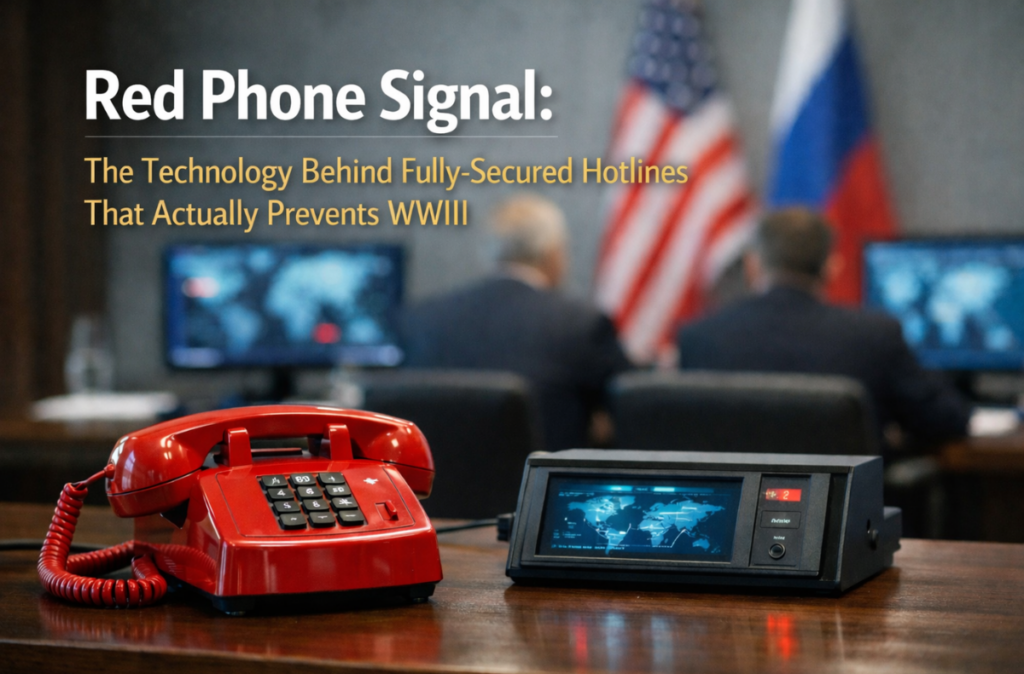
No. The actual red phone signal has never been a voice call. Originally, it utilized teletype machines. Today, the red phone signal travels over secure computer networks using encrypted chat and email to prevent translation errors.
By providing a direct, instant link. If a radar malfunctions and shows an incoming attack, a leader can send a red signal to the opposing side to confirm it is a false alarm, directly avoiding the Nuclear Escalation Ladder.
It is highly unlikely. A legitimate red phone signal uses hardware security modules and Point-to-Point Circuitry, meaning it is physically isolated from the public internet. This protects it from standard hacking techniques.
E2EE ensures that the red phone signal is scrambled before it leaves the sender and only unscrambled when it reaches the intended receiver. This makes the red phone completely unreadable to anyone trying to intercept it in transit.
Aside from the U.S. and Russia, several nations use a red phone signal for de-escalation. Examples include the U.S. and China, India and Pakistan, and North and South Korea, all utilizing dedicated direct communication lines between nations.