
Two technology companies can post the same revenue, serve the same market, and sell for prices that differ by a factor of five. Founders discover this late, usually in the second week of diligence, and almost always after they have already told themselves a number. SaaS is leading the charge with earnings and margins.
The gap is not mysterious. It comes down to which multiple a buyer is applying, and where inside that multiple’s range the business lands. Both are knowable before anyone opens a data room.
Key Takeaways
- Two tech companies can post the same revenue yet differ in valuation due to the multiple a buyer applies.
- Three key ratios inform buyers: Seller’s discretionary earnings, EBITDA, and revenue multiples, each for different business types.
- SaaS companies typically command higher multiples due to their revenue shape and retention rates compared to service firms.
- Factors like revenue concentration, gross margin, and churn significantly influence a company’s position within its valuation range.
- Valuations depend on who is buying; strategic buyers focus on customer lists, while financial buyers emphasize cash flow.
Table of contents
Three numbers, and when each one applies
Buyers of private technology companies work from three ratios, and they are not interchangeable.
Seller’s discretionary earnings is used for owner-operated businesses, where the founder is still doing real work and the profit figure has personal expenses mixed into it. The buyer adds the owner’s salary and perks back, then applies a multiple to what is left.
EBITDA takes over once the business has a management layer that would survive the founder leaving. This is the number that matters in most deals above a few million dollars in revenue, and it is where the widest spread appears.
Revenue multiples are used when growth is fast enough that current profit understates the business, which in practice means high-retention subscription companies and very little else. A revenue multiple applied to a low-growth services firm is a red flag, not a compliment.
The actual ranges
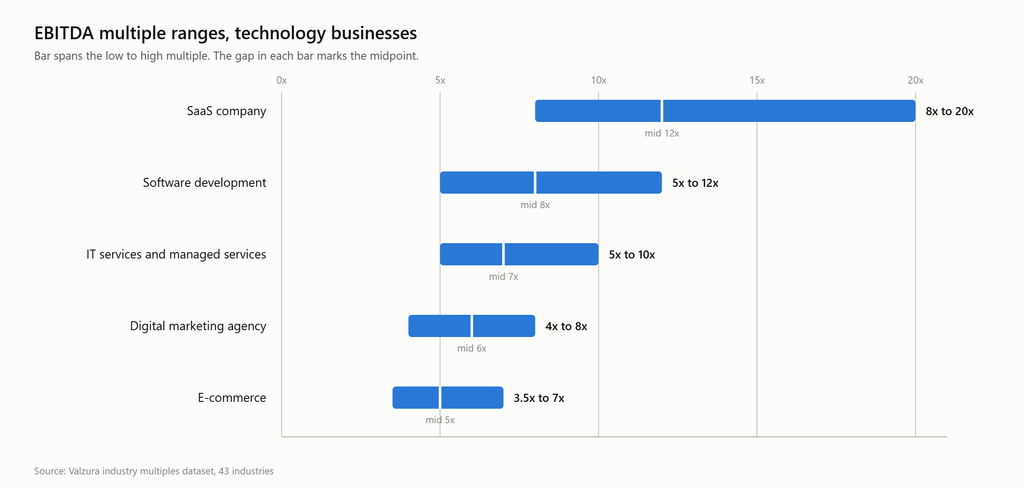
Across five categories of technology business, the spread looks like this.
| Business type | SDE multiple | EBITDA multiple | Revenue multiple | Typical margin |
| SaaS company | 3.0x to 8.0x | 8.0x to 20.0x | 3.0x to 12.0x | 20% |
| Software development | 2.5x to 6.0x | 5.0x to 12.0x | 1.0x to 4.0x | 18% |
| IT services and managed services | 2.0x to 5.0x | 5.0x to 10.0x | 0.8x to 2.5x | 15% |
| Digital marketing agency | 2.0x to 4.0x | 4.0x to 8.0x | 0.5x to 1.8x | 18% |
| E-commerce | 2.0x to 4.5x | 3.5x to 7.0x | 0.5x to 2.0x | 12% |
The midpoints tell the story more sharply than the ranges do. A SaaS company sits around 12x EBITDA. An IT services firm sits around 7x. An e-commerce business sits around 5x. On revenue the distance is starker still: roughly 6x for SaaS against 1.5x for managed services and 1.0x for e-commerce.
These figures come from the industry multiples dataset maintained by Valzura, which tracks 43 industries.
Why the SaaS business is worth more than the software company
The premium is not paid for code. It is paid for the shape of the revenue.
A SaaS company with genuine net revenue retention is selling a stream that continues whether or not anyone makes a sale next quarter. A development shop selling the same amount of work is selling a promise to find more clients. The first is an asset. The second is a job with good margins.
That distinction explains why the SaaS range runs all the way to 20x EBITDA while managed services stops near 10x. It also explains why the bottom of the SaaS range, 8x, overlaps with the top of the services range. A SaaS company with heavy churn and a sales team that has to replace a third of its book every year is, in cash flow terms, a services business with a subscription invoice.
What moves a company inside its own range
Two companies in the same row of that table routinely land at opposite ends of it. The factors that decide this are consistent across deals.
Revenue concentration. A single client at 30% of revenue removes the top third of any range, in every category. Buyers price the day that client leaves, not the day they signed.
Gross margin. Within software, a company running 85% gross margin and one running 55% are valued as different species regardless of what the marketing site says. The second is carrying delivery cost that will not disappear at scale.
Churn and expansion. Retention is the single largest swing factor in the SaaS range. Net retention above 100% moves a company toward the high end and often changes which multiple applies at all. Retention below 80% pulls it toward the services range.
Owner dependence. If the founder is the top salesperson, the lead architect, or the only person the largest accounts will speak to, the business gets priced as seller’s discretionary earnings rather than EBITDA. That shift alone can halve the effective multiple.
Contract quality. Month-to-month terms, no assignment clauses, and handshake renewals all take real money off the table during diligence, and they are among the cheapest things to fix in advance.
What the ranges cannot tell you
A multiple is a summary of what comparable businesses traded for. It is not a prediction, and it is not an appraisal. The same company can sit at different points in the range depending on who is buying: a strategic acquirer consolidating a market pays for the customer list, while a financial buyer pays for the cash flow and discounts anything that depends on the founder staying.
The practical use of a benchmark is narrower and more useful than a valuation. It tells an owner whether the number in their head is inside the range of plausible outcomes, and it identifies which two or three variables are worth working on in the year before a sale. Both of those are answerable from public information, long before an adviser is engaged.
A founder who knows their company sits at the bottom of the IT services range because of client concentration has something specific to fix. A founder who believes their services company is worth a SaaS multiple has a conversation coming that would have been easier eighteen months earlier.