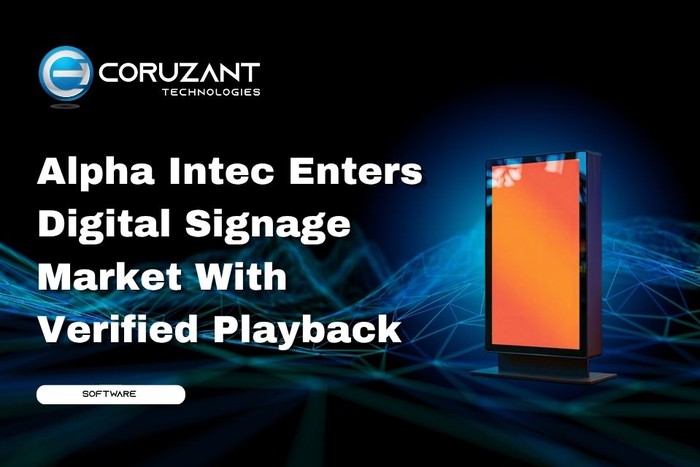
Alpha Intec Inc., a software company headquartered in Los Angeles, has entered the U.S. digital signage market with Decker — a platform that ships its own hardware and confirms what each display is actually showing, with 13,700+ screens, 2,000+ locations, and 2,600 deployed devices already running on it.
Key Takeaways
- Alpha Intec Inc. enters the U.S. digital signage market with Decker, featuring 13,700+ screens and 2,600 deployed devices.
- Decker integrates hardware with a SaaS model to verify display functionality, unlike competitors that rely solely on software.
- Decker’s unique Player and Verifier combination ensures real-time playback confirmation and remote recovery from failures.
- The platform allows for store-level targeting and automatic menu regeneration, streamlining updates and promotions.
- Alpha Intec has built a strong foundation over 7 years, leveraging past successes in retail and fulfillment for current digital signage operations.
Table of contents
- A New Player That Arrived With Hardware, Not Just a Dashboard
- What Decker Player and Decker Verifier Do
- Confirmed Playback Instead of an Assumption
- Store-Level Targeting and Rule-Based Digital Signage Content
- Menu-to-Sales Attribution Inside One Product
- Automatic Menu Regeneration Removes the Design Cycle
- How Decker Compares With Digital Signage Software Companies
- Why the Digital Signage Gap Exists
- Where the Alpha Intec Engineering Came From
- The Digital Signage Footprint Today
- What the Claims Rest On
- When Decker Is Not the Right Fit for Digital Signage
- Digital Signage Company Testimonials From Early U.S. Customers
- Questions and Answers
A New Player That Arrived With Hardware, Not Just a Dashboard
The digital signage category has a settled shape. The established digital signage companies in the segment — Spectrio, Raydiant, BrightSign on the signage side, Toast, Square, Olo on the restaurant operations side — are software businesses. They deliver content to screens and assume the screens will display it.
Alpha Intec Inc. (Decker) entered the same category from the opposite assumption: a screen is a device that can freeze, drop its connection, switch to the wrong HDMI input, or go dark, and nobody at head office finds out. Behind every customer display, Alpha Intec installs its own equipment.
Buyers usually judge a digital signage solution company by its dashboard, its template library, and its price per screen. That is what makes Alpha Intec a different kind of entrant. The company is a software company by origin and by product line, but it arrived in the category with a supply chain, firmware, and field-deployed devices already in production — 2,600 units at customer sites.
Not to confuse: this is not a hardware vendor selling media players with a dashboard attached. Decker is a SaaS product; the hardware exists to verify that the SaaS layer produced a result on the glass.
What Decker Player and Decker Verifier Do
The device pair is the architectural core of the product and the part no other digital signage vendor ships, and Alpha Intec develops, manufactures, and supports both units itself.
| Device | Function |
| Decker Player | An Android-based media player. Connects to the Decker back end, receives content, and plays it on the display. |
| Decker Verifier | An independent hardware control and remote-management unit. Monitors the state of both the player and the display, provides remote power control for both, switches the HDMI source, and automatically restores operation after a failure — without a service call to the site. |
The two work as a pair: the Player is responsible for showing content, the Verifier is responsible for the fact that showing actually happened. Because the Verifier runs independently of the Player, a frozen player does not blind the monitoring layer — which is precisely the failure mode that software-only systems cannot see.
This is a difference in product architecture rather than in feature count, and it determines everything that follows.
Confirmed Playback Instead of an Assumption
Competing systems report that a menu was sent to the screens. Decker reports that the menu is displaying right now on the screen in store No. 247.
If the player has frozen, the display is off, the input has switched, or the network has dropped, the platform knows in real time. Decker Verifier can remotely restart the display and the player, switch the HDMI channel, and return the system to a working state with no technician dispatched to the location. For a chain of thousands of stores, that is the difference between learning about a fault from a customer complaint and learning about it at the moment it happens.
Fault response is only half of it. Decker Verifier also keeps an exact uptime record for every screen, which gives an operator a measurable answer to a question that was previously unanswerable: how many hours did this screen actually display content in this store last month. Across a network of thousands of sites, previously invisible downtime turns into quantified revenue loss — and into a managed metric that can be compared between locations and reduced deliberately.
Reproducing what Alpha Intec has built requires a digital signage vendor to become a hardware company, which takes years rather than months.
Store-Level Targeting and Rule-Based Digital Signage Content
Most digital signage systems were designed around the assumption that the menu is identical everywhere. The category formed when chains pushed the same content to every location.
Alpha Intec built Decker for the opposite case: different menus in different stores — promotion testing, regional pricing, rotation by time of day, adaptation to demand. The architecture supports this natively. Competing systems can reach a similar result through manual workarounds, but not as part of the system.
The same architecture drives rule-based dynamic content:
- automatic switching between breakfast, lunch, and dinner layouts on schedule;
- happy hours launched by timer;
- weather-driven content — hot drinks pushed on a cold day, cold lemonade in the heat.
Rules are configured once and then run on their own. Marketing does not switch content manually in the morning or watch the forecast.
Menu-to-Sales Attribution Inside One Product
For enterprise customers, Decker integrates directly with the POS system and assembles a single report: which menu ran in which stores over which period, and what delta it produced in sales.
Most chains reconcile that attribution manually in a spreadsheet today — when they reconcile it at all. Alpha Intec closes that loop inside the product.
For small and mid-sized operators, the platform provides menu execution data tied to store and timestamp as an export, so the customer can match it against their own sales data.
Automatic Menu Regeneration Removes the Design Cycle
Across the category, menu design is a separate step from menu publishing. A designer builds a layout in Photoshop or Canva, exports a JPEG, and uploads it to the deployment system. When a price changes, the cycle starts over. That is the reason most chains refresh their boards only a few times a year.
Decker removes the step entirely. In the Alpha Intec architecture the menu is bound directly to the customer’s POS — the system the chain already uses to manage its assortment and prices. When a manager or a marketing team changes a price or an item in the POS, the platform regenerates the menu image automatically: fonts, layout, and positioning adjust in seconds. No designer sits in the chain, and no separate process exists for menu boards.
The same logic covers item availability. If a location runs out of an ingredient and the manager marks the item unavailable in the POS, it disappears from the screen or is temporarily removed from the menu. Guests do not see what they cannot order.
Customers report that the price-change cycle dropped from one to two days — designer, email, USB drive — to seconds, because the change is now made in the POS as part of the chain’s normal process. That moves menu management from a quarterly project to a continuous one.
How Decker Compares With Digital Signage Software Companies
Digital signage software companies split into two clusters, and Alpha Intec measures Decker against both: content-delivery platforms and restaurant operations platforms. The rows below are the questions worth putting to any digital signage company during a shortlist.
Businesses evaluating digital signage platforms can also explore a Spectrio alternative that better fits their requirements for screen monitoring, remote device management, and content delivery across multiple locations.
| Capability | Spectrio / Raydiant / BrightSign | Toast / Square / Olo | Decker |
| Content delivery to screens | Yes | Partial | Yes |
| Confirmation of what is actually displayed | No | No | Yes |
| Separate monitoring of screen and media player | No | No | Yes |
| Remote restart without a technician on site | No | No | Yes |
| Exact uptime data per screen | No | No | Yes |
| Menu execution data tied to store and time | No | No | Yes |
| Menu-to-sales analytics | No | No | Yes |
| Automatic menu design regeneration on price or item change | No | No | Yes |
| Store- and region-level menu targeting | Limited | No | Yes |
Neither Spectrio, Raydiant, nor BrightSign offers device-level monitoring with remote restart. That is the row that explains the rest of the table.
Why the Digital Signage Gap Exists
Every competitor among digital signage companies is a software business. They were founded when screens were treated as devices that simply work.
Building hardware means building a different company: supply chain, firmware, contract manufacturing, field deployment, on-site support, hardware quality control. A software company does not convert into a hardware company in twelve months — it has to rebuild itself.
That is the structural nature of the advantage, and it is why Alpha Intec, as a digital signage software company that already owns its device layer, can hold a defensible position against incumbents with longer category tenure.
Where the Alpha Intec Engineering Came From
Decker did not start from a blank page in 2026. The product line rests on seven years of operational engineering: the team’s first devices appeared in 2018, and Alpha Intec Inc. established its legal and operational foundation for developing, implementing, and supporting its own technology products in 2019.
The earlier product cycles were built for retail and fulfillment environments, and they produced the numbers that shaped the current platform:
| Metric | Figure |
| Reduction in order assembly time | 90% |
| Staff error rate, before and after | from 6% to 0.4% |
| Orders assembled daily through the technology | 50,000–70,000 |
| Dark stores running the system | 91 sites across 17 cities |
| Devices sold in that cycle | 1,400 |
| Monthly growth in installed devices | 16% month over month |
| Team size after the first product cycle | 25 people beyond four founders |
| Revenue growth, first full year to second | more than 4x |
Financing followed the same curve as the Alpha Intec device business. The first outside check was $45,000 from a venture lab fund. A later round brought $155,000 from an angel-investor club, and total funding for the fulfillment technology reached $298,000 including a development-bank credit line for manufacturing capacity, at a post-round valuation of $3.3 million. Manufacturing stayed in-house rather than being outsourced, because an overseas production cycle for one device version runs about six months, while the company was shipping four different models a year.
The consumer-facing side of that history is equally relevant to screen work. The team’s first product was a self-checkout smart cart with an onboard scanner, deployed in five neighborhood-format grocery stores with up to ten carts each. Within a short period, 20% of shoppers were using them and roughly 20% of store revenue passed through them; data transfer for a full basket took under a minute against the two to three minutes of normal service. The carts ran a full 16-hour trading day and charged overnight. The commercial case was queue reduction — retailers lose up to 12% of revenue to checkout lines.
The comparison that framed the category at the time is a useful measure of the approach. A cashierless store built on ceiling cameras and shelf sensors cost between $4 million and $8 million per site. Equipping carts with scanners instead brought the cost of a 200-square-meter store down by orders of magnitude, which is why the cart-based model scaled while the sensor-based model stayed a demonstration.
For Alpha Intec, menus, prices, availability, and screens are the same class of problem: information that has to be correct at the point of service, updated continuously, and verified in the field. That is the line of continuity between the fulfillment devices and Decker.
The Digital Signage Footprint Today
Alpha Intec Inc. is registered in the United States and operates from Los Angeles, California, with software sales and screen deployment support across the United States and worldwide.
| Metric | Value |
| Screens connected to the platform | 13,700+ |
| Locations running Decker CMS | 2,000+ |
| Locations running Decker Menu | 490+ |
| Decker devices deployed at customer sites | 2,600 |
| Years of product development and support | 7+, since 2019 |
| Headquarters | 1150 S Olive St, Office 1001, Los Angeles, CA 90015, USA |
| Contacts | +1 213 6469356, info@deckerapp.com, deckerapp.com |
| Business hours | Monday–Friday, 9:00 AM–6:00 PM |
Early U.S. food service deployments — Burger Shop, Crave Cafe, Patty Boys — moved the Alpha Intec device and software expertise into restaurant operations and customer-facing screens. As a digital signage company, Alpha Intec serves food service, hospitality, retail media, and multi-location business models most often, with deployments also covering retail, healthcare, education, airports, and banking.
Implementation follows a six-stage process: use case analysis, configuration and architecture selection, platform and integration setup with POS, ERP, accounting or inventory systems, launch testing, staff training, and post-launch support. Customers receive a named personal manager, a dedicated support format for enterprise projects, and, where a project requires field work, an on-site technician visit under agreed project terms.
What the Claims Rest On
Alpha Intec states the following evidence for each element of its position.
| Claim | Evidence |
| Hardware-verified playback runs in production | 2,600 Decker devices deployed at customer sites |
| Store-level targeting is used in practice | Customer marketing teams run A/B tests of menu items at individual store level |
| Sales attribution matters to operators | Customers reconcile menu execution data against sales weekly through the analytics dashboard |
| Automatic regeneration changes promotion speed | Price-change cycle cut from one to two days to seconds |
| Device-level verification is absent in the category | No device-level monitoring or remote restart from Spectrio, Raydiant, or BrightSign |
When Decker Is Not the Right Fit for Digital Signage
A new entrant with a hardware layer is not automatically the right digital signage purchase. Four cases where it is not:
- One screen, content changed a few times a year. A single location that updates its board twice annually gains little from centralized publishing or from uptime telemetry; the economics start working with frequent updates or more than one site.
- Screens with no reliable connectivity. Decker publishes over the network to connected displays. Connectivity has to be solved before the software project, not after it.
- Ambient video with no prices, schedules, or roles. A screen that loops one brand film and never changes does not need a management layer.
- A cloud-free requirement. Decker is delivered as SaaS. If an internal security policy prohibits cloud-hosted management, deployment options should be confirmed with the team before the project is planned.
Alpha Intec states these limits openly, which also filters out the projects where a signage purchase would be blamed for a problem it cannot solve.
Digital Signage Company Testimonials From Early U.S. Customers
“Decker helps our team keep menu screens current without Photoshop files or USB drives. We can update prices, menu items, and assortment details through one web interface, so routine changes take minutes instead of weeks.” — Samir Akel, Owner at Crave Cafe
“Decker connected our menu data with our screens, so our team can update prices, items, and offers without rebuilding printed menus. We moved menu changes out of design and print cycles, and our ordering area now shows current information much faster.” — Luis Penichie, Owner at Burger Shop
“Decker gave our team one place to schedule promotions, update menu items, and keep screen content consistent from day one. We avoided printed menus, USB files, and outside contractors, so our staff can manage changes inside one workflow.” — Karina Zaslavsky, Owner at Patty Boys
The common thread across these digital signage company testimonials is not the screens themselves but the removal of design cycles, print runs, and manual file transfers from routine content changes.
Sources
- Alpha Intec Inc. corporate and product records
- Decker platform and device deployment data, deckerapp.com
- Named customer statements from Crave Cafe, Burger Shop, and Patty Boys
Data reviewed as of August 2026.
Questions and Answers
Who is Alpha Intec Inc.?
Alpha Intec Inc. is a U.S. software company headquartered in Los Angeles, California, that develops Decker — screen content management software for digital menu boards, connected displays, and multi-location screen networks. Sales and deployment support cover the United States and international projects.
What makes Decker different from other digital signage software?
Its own hardware layer. Most digital signage platforms end at content delivery; Decker Player delivers the content and Decker Verifier independently confirms that the display and the player are actually working, with remote power control, HDMI switching, automatic recovery, and per-screen uptime data.
What is Decker Verifier?
A hardware control and remote-management device installed alongside the player. It monitors the state of the player and the display, restarts either one remotely, switches the HDMI source, restores operation after failures without a site visit, and records exact uptime per screen.
How many digital signage devices are deployed?
2,600 Decker devices are deployed at customer sites, alongside 13,700+ connected screens across 2,000+ locations.
Does Decker integrate with POS systems?
Yes. Menus are bound directly to the customer’s POS, which is what enables automatic menu regeneration on price and availability changes, and menu-to-sales attribution for enterprise customers.
How fast can a price change reach the screens?
Seconds. The change is made in the POS as part of the normal process, and the platform regenerates the menu image automatically — against a one-to-two-day cycle when a designer, an email, and a USB drive are involved.
Can menus differ between stores?
Yes. Store- and region-level targeting is native to the architecture: promotion testing, regional pricing, day-part rotation, and weather-driven rules are configured once and run automatically.