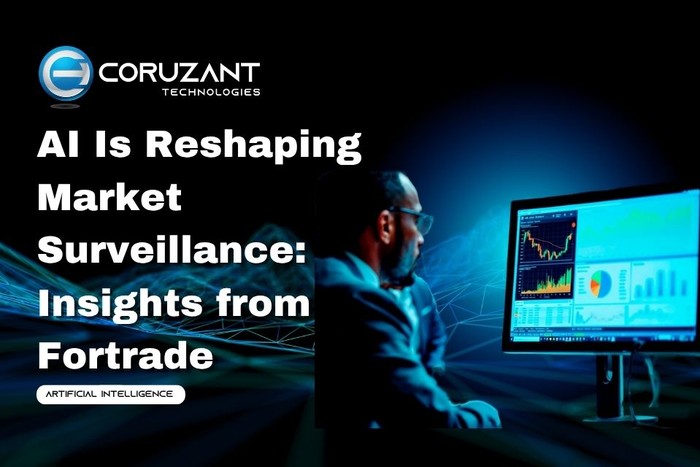
The scale of what financial regulators now monitor has become difficult to picture in ordinary terms. The FCA’s own market oversight function receives over 8 billion MiFID transaction reports a year, 400 million order book messages, and 53 million derivative reports daily.
Fortrade, a CFD trading provider, recognises that the sheer volume behind modern markets is increasing the importance of advanced technology in supporting effective market surveillance and oversight.
CFDs are complex instruments and come with a high risk of losing money rapidly due to leverage. 74% of retail investor accounts lose money when trading CFDs with this provider. Traders should consider whether they understand how CFDs work and whether they can afford to take the high risk of losing their money.
Key Takeaways
- Regulators face challenges with massive data volume in trading, processing billions of reports and messages daily.
- Proactive monitoring, powered by AI, is becoming essential for real-time detection of irregularities in trading activity.
- Human oversight remains crucial as AI does not replace judgment but enhances it; firms must understand market context.
- A well-monitored trading platform can better identify potential issues, ensuring execution integrity and market reliability.
- The integration of AI in market surveillance is ongoing, requiring continuous improvement and adaptation to new regulatory expectations.
Table of contents
The data problem behind every trading platform
Trade surveillance used to be a comparatively narrow exercise. A rules-based system flagged obvious patterns, an analyst reviewed the output, and the process moved at the pace of human attention. That model faces increasing challenges against the volume of activity modern markets now generate.
The scale involved is easier to grasp through what surveillance infrastructure actually processes in practice. LSEG’s own trade surveillance technology processes billions of trade and order messages across its venues every single day, correlating that volume against public market data, reference data, and news to generate alerts designed to hold up under scrutiny rather than simply adding to the noise.
Multiply that kind of throughput across every other exchange, venue, and asset class a modern trading ecosystem spans, and the scale of the underlying data problem becomes clearer.
Why proactive detection is becoming more important
The practical response to that volume has included a shift towards proactive monitoring. Rather than reviewing suspicious activity after the fact, AI-driven systems are increasingly built to flag irregularities as they happen, correlating order flow, timing, and behavioral patterns across asset classes rather than treating each market in isolation.
This is not a hypothetical trend. Market infrastructure providers are already developing and offering this capability directly. LSEG’s own surveillance offering, launched at the start of 2026, is explicitly designed around cross-venue behavioral anomaly detection and reducing false positives, rather than simply generating more alerts for analysts to sort through by hand.
This shift matters for platform integrity across the industry, not just for formal compliance. In principle, a trading environment that can identify unusual order flow or execution anomalies quickly is better positioned to identify potential issues at an earlier stage than one relying on manual review to catch problems only after the fact.
The alternative, a system that only catches problems well after they have already affected pricing or execution, is far less useful to anyone trading in real time.
That said, faster detection is not automatically better detection. Surveillance tools that flag too aggressively create a different problem: a flood of false positives that can bury genuine issues under noise, which is precisely why the technology needs to be calibrated carefully rather than simply deployed and left running.
Why human oversight has not become optional
The regulatory position on this is worth taking seriously, because it complicates the simpler narrative of AI simply replacing human judgement.
The FCA’s own director of market oversight has been explicit that AI does not introduce new categories of risk so much as amplify existing ones, particularly around explainability, data quality, and model validation, and that responsibility for how these systems behave rests with the firms deploying them, not with the models themselves.
That framing matters for how Fortrade views the broader role technology plays across the industry. AI-driven monitoring, where it is deployed, can process volumes and correlate patterns that no team of analysts could manage manually, but it does not remove the need for people who understand market context, intent, and the difference between unusual and illegitimate activity.
The firms getting this right tend to treat AI as a tool that expands what human judgement can act on, not a replacement for that judgement.
What this means for the platforms traders actually use
For an individual trader, most of this activity is invisible by design. Surveillance systems, where they are used, are not something a retail CFD trader interacts with directly, but their effectiveness can shape the trading environment in ways that are easy to overlook.
A platform where execution monitoring and anomaly detection are effective is, in principle, better positioned to identify unusual activity and potential execution or market-integrity issues at an earlier stage. That is a standard against which trading platforms can be assessed, rather than a description of any single provider’s current technology, Fortrade included.
Fortrade’s own trading platforms are built around the more foundational principle of dependable, day-to-day execution across web, desktop, and mobile, which Fortrade considers the baseline any provider needs in place before more advanced monitoring capability becomes relevant at all.
As the volume and complexity of multi-asset trading continues to grow, the technology underpinning platform integrity across the sector can no longer be treated simply as a background function.
It is, arguably, one of the more consequential parts of what will separate a dependable trading environment from one that only looks dependable until conditions get difficult.
A shift still very much in progress
None of this suggests the problem is solved. Surveillance and monitoring systems continue to generate false positives, data quality remains inconsistent across firms, and the regulatory expectations around explainability are still evolving alongside the technology itself.
What has changed is the direction of travel: proactive, AI-assisted monitoring is becoming an increasingly important part of modern surveillance, alongside traditional review and human oversight.
The broader direction suggests that platforms will increasingly need to treat this as ongoing infrastructure work rather than a feature to announce once and move on from.
As with any leveraged trading product, no amount of technology behind the platform removes the underlying risk of the position itself.
*PLEASE NOTE: CFDs are not available to US retail investors. Anyone in the United States cannot legally open an account with Fortrade.*