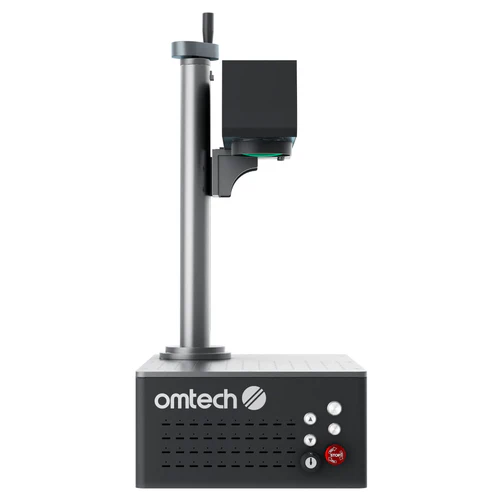
Fiber laser marking is now the standard for permanent metal identification in manufacturing. From automotive parts to surgical instruments, the marks are fast, permanent, and require no consumables. This article explains why manufacturers across industries have adopted fiber laser marking and what it delivers that other methods cannot.
OMTech supplies fiber laser marking systems used by small manufacturers, contract shops, and production facilities across the United States.
Table of Contents
Why Fiber Laser Marks Metal Where Others Cannot
CO2 lasers at 10,600 nanometers reflect off most metals. Fiber lasers at 1,064 nanometers are absorbed efficiently by steel, aluminum, brass, copper, and titanium. This wavelength difference is fundamental, not a settings issue.
Key advantages fiber laser marking delivers over competing methods:
- Marks survive heat treatment, chemical exposure, abrasion, and decades of operational service
- No physical contact means no stress risers in fatigue-sensitive components
- No consumables, including inks, chemicals, or marking compounds
- Galvo scanning speeds allow 2D data matrix codes in two to five seconds per part
- Consistent output across 100,000+ hour source lifetime first part and the millionth part look identical
- Meets automotive, medical, and aerospace traceability standards
How Fiber Laser Marking Works
A ytterbium-doped fiber laser produces a highly coherent 1,064 nm beam that is directed by a galvo scanning head across the metal surface according to a digital design file. The marking process is controlled by adjusting laser parameters such as power, speed, and frequency to achieve different surface effects. Annealing heats the material below its melting point to create a permanent color change without removing material, making it ideal for dark, high-contrast marks on stainless steel while maintaining the original surface finish. Engraving uses higher laser energy to remove material and create permanent recessed marks with physical depth, commonly used for deep serial numbers, part identification, and traceability applications. Ablation selectively removes coatings, paint, or oxide layers to reveal the underlying material, providing high-contrast identification on coated metal surfaces without affecting the base material.
Metals Fiber Lasers Mark Effectively
Fiber laser marking provides permanent, high-precision identification across a wide range of metals, delivering excellent contrast, durability, and traceability for industrial, medical, aerospace, and decorative applications. Different materials respond uniquely to laser energy, allowing manufacturers to achieve the required marking depth, appearance, and surface protection.
- Steel and mild steel: High-contrast marks and deep engraving suitable for general industrial applications, tooling, and part identification.
- Stainless steel: Dark annealed marks without material removal, as well as bright ablated marks on brushed and finished surfaces.
- Aluminum: Clean, precise markings on raw and anodized aluminum with strong contrast and excellent readability.
- Brass and copper: Detailed engraving and marking for electrical components, connectors, and decorative products.
- Titanium: Color marking at different power settings, widely used for medical devices and aerospace components.
- Precious metals: Fine marking on gold, silver, and platinum for jewelry hallmarking, branding, and personalization.
Industry Applications Driving Adoption
Automotive Manufacturing
Automotive traceability requires permanent, high-precision identification throughout the vehicle lifecycle. Marking solutions support VIN plates, chassis identification, and regulatory compliance with NHTSA requirements, ensuring accurate vehicle tracking, safety documentation, and recall management. Critical components such as engine blocks, crankshafts, transmissions, brake systems, steering assemblies, and safety components can be serialized for complete part history and quality control.
For high-volume automotive production, marking systems integrate directly with Manufacturing Execution Systems (MES), ERP platforms, and automated production lines to generate unique serial numbers, capture real-time production data, and maintain full traceability from raw material to finished vehicle. Durable marks are designed to withstand harsh environments, corrosion, heat, fluids, and long-term vehicle operation.
Medical Device Manufacturing
Medical device manufacturers rely on permanent identification to meet strict global regulatory requirements, including FDA UDI (Unique Device Identification) and EU MDR compliance. Laser marking and direct part marking technologies enable precise serialization of surgical instruments, implants, and medical components while maintaining product safety and regulatory traceability.
Identification marks are engineered to survive demanding sterilization cycles, chemical exposure, and repeated cleaning processes. For implants and precision medical devices, markings provide long-term readability without compromising material integrity. High-quality marking processes create clean, burr-free results with minimal thermal impact, preventing stress concentrations and maintaining the performance of critical components.
Electronics and Industrial Manufacturing
Electronics and industrial manufacturers require reliable identification for product tracking, quality assurance, and lifecycle management. In addition, marking solutions support PCB identification, electronic component labeling, enclosure serialization, and industrial equipment tracking, enabling efficient inventory control and failure analysis.
Furthermore, industrial tools, hardware, and mechanical components can be permanently marked with brand logos, model numbers, sizes, material grades, batch codes, and compliance information. Similarly, aerospace and high-performance industries use advanced traceability markings for part authentication, fatigue life monitoring, maintenance records, and component history tracking.
Moreover, for aftermarket and premium products, customized marking solutions provide durable branding, product authentication, and enhanced customer value through high-quality logos, serial numbers, and unique identifiers that withstand demanding operating conditions. As a result, manufacturers can improve traceability, protect product identity, and maintain quality throughout the entire product lifecycle.
MOPA Fiber Lasers: Color Marking Capability
MOPA (Master Oscillator Power Amplifier) fiber lasers add independent pulse duration control to standard fiber laser capability. This enables color marking on specific metals. Fiber laser marking machines in the MOPA range produce:
- Gold, blue, red, green, and black on anodized aluminum through controlled layer ablation
- Interference colors on stainless steel through oxidation at precise temperature control
- Black annealed marks on titanium at specific pulse parameters
MOPA capability is specified for premium consumer products, medical devices, and anti-counterfeit applications where standard fiber output is insufficient.
Choosing the Right Fiber Laser for Production
Key specifications that determine the suitability of a fiber laser marking system for manufacturing applications include:
- Power: 20W systems are suitable for most general marking applications. 30W–50W lasers provide faster processing, larger marking capacity, and deeper engraving capability. 100W+ systems are designed for heavy-duty engraving and high-volume production environments.
- Marking Field: A standard 110 mm × 110 mm marking area supports most industrial components. Larger field sizes are available for oversized parts, reducing the need for repositioning and improving production efficiency.
- Scan Speed: High-speed galvo scanning systems (3,000–10,000 mm/s) enable rapid marking of serial numbers, barcodes, logos, and complex designs. Higher scan speeds help reduce cycle times and increase overall production throughput.
- Software: EzCad2 is widely used as an industry-standard marking platform, supporting text, logos, barcodes, QR codes, and automated serial number generation. LightBurn-compatible systems offer flexible design tools and easier workflow management.
- Cooling System: Air-cooled fiber lasers are suitable for most industrial marking applications with low maintenance requirements. Water-cooled systems are preferred for continuous operation, high-power lasers, and demanding production environments requiring extended duty cycles.
Additional factors such as beam quality, marking accuracy, rotary axis compatibility, and automation integration. MES/ERP connectivity also influences system performance and suitability for advanced manufacturing applications.