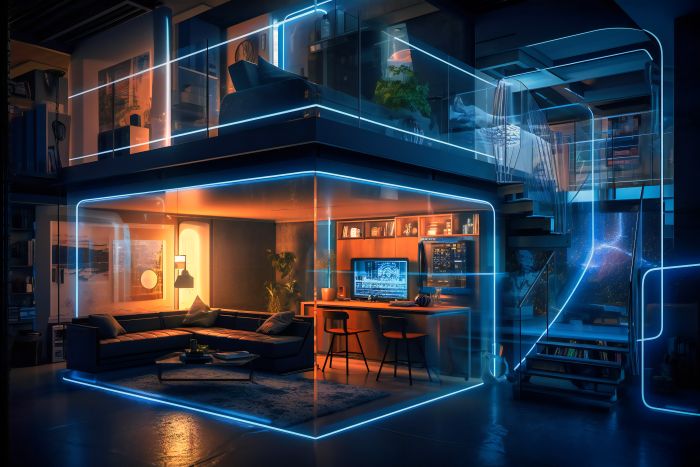
Ask anyone who has tried to renovate a home, list a property, or pitch a space, and they will tell you the same thing: the problem was never the idea. People know what they want. They want the bedroom to face the morning light, the kitchen to open onto the living room, the awkward hallway to disappear. The problem was getting that picture out of their head and onto something other people could see and argue about. They didn’t know how to make the drawing come to light.
For a long time, that step had a gatekeeper. You needed someone who could draw — and not just sketch, but produce a measured, readable plan. That requirement quietly shaped the entire industry. It decided who got to participate in spatial decisions and who just nodded along to a drawing they could not quite read. What is happening now is that the gate is being unlatched, not by replacing the people who draw, but by removing the assumption that drawing has to come first.
Key Takeaways
- The new generation of design tools allows users to describe spaces and receive layouts without needing drawing skills.
- This shift reduces the cost of iteration, enabling exploration and creativity in space planning.
- 3D modeling features enhance the user experience by giving a realistic feel of the space.
- Users should look for tools that offer various visual styles and export options, as well as maintain user privacy.
- Empowering individuals to create visuals fosters better communication and collaboration in the design process.
Table of contents
The Shift of Drawing in Plain Terms
The newest generation of design tools does not ask you to draw anything. You describe a space the way you would describe it to a friend — “a one-bedroom with a galley kitchen, a work nook by the window, maybe forty square meters” — and the software returns a top-down layout with walls, doors, windows, and labeled rooms. Change a word, get a new version. Do not like it, throw it away. The cost of being wrong drops to almost nothing.
This sounds like a small convenience until you watch how it changes behavior. When drawing iteration is expensive, people commit to their first idea too early and defend it too long. When iteration is nearly free, they explore. They generate the layout they think they want, then five they did not expect, and somewhere in those five is usually the one they did not know to ask for. The tool is not being creative on their behalf. It is lowering the price of curiosity.
Where It Earns Its Keep
It helps to be precise about what this technology is actually good at, because the hype tends to oversell it. These tools are not architects, surveyors, or structural engineers, and the honest products in the space say so out loud. What they are genuinely good at is the front of the process — the part before anyone has committed money, where the goal is to get a shared picture on the table fast.
A homeowner can walk into a contractor meeting with three real layouts instead of a vague feeling. A small developer can test how a unit reads before paying for proper drawings. A designer can skip the tedious blocking-out stage and jump straight to refinement. In each case the win is the same: less time spent translating, more time spent deciding. Platforms such as floor plan AI are built around exactly this moment — you type a sentence, choose a drawing style from technical blueprint to a softer illustrated look, and download a finished plan you can hand to someone else in minutes rather than days.
The Part That Surprises People
The feature that tends to win skeptics over is not the 2D plan. It is the jump to 3D. A flat drawing tells you where the walls go. It does not tell you what it feels like to stand in the room, and that feeling is what people actually decide on. Being able to take the same description and turn it into a rotatable 3D model closes that gap.
Two practical details decide whether the 3D side is real or a gimmick. The first is the export format. A render you can only spin around inside one website is a dead end; a model you can download in a standard format and open in tools like Blender, Unity, or Unreal is a starting point you can keep building from. The second is control over detail — a light draft mesh for quick previews, a dense high-resolution model for a final render — so the file matches the job instead of forcing one size onto everything.
How to Tell the Useful Drawing Tools From the Noise
The category is filling up fast, and the quality range is wide. A few questions cut through most of it:
- Can it produce more than one visual style, so the same plan works for both a permit conversation and a marketing listing?
- Does it export to formats you can use elsewhere — high-resolution images for listings, downloadable models for a 3D pipeline?
- Can you feed it a reference photo or sketch to steer the result, rather than starting from zero every time?
- Is it honest that outputs are concepts, not surveyed construction documents?
- Do your prompts and plans stay private instead of becoming someone else’s training data?
That fourth point is the tell. A trustworthy tool is upfront about its limits. Anything promising engineering-grade precision from a one-line prompt is selling a fantasy, and you will find out the hard way on site.
Why This Matters Beyond Convenience
It is tempting to file this under “nice time-saver” and move on. But the deeper effect is about who gets to be in the room. For most of modern design history, the inability to draw meant the inability to fully participate. The client described, the professional drew, and a lot got lost in that handoff — not because anyone was careless, but because language and pictures do not map cleanly onto each other.
When anyone can produce a credible visual of their own idea, the conversation changes shape. The homeowner is not reacting to the architect’s interpretation; they are bringing their own version to react against. The agent is not waiting on a draftsperson; they are shipping listings the same afternoon. The work that requires real expertise — load-bearing walls, code compliance, the things that keep a building standing — still belongs to professionals. What has been handed back to everyone else is the early, exploratory thinking that was never really a drafting problem in the first place.
The Bottom Line
The tools will not design your home, and they will not replace the people who make sure it is safe to live in. What they do is unstick the part of the process that was stuck for no good reason — the gap between having an idea and being able to show it. Use AI for the fast, throwaway exploration. Bring the professionals in for the parts that have to be right. The vision was always yours. Now you do not need to wait on someone else’s pen to see it.