Walk into a modern packaging facility today, and something is noticeably different. The machines move with a kind of quiet confidence. Fewer people are hovering near the line, fewer stoppages, and far fewer mistakes.
A big part of that change comes down to one machine that most people outside the industry rarely think about: the capping machine.
It sounds simple enough. A machine that puts caps on bottles and containers. But what is happening inside that machine today and what it connects to across the production line tells a much bigger story about where manufacturing technology is heading.
Table of contents
The Old Way Was Good Enough Until It Wasn’t
For a long time, capping machines did their job and nothing more. An operator set the torque, the machine applied it, and you hoped the seal held. Quality checks happened after the fact, which meant problems were caught too late after entire batches had already been run.
In industries like food, beverage, and pharmaceuticals, that approach is no longer acceptable. A faulty seal does not just cost you a product; it can cost you a customer, a compliance audit, or worse. Traditional systems also rely heavily on manual setup and oversight, which introduces variability into the process.
That pressure for consistency and reliability is exactly what has driven the shift toward smarter capping technology. Modern systems now incorporate sensors, real-time monitoring, and data-driven controls to optimize performance. According to McKinsey & Company, advanced manufacturing analytics can reduce equipment downtime by up to 50% while improving overall efficiency, demonstrating how intelligent systems are transforming traditional production environments.
PLC Control Changes Everything
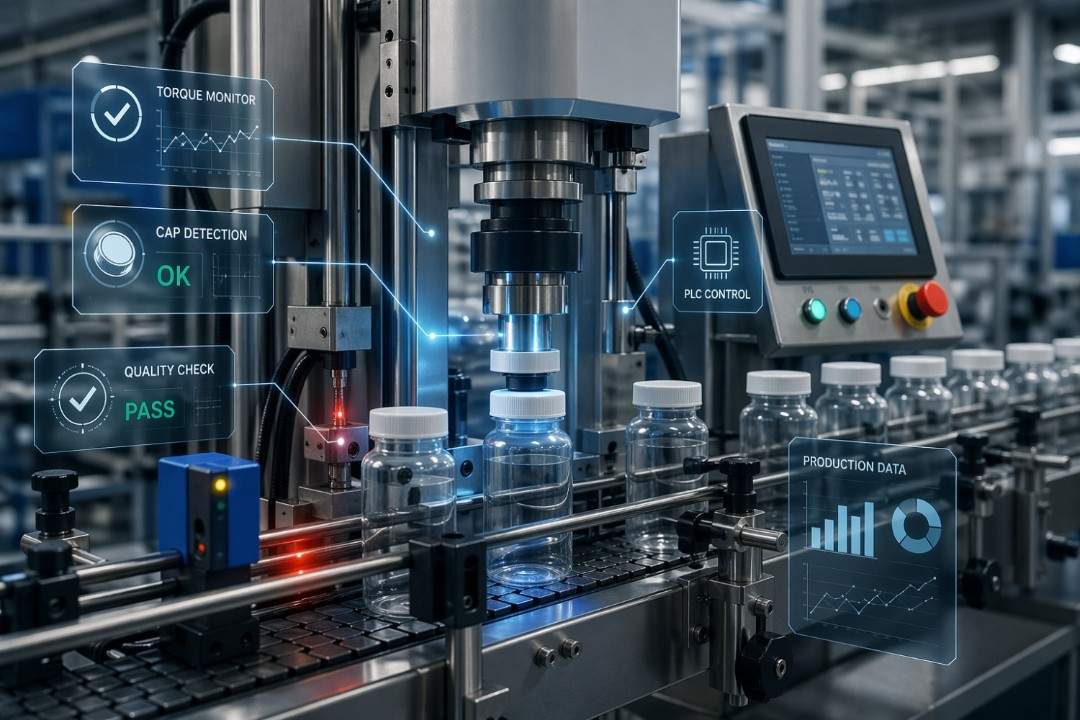
The introduction of programmable logic controllers into capping machines was a turning point. Instead of mechanical settings that someone had to adjust by hand, PLCs let operators store and recall precise parameters, such as torque values, cycle speeds, cap types for every product on the line.
Switching between products used to mean recalibrating the machine manually, which took time and introduced the risk of human error. With PLC control, you pull up the saved profile, and the machine adjusts itself. What once took an hour now takes minutes.
Companies like Packserv have built PLC control and electronic torque management into the core of their capping machine designs, giving manufacturers a level of precision and repeatability that simply was not possible with older mechanical systems.
For any operation running multiple SKUs on the same line, that kind of flexibility is not just useful, it is essential.
Sensors That Catch Problems Before They Become Problems
Modern capping machines are loaded with sensors. Optical sensors, proximity sensors, and torque monitors are all watching the process in real time, every cycle.
Here is what that looks like in practice. A container arrives on the conveyor without a cap pre-positioned correctly. The sensor detects it instantly. The machine pauses. No damage, no faulty seal, no downstream problem. The fix happens in milliseconds before a human would have even noticed.
The same goes for torque. If the applied torque drifts outside the acceptable range, too tight, too loose, the system flags it immediately. The operator gets an alert, the data gets logged, and the production team can trace exactly when and where the deviation happened.
That kind of real-time feedback loop used to require a dedicated quality inspector. Now it is built into the machine itself.
How It Fits Into the Bigger Picture
A smarter capping machine is valuable on its own. But its real impact shows up when it operates as part of a connected production line.
When the capper communicates with the filler upstream and the labeller downstream, the whole line starts to function as a single coordinated system. Throughput data flows to a central dashboard. Bottlenecks become visible. Decisions that used to be made on gut feel can now be made on actual numbers.
This is what Industry 4.0 looks like when you strip away the jargon. It is not about having the most advanced technology for its own sake. It is about having machines that talk to each other, share data, and give your team the context they need to make better decisions faster.
The capping machine sits right at the centre of that. It is one of the last touches a product receives before it leaves the line, which makes its data torque readings, cycle counts, and fault logs particularly valuable for overall line management.
Choosing the Right Machine for Your Line
One thing worth knowing is that a smarter capping process is not reserved for large-scale operations. The range of machines available today covers every production size.
A compact bench-top capper with electronic control is a perfectly capable starting point for a business running smaller batches. It gives you the precision and repeatability of automated capping without the footprint or cost of a full inline system. And when the time comes to scale up, those machines can be integrated into a larger line rather than replaced.
For higher-volume operations, automatic inline cappers offer continuous operation with minimal intervention, sensors triggering each cycle, conveyors keeping the pace, and data feeding back to the dashboard the whole time.
The key is matching the machine to the actual demands of your line. A good starting point is reviewing the full range of explore our capper range options available from pneumatic and electronic timer models to PLC-controlled automatic systems and ROPP cappers, and working out which configuration fits your cap style, container type, and production volume.
The Bottom Line
Smart technology in manufacturing does not always announce itself loudly. Sometimes it shows up as a machine that just works better, catching problems earlier, running longer without issues, and giving your team the information they need without asking for it.
That is exactly what has happened with the capping machine. PLC control, smart sensors, electronic torque management, and line connectivity have quietly turned a straightforward mechanical device into one of the most capable tools on the production floor.
If you are still running older capping equipment and wondering why your defect rates are harder to bring down or your changeovers take longer than they should, the gap between what you have and what is now available is probably larger than you think.
Start with a single cell, measure the difference, and build from there. The gains tend to compound quickly once the data starts flowing.